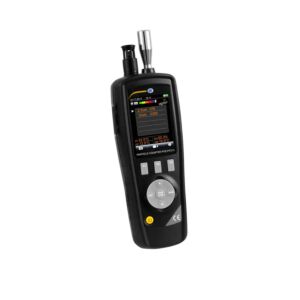
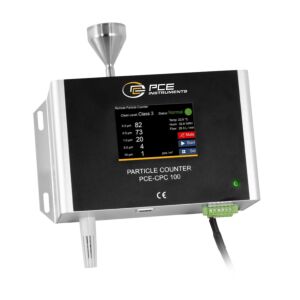
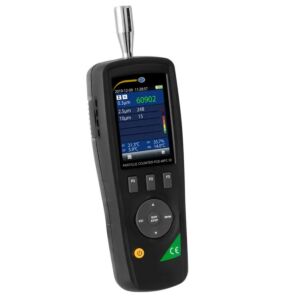
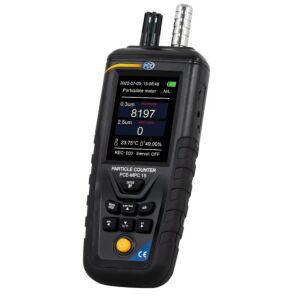
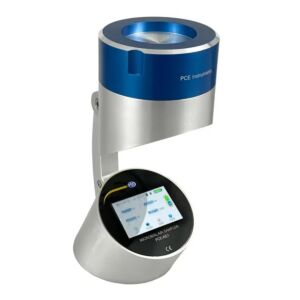
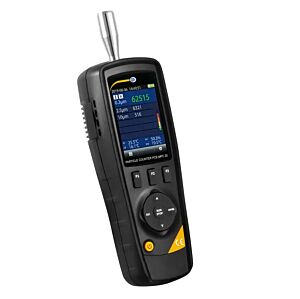
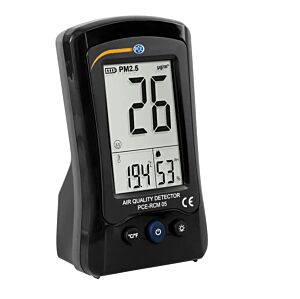
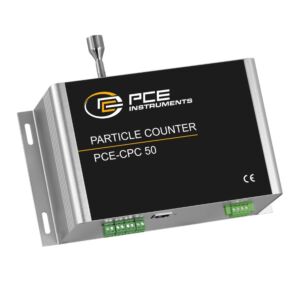
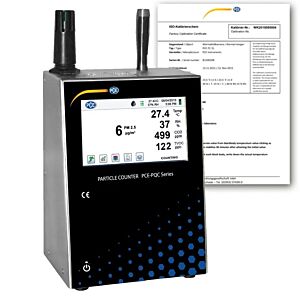
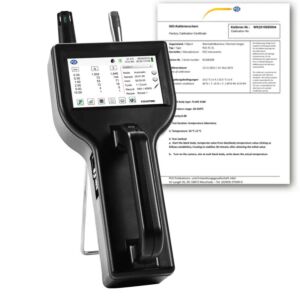
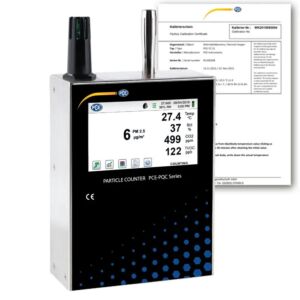
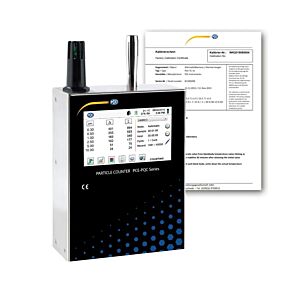
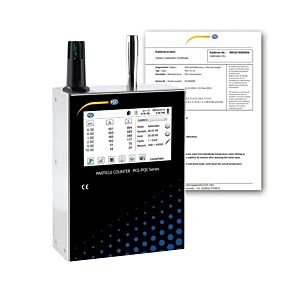
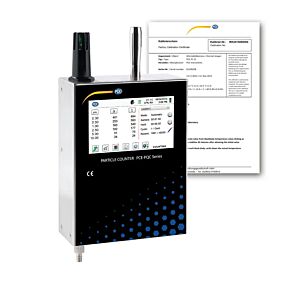
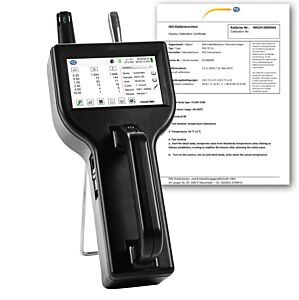
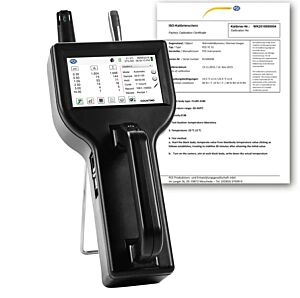
The Air and Particle Samplers category includes professional instruments designed to measure, monitor and document air quality and airborne particles in industrial environments, laboratories, cleanrooms, production departments, HVAC systems, controlled environments, technical offices, warehouses, process areas and zones where air quality can affect safety, health, product quality and process stability. This category includes particle samplers, particle counters, PM2.5 and PM10 instruments, mass concentration meters, continuous monitoring devices, VOC and CO₂ instruments, temperature and humidity meters, and advanced thermo-hygrometers with recording and analysis functions.
An air and particle sampler converts air quality into measurable technical data. In many environments, contamination is not visible to the naked eye: fine particles, aerosols, dust, machining residues, fibres, process emissions, airborne contaminants and microclimatic variations can affect production results or operator safety without being immediately perceived. A measuring instrument allows particle number, particle size, mass concentration, temperature, humidity, dew point, indoor air quality and trends over time to be checked.
Particle counters measure the quantity of particles present in a volume of air. They can distinguish different size classes, such as 0.3 µm, 0.5 µm, 1 µm, 2.5 µm, 5 µm or 10 µm, depending on the model and application. This information is essential in cleanrooms, laboratories, electronics production, pharmaceutical, medical, optical, food, painting, controlled environments and processes where even minimal contamination can compromise product quality. In professional inspections, particle count must be interpreted together with sampled volume, measuring point, sampling time, instrument flow rate and environmental conditions.
Portable particle samplers are suitable for quick field checks, plant inspections, periodic controls, contamination source investigations and preventive maintenance. They can be used to check filters, ducts, departments, workstations, extraction systems, production environments and critical points where dust or aerosols may be present. Models with data memory, alarms and communication interfaces allow measurements to be stored, values to be compared over time and environmental conditions to be documented before and after maintenance, cleaning or filter replacement.
Instruments for PM2.5 and PM10 measure fine and inhalable particles in the air. These parameters are important in workplaces, offices, laboratories, urban areas, production environments, warehouses, workshops, schools, industrial plants and locations where particulate matter may come from combustion, processing, traffic, dust, ventilation systems or internal processes. Monitoring PM2.5 and PM10 helps assess breathable air quality, identify critical conditions, verify ventilation effectiveness and check concentration trends over time.
Devices for VOC and CO₂ monitoring complete indoor air quality analysis. CO₂ is often used as an indicator of air exchange and room occupancy, while VOCs may come from solvents, paints, chemicals, adhesives, materials, production processes or cleaning activities. In technical and production environments, monitoring these parameters helps verify whether ventilation is adequate, whether abnormal emissions are present or whether a process requires additional extraction, filtration or containment measures.
The measurement of temperature and humidity is closely linked to particle control. Humidity can influence electrostatic charges, particle adhesion, condensation, material stability, comfort, sample preservation and process behaviour. Temperature can affect air density, working conditions, product stability and HVAC system performance. In cleanrooms, laboratories and sensitive processes, particle data should often be evaluated together with thermo-hygrometric parameters to correctly understand environmental behaviour.
Air and particle samplers are fundamental in preventive maintenance. A progressive increase in particle count may indicate saturated filters, poor sealing, duct leakage, insufficient cleaning, component wear, process contamination or unfiltered air entry. A variation in PM2.5, PM10 or particles in a specific size class can help identify the source of the problem. Periodic measurement makes it possible to create reference values, verify the effectiveness of interventions and prevent situations that could generate rejects, non-conformities or risks for operators.
In corrective maintenance, these instruments help diagnose existing problems. If a cleanroom does not maintain the required level, if an HVAC system does not provide adequate filtration, if dust accumulates in a department, if a process generates particles or if a product shows contamination defects, the sampler helps identify where and when the anomaly occurs. Comparing measurements at different points in the environment allows critical zones, incorrect air flows, stagnant areas, ineffective filters or contamination entry points to be identified.
In quality control, air and particle samplers are used to verify environmental conditions, validate production areas, document tests, check cleanliness, monitor sensitive environments and support internal procedures. In sectors such as pharmaceutical, medical, electronics, optical, food and painting, particles can compromise sterility, finish, assembly, electronic operation, adhesion, coating or aesthetic quality. A reliable instrument keeps contamination risk under control and provides objective data on environmental status.
The correct instrument must be selected according to measuring range, detectable particle sizes, sampling flow rate, accuracy, resolution, data memory, alarms, autonomy, sensor type, data export capability, certification, robustness, fixed or portable installation and operating environment. Accuracy indicates how close the measured value is to the real or reference value, while resolution indicates the smallest variation distinguishable by the instrument. In particle counters, resolution can also mean the ability to distinguish different size classes or changes in concentration.
Reliable measurements require the sampling point to be defined correctly. Instrument position, height from the floor, distance from air outlets, doors, machines, operators, extraction systems and contamination sources can influence the measured value. In a controlled environment, sampling near a supply air outlet may give a different result from a work zone or a point near a door. For this reason, it is important to define a consistent method, maintain the same measuring points, record operating conditions and interpret data according to the real environment.
The connection with heights, transmission backlash, form errors and geometry is indirect but technically important. Air and particle samplers do not measure mechanical dimensions or geometries, but they help control environmental conditions that can affect surfaces, assemblies, machining and precision. In a precision machine, particles and dust can settle on guideways, support surfaces, sensors, optics, encoders, couplings, measuring surfaces and moving components. Over time, residues and contaminants can contribute to wear, friction, loss of smooth movement, clearance variations and functional defects.
In painting, bonding, assembly or micro-production departments, airborne particles can generate surface defects, inclusions, poor adhesion, aesthetic errors, coating irregularities and coupling problems. In cleanrooms or laboratories, particles deposited on samples, instruments or reference surfaces can alter results, measurements and finishes. Even though the instrument does not directly measure form errors, it helps prevent conditions that can favour contamination, surface defects and loss of geometric quality.
In HVAC applications, the sampler helps verify whether filters, air changes, differential pressures and flows are consistent with process requirements. An environment with insufficient air exchange may accumulate CO₂, VOCs and particles; unbalanced airflow may move contaminants towards sensitive areas; inadequate filtration may allow particulate entry. For this reason, air monitoring is an integral part of the design, adjustment and maintenance of technical systems.
An important practical recommendation is to distinguish between instant measurement, periodic sampling and continuous monitoring. An instant measurement provides a snapshot, useful for quick checks. Periodic sampling allows conditions to be compared over time. Continuous monitoring is useful when the process is sensitive or when variations may occur quickly. For critical environments, instruments with memory, alarms, reports and data export should be selected so that environmental control becomes a documented procedure.
Tadaah presents the Air and Particle Samplers category as a technical reference for companies, technicians, engineers, maintenance specialists, laboratories and quality departments that need to monitor air, particles and environmental conditions professionally, reliably and in a documentable way. Correct selection of particle counters, portable samplers, PM2.5 and PM10 instruments, VOC, CO₂, temperature and humidity monitors helps improve quality control, preventive maintenance, safety, environmental cleanliness, process stability and contamination prevention.