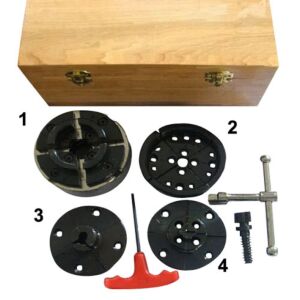
Holzstar woodturning accessories extend the operating range of a wood lathe, adapt the machine to workpieces of different shapes and sizes and improve control during holding, profiling and profile reproduction. The category includes bed extensions, four-jaw self-centring chucks, professional chucks with interchangeable or reversible jaws, faceplates, drive centres, longitudinal and cross-copying attachments and sets of turning tools. Holzstar accessories belong to the same field of application but have different connections, working ranges and compatibility requirements that must be checked against the lathe and intended operation.
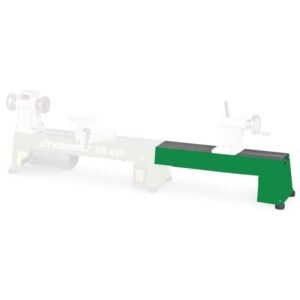
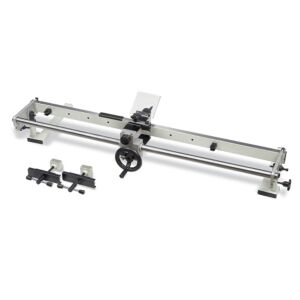
Holzstar bed extensions increase the available distance between the headstock and tailstock, allowing longer components to be mounted. They are particularly useful for producing table legs, uprights, spindles, handrails, handles and elongated furniture components. A Holzstar extension must be designed for the specific lathe because the guide geometry, bed height, mounting points and alignment must correspond to the original machine.
When installing a Holzstar bed extension, mating surfaces must be clean and free from chips, dust or residue that could create a step between the two sections. After fastening, continuity should be checked by moving the tailstock across the joint. Incorrect alignment can restrict movement, alter tailstock position and compromise workpiece concentricity. The support beneath the Holzstar lathe must also carry the additional length and weight without deflection.
Increasing the available turning length does not eliminate workpiece flexure. A long, slender wooden component may vibrate or bend under tool pressure even when correctly supported at both ends. When using a Holzstar bed extension, it is advisable to take light cuts, use sharp tools and minimise tool overhang beyond the rest. A suitable intermediate support may be required for particularly flexible components.
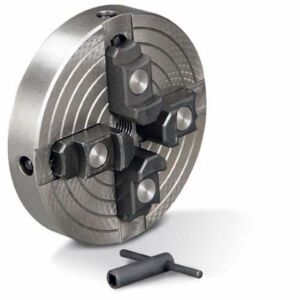
Holzstar four-jaw self-centring chucks hold the workpiece on the headstock while maintaining it around the rotational axis. The jaws move simultaneously and can grip the outside of a cylindrical tenon or expand inside a prepared recess. This flexibility makes Holzstar chucks suitable for bowls, cups, platters, vessels, knobs, decorative components and other workpieces that cannot be held solely between centres.
For external gripping, the Holzstar chuck jaws close around a tenon prepared on the workpiece. The tenon must be concentric, regular and proportioned to the installed jaws. Its shoulder should seat uniformly against the jaw faces to limit tilting and run-out. A tenon that is too small provides insufficient contact, while an excessively large tenon may position the jaws outside their most effective gripping range.
For internal gripping, the Holzstar jaws expand inside a circular recess. The recess must have correctly formed walls and sufficient depth to support expansion without weakening the bottom of the component. Pressure must be controlled, particularly with soft timber, thin sections or irregular grain. Excessive expansion can split the workpiece or deform the recess.
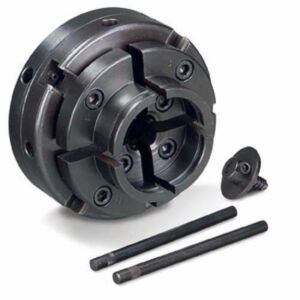
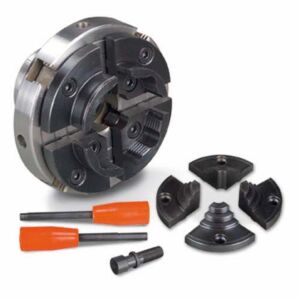
Holzstar chucks with reversible or interchangeable jaws offer additional flexibility. Changing jaw orientation or fitting a different jaw set adapts the holding range to different tenons, recesses and workpiece geometries. The jaws must be installed in their specified order and position. Sliding surfaces must remain clean and every element must seat correctly against the Holzstar chuck body.
Professional Holzstar chucks can be combined with different plates and gripping arrangements. Selection should not be based solely on chuck diameter. The spindle-nose thread, connection type, jaw travel, gripping form, workpiece diameter, blank mass and clearance above the lathe bed must all be checked. A Holzstar chuck that is unnecessarily large for the machine or component increases rotating inertia and reduces operating space.
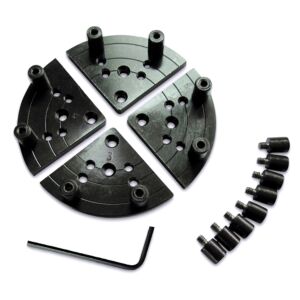
Holzstar faceplates are attached directly to the blank with screws through the available mounting holes. They provide a broadly distributed holding method and are useful during initial machining before a tenon or recess has been prepared for a chuck. The screws must be suitable for wood, sufficiently strong and distributed evenly. Uncertain or brittle fasteners should never be used on a rotating workpiece.
The seating surface for a Holzstar faceplate must be flat and free from loose or friable material. Screw position must be considered when planning the finished profile so that the cutter cannot contact the metal fasteners. When both sides of a workpiece require machining, the Holzstar faceplate can be used initially and replaced later by a Holzstar self-centring chuck once a suitable holding feature has been produced.
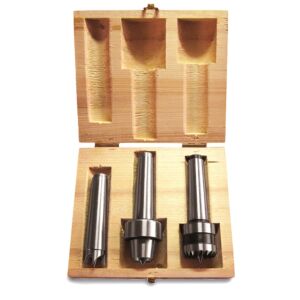
Holzstar drive-centre sets are primarily used for spindle turning between centres. The drive centre fits into the lathe headstock through the compatible taper and transmits rotation through teeth, points or gripping features. The tailstock supports the opposite end and maintains axial alignment. Different Holzstar drive centres can be selected according to blank section, timber hardness, available end surface and required stock removal.
Before fitting a Holzstar drive centre, the workpiece centre should be marked accurately and a suitable seating point prepared when required. Uneven engagement may cause slipping, vibration or blank movement. Tailstock pressure must maintain the drive without crushing the wood. During the first roughing passes, the Holzstar drive centre should be checked to confirm that it has not lost its grip.
The taper on a Holzstar drive centre and the corresponding machine socket must be completely clean. Dust or debris can prevent full insertion, causing run-out or reducing stability. The removal system specified for the lathe should be used without striking precision surfaces. Before purchasing, taper size and compatibility with the headstock or tailstock must be confirmed.
Holzstar copying attachments reproduce longitudinal profiles and cross-sectional forms from a template or reference component. They are particularly useful when producing repeated furniture legs, spindles, handles and decorative elements. The system guides the cutting assembly along the reference profile and transfers its shape to the rotating workpiece.
During longitudinal copying, the Holzstar attachment travels parallel to the workpiece axis. Cutter position determines the diameter produced in each section while the stylus follows the template. During cross movement, the cutter advances towards the rotational axis to create diameter changes, grooves and transitions. The cutting edge must be presented at an angle suitable for the direction of travel and profile geometry.
A Holzstar copying attachment does not replace blank preparation. The workpiece should first be turned into a regular cylinder with a consistent machining allowance. If the blank remains square or has substantial diameter variations, the cutting assembly is subjected to repeated impacts that increase vibration and reduce copying accuracy. The profile should therefore be approached through progressive passes.
The template must be rigid, secure and free from unwanted irregularities because defects can be reproduced on the component. Stylus and cutter must be adjusted so that the relationship between the reference shape and machined diameter remains constant. Before starting a production batch, a test component should be turned, measured and used to refine the Holzstar copying settings.
Clearance around the Holzstar copying attachment must be checked throughout its complete travel. Cutter, support, stylus and moving parts must not interfere with the chuck, tailstock, drive centre or lathe bed. In narrow grooves or abrupt diameter changes, the cutter radius and stylus shape may limit the reproduction of very small details. Templates must therefore be designed around the actual geometry of the Holzstar copying system.
Holzstar turning-tool sets include different profiles for roughing, cylindrical turning, shaping, cutting coves, finishing and parting. Each Holzstar tool requires the correct position on the tool rest. A roughing gouge works with the rest close and generally parallel to the blank. Profiling tools are progressively rolled and inclined to follow curves and transitions. A skew chisel requires controlled presentation, while a scraper must be firmly supported with limited overhang.
The tool rest must support the Holzstar tool before its cutting edge contacts the timber. The handle should be held securely and movement guided with the operator’s body rather than abrupt hand corrections. The gap between the rest and workpiece must be reduced as stock is removed. After every rest adjustment, the workpiece should be rotated manually to confirm adequate clearance.
Sharpening directly affects the performance of Holzstar turning tools. An efficient edge severs the fibres with less pressure, improves control and reduces subsequent sanding. A blunt tool tends to compress or tear the wood. The original bevel geometry should be maintained using sharpening equipment appropriate to the tool profile and steel.
Before purchasing Holzstar accessories, users must verify the lathe model, spindle thread, taper connection, chuck dimensions, jaw gripping range, spindle height, bed profile and mounting points. Compatibility of Holzstar copying attachments and bed extensions must be model-specific because machine geometry and alignment are essential. For Holzstar chucks and drive centres, weight, dimensions, holding method and normal workpiece size must also be considered.
Maintenance of Holzstar accessories includes removing dust and chips, checking threads, cleaning tapers, inspecting jaws and verifying every locking device. The guides of Holzstar copying attachments and the surfaces of Holzstar extensions must remain clean and move smoothly. A Holzstar chuck with damaged jaws, irregular movement or unreliable tightening should not be used until the fault has been corrected.
The Holzstar woodturning-accessory category enables the lathe to be configured around the workpiece and required result. Holzstar extensions, chucks, jaws, faceplates, drive centres, copying attachments and cutting tools perform different but complementary functions. Their correct combination allows longer components to be mounted, different holding methods to be adopted, repeated profiles to be reproduced and the most suitable tool to be used at each stage, increasing flexibility, control and workflow continuity.