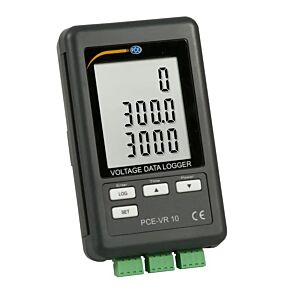
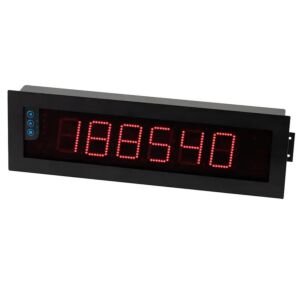
The Panel Indicators and Panel Instruments category includes professional devices designed to display, monitor, convert and manage signals from sensors, transducers, load cells, measuring instruments, industrial machines, process systems, electrical panels and automation systems. These devices are installed on front panels, control cabinets, test benches, production lines or technical stations to make an operating parameter immediately readable. They can display electrical values such as voltage, current, mV, mA and V, load cell signals in mV/V, temperature, frequency, pulses, process signals, converted analogue values and physical quantities associated with industrial sensors.
A panel indicator allows the operator to monitor a technical value without having to connect a portable instrument every time. On an industrial machine, a display may show force, weight, pressure, temperature, speed, level or position. On a test bench, it may show the value generated by a load cell, pressure transducer or process sensor. In an electrical cabinet, it may display voltages, currents, analogue signals or control states. In models with large LED digits, the value can also be read from a distance, which is useful in production departments, test rooms, warehouses, automated lines and workstations where the operator is not always close to the instrument.
Panel instruments are important because they convert a signal that is often not directly readable into clear and usable information. A load cell, for example, generates a very small signal, usually expressed in mV/V, which must be amplified, converted and displayed. A process sensor may provide a 4-20 mA or 0-10 V signal representing pressure, temperature, flow, position or level. A panel indicator allows that signal to be associated with an understandable engineering value such as kg, N, bar, °C, mm, Hz or custom units, making control, adjustment and diagnosis easier.
In industry, these instruments are used on automatic machines, presses, dosing systems, test benches, weighing systems, force control systems, assembly lines, distribution panels, laboratory instruments, HVAC systems, production systems, process applications, test equipment and continuous monitoring devices. They are especially useful when the value must always be visible, when the real value must be quickly compared with an expected value or when the operator must adjust a process according to the displayed measurement.
In preventive maintenance, panel indicators help identify drift, instability, progressive variation and out-of-tolerance conditions. A process value that slowly moves away from the reference may indicate wear, unstable sensor behaviour, incorrect adjustment, loss of calibration, electrical problems, load variation or system degradation. A constantly visible display allows the maintenance technician to check the system during normal operation and not only during a manual inspection. In systems with data logging or data output, the trend can be recorded over time to verify when the anomaly appears.
In corrective maintenance, these instruments are useful for diagnosing existing faults. If a machine behaves irregularly, if an actuator does not reach the expected position, if a test bench returns inconsistent results or if a weighing system is unstable, the panel indicator allows the signal value to be checked and helps determine whether the problem comes from the sensor, wiring, calibration, power supply, electrical interference or the connected mechanical component. An unstable value may indicate vibration, interference, incorrect connections, insufficient shielding, damaged sensor or incorrectly applied load.
The choice of a panel indicator or panel instrument must be based on input signal type, measuring range, accuracy, resolution, number of digits, display readability, panel format, power supply, available outputs, compatibility with sensors and transducers, signal scaling capability, alarms, relays, digital communication, data memory, logging, protection rating and robustness. Accuracy indicates how close the displayed value is to the real value, while resolution indicates the smallest readable variation. In professional applications both parameters must be evaluated, because a display with many digits does not automatically guarantee correct measurement if the sensor, calibration or wiring are not suitable.
Resolution is particularly important when monitoring small signals, load cells, voltage variations, process differences or measurements requiring fine reading. In weighing or force systems, a few digits of difference may indicate real load variation or electrical noise. In long-distance displays, immediate readability may be more important than showing many decimals. The choice must therefore be consistent with the application: a laboratory requires detail and stability, a production line requires visibility and robustness, and a machine panel requires signal compatibility and electrical safety.
Load cell indicators are widely used in weighing systems, force control, presses, test benches, dosing, load monitoring and automation. The load cell must be correctly connected, powered with a stable voltage and calibrated so that the displayed value corresponds to the real force or weight. Incorrect calibration can generate process errors, wrong dosing, production rejects or unreliable interpretation. For this reason, zero, full scale, linearity, signal stability and correct load application must be checked.
Process signal indicators display values from industrial transducers with standard outputs. They can be used for pressure, temperature, flow, level, humidity, speed, position, voltage or current. The possibility of setting custom scales allows the electrical signal to be converted into engineering units readable by the operator. For example, a 4-20 mA signal can be displayed as 0-100 bar, 0-500 °C, 0-1000 mm or any other scale consistent with the sensor. This function is essential for integrating panel instruments into different industrial processes.
Panel instruments with high-brightness LED displays are suitable when the value must be read from a distance or in environments with poor visibility. They can be installed on production lines, warehouses, control rooms, test benches, weighing systems or stations where the value must be visible to several operators. In production departments, immediate readability reduces the risk of error, speeds up checks and allows the process to be monitored without interrupting activity. Digit size, display colour, brightness and viewing angle therefore become important technical elements.
Correct use requires attention to wiring and installation. Analogue signals must be connected with suitable cables, preferably shielded when the environment contains electrical interference. Signal cables should be separated from power lines, inverters, motors and relays when possible. Grounding, shielding and stable power supply are essential to avoid unstable readings. Before commissioning, it is advisable to check input type, set scale, displayed unit, signal direction, zero, full scale, any alarms and consistency between real value and displayed value.
The connection with heights, transmission backlash, form errors and geometry is indirect but technically relevant. Panel indicators do not necessarily measure geometry directly, but they can display signals from position sensors, load cells, displacement transducers, measuring systems or process controls that influence dimensions, heights, play and mechanical behaviour. On an automatic machine, an indicator may show position, clamping force or applied load. If the value changes compared with the reference, it may indicate wear, mechanical play, deformation, loss of alignment or adjustment error.
On a production line, a force variation displayed on an indicator may show that a component is not resting correctly, that working height has changed, that a guide has friction or that a transmission system has play. On a test bench, a non-repeatable load value may reveal misalignment, form errors, sample deformation or problems with fixing accessories. In a position control system, an unstable value may indicate play, vibration, unstable encoder signal or incorrectly fixed sensor. For this reason, panel instruments are often part of mechanical diagnosis and not only electrical monitoring.
Panel indicators and instruments are also important for safety and operational management. A visible value allows the operator to quickly recognise abnormal conditions such as overload, excessive pressure, temperature out of limit, non-compliant weight, missing signal or incorrect voltage. When the instrument has relay outputs or alarms, it can be integrated into signalling or control systems, activating warnings, machine stops or automatic interventions. In this way, the indicator becomes not only a display, but an active element of the process.
In quality control and laboratories, panel instruments help stabilise and standardise value reading during repetitive tests. On a test bench, the operator can always monitor the same parameter with the same display, reducing interpretation errors. In systems with data logging, recording allows tests to be compared, reports to be created, drift to be checked, peaks to be analysed and process behaviour to be documented. This is useful for testing, validation, internal checks, scheduled maintenance and technical verification.
An important practical recommendation is to choose the indicator starting from the real available signal and not only from the value to be displayed. It is necessary to know whether the sensor provides mV/V, mA, V, pulses, frequency, Pt100, thermocouple or another output type. The technical unit to be displayed, working range, required resolution, reading distance, installation environment and possible need for alarms or communication must then be defined. Correct selection avoids incompatibility, unstable readings, incorrect scaling and integration problems in the panel.
Tadaah presents the Panel Indicators and Panel Instruments category as a technical reference for companies, technicians, engineers, maintenance specialists, laboratories, panel builders and machine manufacturers that need to display, monitor and manage industrial signals professionally. Choosing the correct instrument helps improve quality control, preventive maintenance, diagnostics, process adjustment, operational safety and technical documentation. To select the most suitable product, it is advisable to evaluate input signal, measuring range, accuracy, resolution, display, power supply, outputs, communication, mounting, operating environment and compatibility with existing sensors and systems.