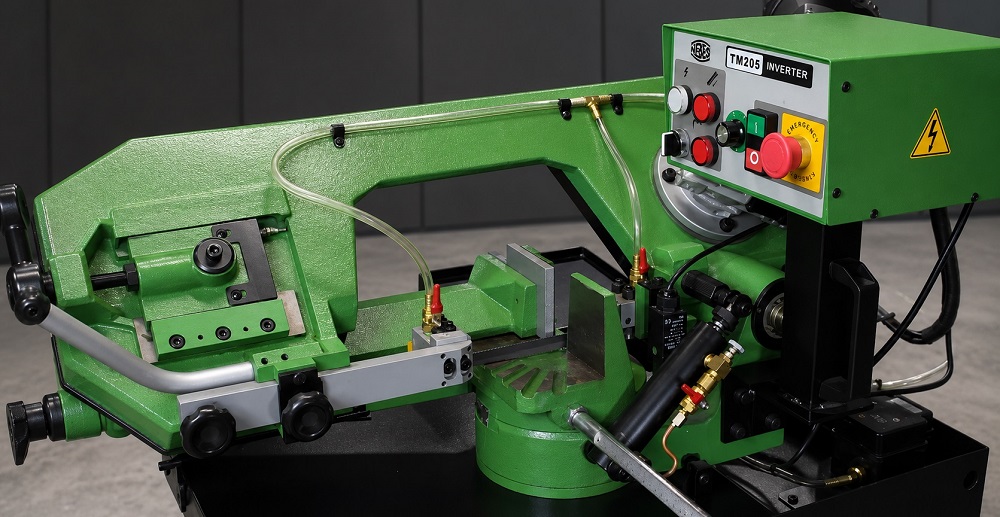
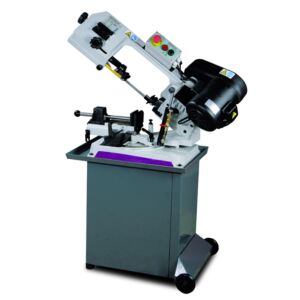
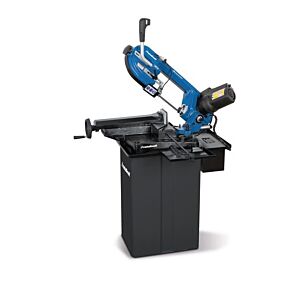
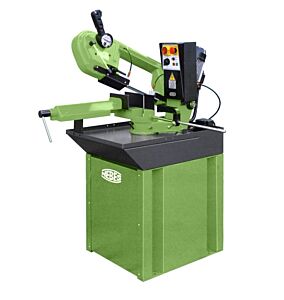
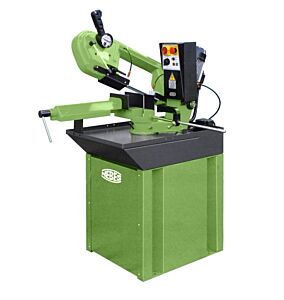
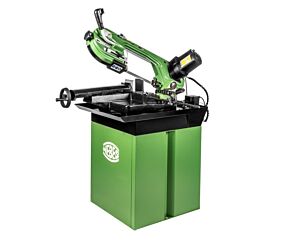
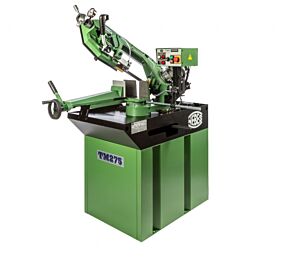
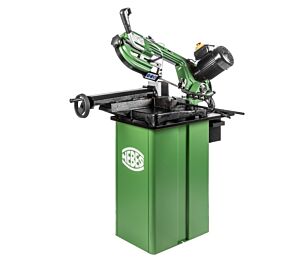
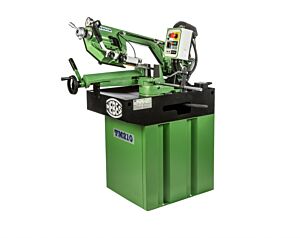
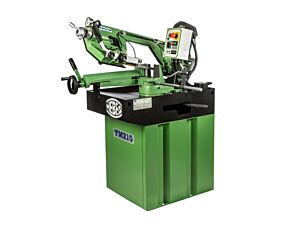
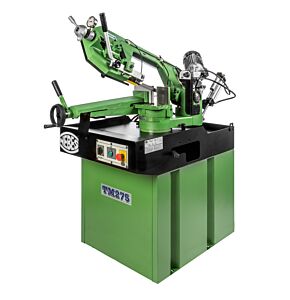
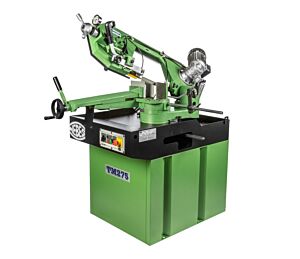
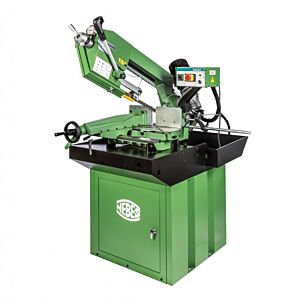
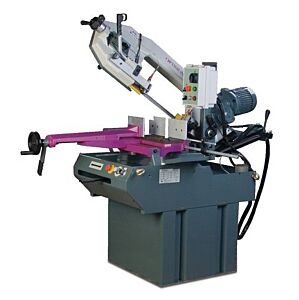
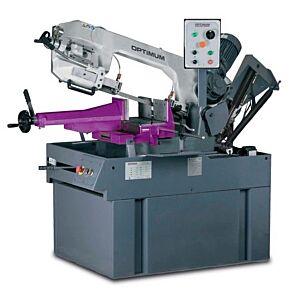
METALLKRAFT, NEBES Elettromeccanica and OPTIMUM horizontal metal-cutting band saws are stationary machines designed for the controlled cutting of solid bars, tubes, profiles, material bundles and metal components. The category includes machines of the same general construction but with different cutting capacities, saw-frame rigidity, feed systems, speed controls, vice configurations, mitre-cutting capabilities and coolant equipment. Compact models meet the needs of workshops with variable production and limited space, while more substantial machines are suitable for repetitive cycles, demanding sections and continuous professional use.
On a horizontal band saw, the workpiece remains clamped in the vice while the saw frame progressively lowers the blade into the material. The continuous band travels around the wheels, is guided near the cutting zone and removes chips through the regular action of its teeth. This arrangement provides good stability, permits control of feed pressure and reduces the impacts associated with reciprocating cutting. Correctly matched machines, blades and parameters can produce sections ready for welding, assembly or subsequent machining with limited secondary finishing.
Depending on the model, saw-frame descent may be manual, gravity-assisted, hydraulically controlled or incorporated into a semi-automatic cycle. The descent system must maintain pressure appropriate to the material, shape and section size. Excessive descent overloads the teeth, can deflect the blade and produces an irregular surface. Insufficient descent causes the teeth to rub, increases heat and accelerates wear without necessarily improving accuracy. On hydraulically controlled machines, the setting should be established after verifying blade type, speed, workpiece material and the effective section encountered by the teeth.
The saw must be installed on a stable and level floor. Incorrect support can introduce structural twist and compromise alignment between the saw frame, vice and worktable. The surrounding area must allow bars and profiles to be handled without forcing the operator into an unstable position. Infeed and outfeed roller conveyors should be aligned with the vice-support height so that the material is neither lifted nor tilted during clamping.
The workpiece must be cleaned of chips, dirt, burrs and loose scale before being placed in the vice. Solid bars and profiles should rest on stable surfaces and be clamped close to the cutting line. Clamping too far away leaves an unsupported section that can vibrate, while excessive pressure can deform thin-wall tubes and hollow profiles. Suitable jaws, protective inserts or shaped supports may be used for delicate components, provided they do not reduce stability or create items that the blade could catch.
Round tubes and cylindrical bars must be prevented from rotating. Angle, channel, T-section and box profiles should be oriented according to the way in which the teeth progressively enter the material. An arrangement that exposes the blade to a sudden transition from a thin wall to a much wider area can produce impact, vibration and abrupt load changes. Where possible, the profile should be positioned so that the blade encounters a progressive section while maintaining a suitable number of teeth in contact.
Bundle cutting can increase productivity but requires a clamping system that immobilises every element. Relative movement between tubes or bars can cause the teeth to snag, chip or draw a component out of position. Bundles should be arranged regularly and without voids that allow movement during frame descent. This method should only be used when the vice, machine capacity and blade are suitable for multiple-piece clamping.
Long components require roller stands or conveyors on both sides of the saw. Supports must carry the material without altering its position in the vice. A support that is too low causes the component to incline, while one that is too high can lift it from the vice bed. During the final stage of the cut, the separated length must remain supported so that it cannot fall, close the kerf on the blade, damage the teeth or create a hazard.
Depending on configuration, METALLKRAFT, NEBES Elettromeccanica and OPTIMUM saws may use a swivelling saw frame, rotating vice or alternative angular-reference system for mitre cuts. Before setting an angle, the rotating surfaces should be cleared of chips, only the specified locks released, the reference positioned and all parts securely locked again. Available cutting capacity may change when the frame is angled, so the operator must verify that the blade, vice and workpiece can complete the movement without interference.
The angular scale simplifies setup, but components intended for frames, welded structures or accurate joints should be verified after the first cut with a square or suitable measuring tool. Error may arise not only from the angular reference but also from blade deflection, clamping or profile support. Once the correct setting has been established, a length stop and repeatable loading method help maintain consistent parts throughout the batch.
Blade selection must consider workpiece material, hardness, solid-section size, wall thickness and profile shape. Tooth pitch that is too coarse for thin-wall tube leaves too few teeth engaged and can cause snagging or tooth stripping. Pitch that is too fine for a large solid section provides insufficient gullet volume for chip evacuation, leading to loading, heat and loss of cut straightness. A correct selection keeps several teeth simultaneously engaged while leaving sufficient space to transport chips out of the kerf.
Bimetal blades are suitable for a broad range of steels, alloy steels, stainless steels and non-ferrous metals. Variable-pitch teeth reduce contact periodicity and are useful for tubes, profiles and mixed sections susceptible to vibration. Particularly hard, abrasive or difficult-to-cut materials may require specialised or carbide-tipped blades, provided the machine has the necessary rigidity and speed control. Blade length, width, thickness, tooth direction and construction must comply with the saw specification.
Blade speed should be matched to the material. Hard steels, stainless steels and tough alloys generally require a lower speed, while aluminium, brass and more easily machined materials may permit higher speeds. Mechanical speed changes, electronic controls or inverter systems increase the ability to adapt the saw to different alloys. Increasing speed indiscriminately does not always shorten the total operation: it can damage the teeth, generate heat and lead to premature blade replacement.
Correct feed should produce a formed and regular chip. Dust or extremely fine chips can indicate that the teeth are rubbing because of insufficient feed, blade wear or incorrect speed. Heavily distorted, welded or heat-discoloured chips may indicate excessive feed, inadequate coolant or unsuitable speed. Observing chip formation allows the operator to correct the process before severe cutting deviation or blade failure develops.
A new blade requires a controlled break-in period under reduced load. The initial cuts allow the cutting edges to stabilise and reduce the risk of microscopic chipping. Feed can then be increased progressively. Break-in is particularly important for bimetal blades and can significantly extend their working life. Starting immediately on material with a hard skin, irregular surface or heavy scale increases the risk of premature damage.
The coolant system reduces friction and heat, improves chip evacuation and helps protect the blade teeth and cut surface. Fluid should reach the point where the blade enters the material and should be delivered consistently. Coolant level, concentration and cleanliness require regular checks. Degraded or contaminated fluid loses lubricating performance, creates deposits and can damage pumps and lines. Liquid must not be added to machines designed exclusively for dry cutting unless its use is approved by the manufacturer.
Blade guides should be positioned as close to the workpiece as practical, leaving only the band length required for the cut unsupported. Excessive distance increases blade deflection and cutting deviation. Bearings, guide pads or inserts must support the back and sides of the band without preventing free movement. Tension must also be appropriate: insufficient tension encourages wandering, while excessive tension overloads the weld, wheels and bearings. All adjustments must be made with the saw stopped and isolated from its power supply.
An out-of-square cut is not always caused by vice alignment. Uneven blade wear, unsuitable tooth pitch, insufficient tension, widely spaced guides, excessive feed, poor workpiece support or packed chips can produce the same result. These points should be examined before machine alignment is altered. Blade-to-table squareness should also be checked using a blade in good condition, because a permanently distorted band can provide misleading measurements.
Routine maintenance includes cleaning the cutting area, vice, guides, wheels and coolant tank. The blade brush must remove chips from the tooth gullets without applying excessive pressure. Blade tension, weld, teeth, guards, cables, controls, descent cylinder and stopping devices require regular inspection. Coolant leaks, unusual play, noise or irregular movement should be investigated before cutting continues. Chips must not be removed by hand, and the machine must never be cleaned while the blade is moving.
Important purchasing criteria include cutting capacity for solid material, tube and profile, saw-frame rigidity, base stability, vice accuracy and clamping speed, mitre capability, descent system, speed control, coolant equipment and ease of blade replacement. Maintenance access, blade and spare-part availability, compatibility with roller conveyors, length-stop provision and the space required to handle stock are also important. Selection should be based on the most frequent operations without overlooking less common sections that are genuinely processed in the workshop.
METALLKRAFT, NEBES Elettromeccanica and OPTIMUM horizontal metal-cutting band saws are used in structural-steel fabrication, machine shops, toolrooms, maintenance departments and companies manufacturing steel structures. Applications include machine-tool rebuilding and the production of frames, supports, railings, doors, windows, plant equipment, pipework and components intended for welding or CNC machining. Suitable blades and parameters allow the processing of carbon steels, alloy steels, stainless steel, aluminium, brass, copper and other compatible materials.
Horizontal band-saw flexibility depends on the ability to adapt the vice, cutting angle, blade, speed, feed and coolant to the workpiece. Final accuracy does not result from one feature alone but from the balance of the complete cutting system. A correctly installed and adjusted saw reduces material waste, blade consumption and secondary machining while providing regular, repeatable cuts for one-off components and small or medium production batches.
Tadaah supports the selection of METALLKRAFT, NEBES Elettromeccanica and OPTIMUM horizontal metal-cutting band saws by evaluating material, section shape and size, operating frequency, mitre requirements, automation level and available space. Correct selection considers machine construction, vice, feed system, blade speed, blade specification, tooth pitch, coolant and stock support together, identifying a solution genuinely suited to professional requirements.
URL: horizontal-metal-cutting-band-saws
Meta title: Professional Horizontal Metal-Cutting Band Saws
Meta description: Horizontal band saws for cutting metal bars, tubes and profiles, with controlled feed, coolant and mitre-cut capability depending on the model.
Keywords: horizontal metal-cutting band saws, horizontal metal band saw, stationary metal band saw, solid bar cutting band saw, tube cutting band saw, profile cutting band saw, steel cutting band saw, stainless steel band saw, aluminium cutting band saw, fabrication band saw, machine shop band saw, toolroom band saw, hydraulic downfeed band saw, semi-automatic band saw, coolant band saw, inverter band saw, variable-speed band saw, mitre-cutting band saw, metal band saw with vice, bimetal band saw blade, horizontal band saw blades, METALLKRAFT band saws, NEBES Elettromeccanica band saws, OPTIMUM band saws