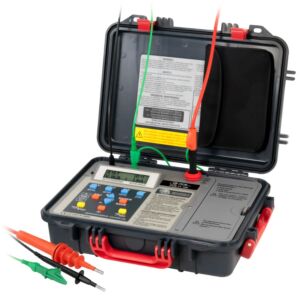
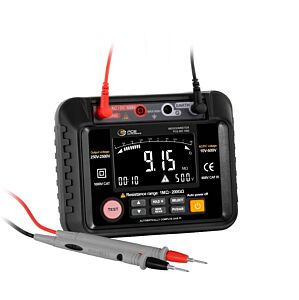
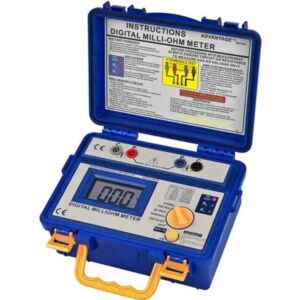
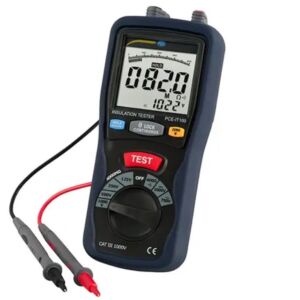
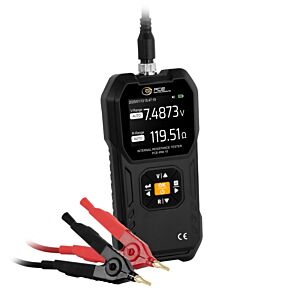
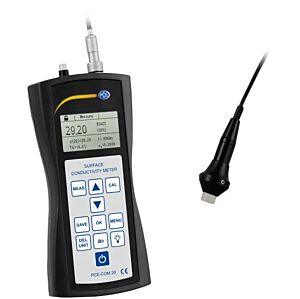
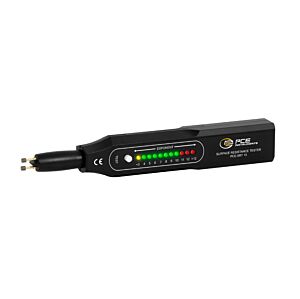
The Resistance and Resistivity Meters category includes professional instruments designed to measure electrical resistance, continuity, insulation, material resistivity and the quality of electrical connections in industrial systems, machines, electrical panels, motors, cables, electronic components, control systems, grounding systems, laboratories and maintenance applications. These instruments verify whether a circuit is correctly conductive, whether insulation is still effective, whether a connection has abnormal resistance or whether a material has electrical properties consistent with the intended application.
Resistance measurement is essential because many electrical defects are not visible. A terminal may appear tightened but have high contact resistance due to oxidation, dirt, vibration or incorrect tightening. A cable may look intact but have degraded insulation. A motor may operate but show insufficient insulation resistance before failure. An electronic component may be connected but not meet the required resistive value. Measuring resistance and resistivity therefore allows technicians to move from visual inspection to objective technical control.
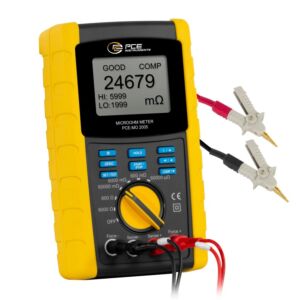
Milliohmmeters are used to measure very low resistance values, typical of contacts, busbars, joints, windings, power connections, relays, switches, terminals, conductors, solder joints and systems where even a few milliohms are important. In these cases, a standard multimeter may not be sufficient because the resistance of test leads and cables can influence the result. For this reason, professional milliohmmeters often use more stable measuring methods, such as four-wire connection, which helps reduce the influence of cable resistance and obtain more reliable values.
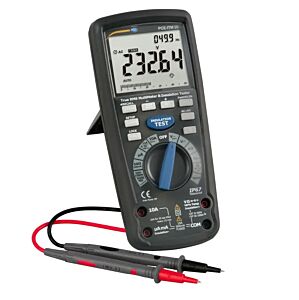
Ohmmeters and continuity testers are used to check circuits, wiring, components, resistors, connections and conductor integrity. They verify whether an electrical path is open, interrupted, partially compromised or correctly conductive. In maintenance, a simple continuity measurement can quickly identify a broken cable, defective contact or incorrect connection; in professional applications, however, it is often necessary to go beyond the “open/closed” check and measure the actual resistance value to understand connection quality.
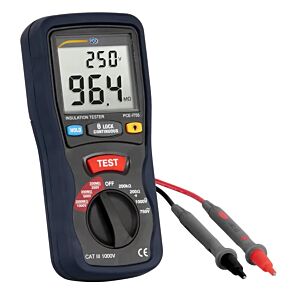
Insulation testers are essential instruments for checking insulation resistance in cables, motors, transformers, panels, electrical equipment and systems. They apply a defined test voltage and measure resistance between conductors or between conductor and ground. Effective insulation must show high values; if the value is too low, humidity, contamination, ageing, micro-damage, dirt, deterioration of insulating material or installation defects may be present. Insulation testing is very important for safety, failure prevention and system reliability.
Resistivity is a material property and indicates its intrinsic ability to oppose current flow. Measuring resistivity is useful in laboratories, quality control, material verification, electronics production, checks on conductive or insulating materials, antistatic floors, technical materials, surface treatments and applications where the electrical behaviour of the material must be controlled. Unlike resistance, which also depends on part geometry, resistivity allows materials and surfaces to be compared using a more technical and repeatable criterion.
In preventive maintenance, resistance and resistivity meters help identify defects before they cause machine downtime or dangerous conditions. An increase in contact resistance can generate overheating, voltage drops, loss of efficiency and failure risk. A decrease in insulation resistance can anticipate leakage currents, protection trips, short circuits or damage to motors and systems. Periodically monitoring these values allows a history to be created, progressive drift to be recognised and maintenance to be planned before the problem becomes critical.
In corrective maintenance, these instruments help diagnose existing anomalies. If a motor does not start correctly, if a protection trips, if a panel shows overheating, if a line has voltage drops, if an electronic device behaves unstably or if a system shows leakage, resistance, insulation and continuity measurements help isolate the cause. The technician can check connections, windings, cables, grounding, terminals, contacts, fuses, relays, switches and components, reducing diagnostic time.
The correct instrument must be selected according to measuring range, accuracy, resolution, test voltage, connection method, application type, electrical safety, data memory, certification, robustness, accessories and ease of use. Accuracy indicates how close the measured value is to the real value, while resolution indicates the smallest variation readable by the instrument. At very low resistance values, resolution is essential to distinguish differences of a few milliohms; at very high values, such as insulation tests, measurement stability and correct test voltage selection are important.
To obtain reliable measurements, the measuring point must be prepared correctly. Contacts must be clean, stable and properly connected. In low-resistance tests, false values caused by oxidation, insufficient probe pressure, long cables, vibration or unstable contacts must be avoided. In insulation tests, the circuit must be disconnected from power and sensitive components, following appropriate safety procedures. Residual capacitance must be discharged, the instrument must be suitable for the test voltage and the value must be interpreted according to the system, material and environmental conditions.
The connection with heights, transmission backlash, form errors and geometry is indirect but technically relevant. Resistance meters do not directly measure dimensions, play or geometry, but they can reveal electrical effects caused by mechanical problems. A contact that is not properly seated, a deformed terminal, a non-flat surface, a coupling with play, vibration or uneven tightening can increase contact resistance. In machines and systems, a mechanically unstable component can generate micro-interruptions, continuity variations or non-repeatable electrical signals.
In systems subject to vibration, movement or mechanical transmission, poorly secured wiring, a connector with play or a deformed contact can cause intermittent variations that are difficult to identify. A resistance meter verifies whether the connection maintains continuity and stable value during targeted checks. In test benches and laboratories, correct sample geometry can influence resistivity measurement because if the contact surface is not uniform or if electrode pressure changes, the measured value may not be representative.
In quality departments, these instruments are used to verify supplies, electrical components, cables, windings, resistors, conductive materials, insulating materials and finished products. Value documentation makes it possible to compare batches, validate processes, record tests and identify non-conformities. In laboratories, instruments with data memory, calibration certificate or software interface improve traceability and allow more complete analysis.
An important practical recommendation is to choose the instrument according to the type of resistance to be measured. Low resistances require suitable milliohmmeters and stable connections; insulation requires instruments with adequate test voltage; materials and surfaces require evaluation of sample geometry and contact method; quick continuity checks may be performed with a simpler instrument. Using an unsuitable instrument can lead to inaccurate results or incorrect interpretation.
Tadaah presents the Resistance and Resistivity Meters category as a technical reference for companies, technicians, engineers, maintenance specialists, laboratories and quality departments that need to check electrical resistance, insulation, continuity and resistivity professionally, reliably and in a documentable way. Choosing the correct instrument improves preventive maintenance, fault diagnosis, electrical safety, quality control, component testing and system reliability. To select the most suitable product, it is advisable to evaluate measuring range, accuracy, resolution, test voltage, measuring method, accessories, certification, data memory and real operating conditions.