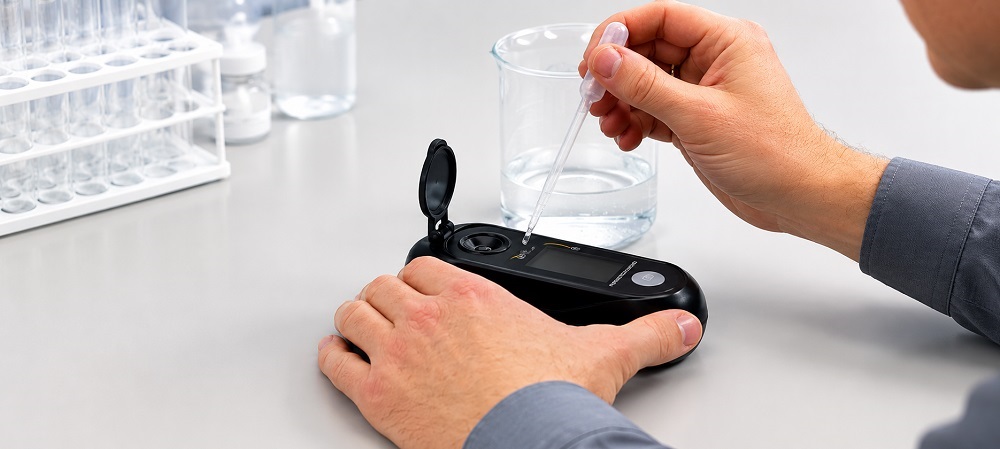
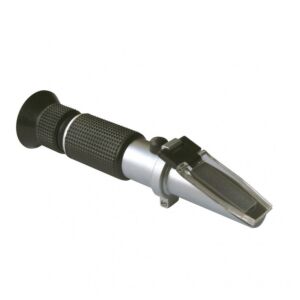
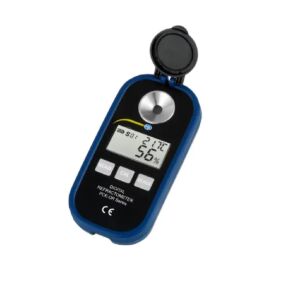
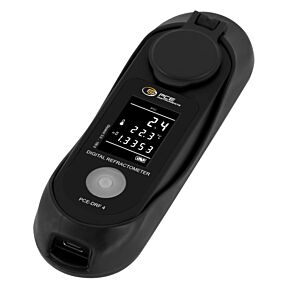
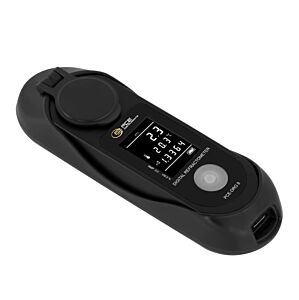
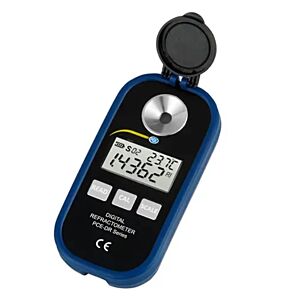
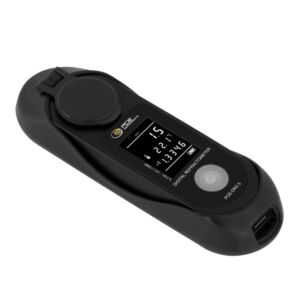
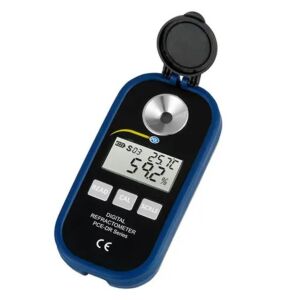
Refractometers are professional instruments designed to measure the refractive index of a liquid or solution and, when supported by the instrument, convert it into useful parameters such as Brix, concentration percentage, sugar content, salinity, glycol concentration, purity or sample composition. The operating principle is based on the deviation of light when it passes through a material with a different optical density. Each solution modifies the light path in a characteristic way, and the refractometer uses this variation to provide a fast, repeatable and comparable numerical measurement. For this reason, it is widely used in laboratories, quality control, the food industry, beverage production, industrial maintenance and processes where liquid concentration must be checked accurately.
This category includes digital portable refractometers, waterproof refractometers, Brix refractometers, models for wine, beer, coffee and honey, instruments for sodium chloride, glycol, NMP and technical fluids, as well as Abbe bench refractometers used when a more accurate refractive index measurement is required. Digital portable models are especially suitable for rapid measurements in production, in the field or in laboratories because they require only a few drops of sample, show the value directly on the display and often include automatic temperature compensation. Bench models are more suitable for analytical checks, comparative tests, internal calibration and measurements on samples requiring greater optical stability and more detailed reading.
In the food sector, refractometers are used to check sugars, concentration, ripeness, apparent density and quality of liquid or semi-liquid products. In juices, syrups, preserves, jams, honey and sugar-based preparations, the Brix value helps estimate soluble solids content and verify process consistency. In winemaking, refractometers are used to assess the sugar content of must, follow grape ripening and support technical decisions during harvest and vinification. In beer production, they allow the operator to check wort, verify sugar concentration and monitor certain brewing process stages. For coffee, dedicated instruments measure parameters related to extraction, concentration and preparation repeatability.
In industrial and maintenance applications, refractometers are used to check technical fluids, emulsions, coolants, glycol solutions, antifreeze, metalworking fluids, detergents, brines, chemical products and aqueous mixtures. Concentration measurement is essential to maintain stable fluid performance, avoid incorrect dilution, reduce corrosion risk, improve process stability and prevent problems in systems, circuits, machines or cooling systems. In glycol control, for example, the refractometer verifies solution concentration and helps assess antifreeze or thermal protection. In brines and saline solutions, it monitors sodium chloride concentration and process stability.
The operating procedure of a refractometer is simple, but care is required to obtain reliable measurements. The sample is placed on the prism or measuring surface, the instrument detects the refractive index and displays the value in the selected scale. With digital models, only a few drops are needed; the operator applies the sample, closes the protective cover if present, starts the measurement and waits for the reading. After each use, the prism must be cleaned carefully to avoid contamination between different samples. Sugar residues, oils, emulsions, salts or solvents can alter subsequent measurements if not properly removed. In bench refractometers, cleaning and sample stability are even more important because instrument accuracy requires clean optical surfaces and controlled measuring conditions.
Accuracy and resolution are fundamental parameters when choosing a refractometer. Accuracy indicates how close the measurement is to the true value, while resolution indicates the smallest displayed increment. An instrument with good resolution makes it possible to observe minimal concentration variations, but the quality of the result also depends on calibration, sample temperature, prism cleanliness and correct distribution of the liquid on the optical surface. Many professional refractometers include automatic temperature compensation, which is very important because the refractive index changes with temperature. Without compensation or thermal stabilization, two measurements of the same sample may produce different results.
Calibration is an essential adjustment. In many cases it is performed with distilled water or certified standard solutions, depending on the measuring range and scale used. Regular calibration keeps the instrument reliable over time and reduces systematic errors. In professional checks, it is good practice to verify zero or a reference point before starting a series of measurements, especially when the instrument is used in environments with temperature variations, on very different samples or in contexts where the result must be documented. Reading stability must always be checked: fluctuating values or abnormal response times may indicate a dirty prism, non-homogeneous sample, air bubbles, unstable temperature or the need for maintenance.
The field of application for refractometers is very broad. In laboratories, they are used for routine analysis, raw material control, sample verification, batch comparison and formulation testing. In production, they allow rapid checks directly on the line or near the process, reducing response times and improving quality continuity. In quality control departments, they are used to verify conformity, repeatability, concentration and stability of liquid products. In preventive and corrective maintenance, they are useful for checking plant fluids, antifreeze, metalworking emulsions, technical detergents and solutions that must maintain a defined concentration to operate correctly.
Although refractometers are not mechanical instruments with transmission backlash, the technical concept of stability can be applied to the precision of the optical system, cover closure, prism flatness, repeatability of sample positioning and absence of movement or contamination that could affect the reading. In portable refractometers, a dirty, scratched or insufficiently covered measuring surface may generate errors. In bench refractometers, shape and geometry errors may concern optical alignment, non-uniform liquid distribution, the presence of bubbles or insufficient contact between the sample and prism surface. These aspects are important because optical measurement requires correct contact geometry between sample and reading system.
Height and positioning are especially relevant in bench models and laboratory procedures. The instrument should be placed on a stable, clean, vibration-free surface, in an ergonomic working position that allows the operator to apply the sample, adjust the reading, clean the prism and record data without imprecise movements. With digital portable models, it is important to keep the instrument stable during measurement, avoid excessive inclination that may move the sample and protect the prism from impacts or abrasion. The sample must correctly cover the optical area, must not be too scarce and should be free from coarse particles or bubbles that could interfere with light transmission.
To obtain reliable results, the sample should be homogenized before measurement, especially when working with emulsions, dense food products, honey, musts, syrups or liquids with suspended particles. It is important to avoid contamination between different samples, clean the prism with suitable materials, avoid abrasive tools and respect temperature stabilization times. When measuring very hot or very cold solutions, it is preferable to wait until the sample reaches a temperature compatible with the instrument operating range. In processes where concentration changes rapidly, such as fermentation, evaporation, dilution or mixing, the refractometer must be used with a consistent procedure to make data comparable over time.
Refractometers are therefore essential professional instruments for companies, technicians, engineers, maintenance operators and laboratories that need to control concentration, quality and stability of liquids and solutions. The availability of digital, waterproof, portable, application-specific and bench models makes it possible to choose the most suitable instrument according to sample type, measuring range, required accuracy and working environment. For Tadaah, a category dedicated to refractometers provides a complete technical reference to help professionals and companies select the correct device, optimize controls, improve traceability and reduce measurement errors in food, industrial, chemical and laboratory processes.