Abrasive belt deburring machines for metal
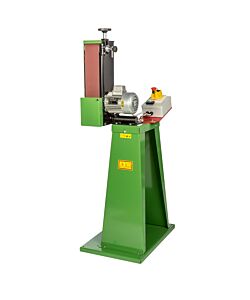
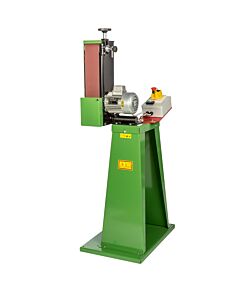
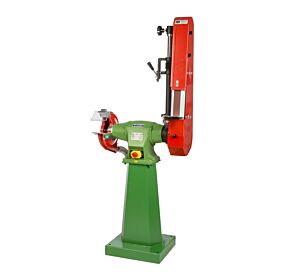
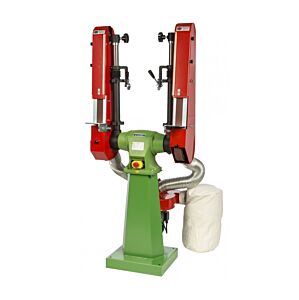
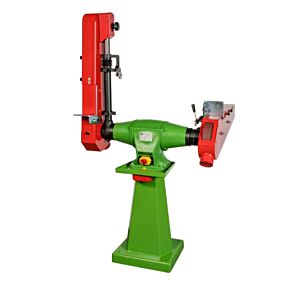
NEBES Elettromeccanica abrasive belt deburring machines are professional machines designed to remove burrs, sharp edges, casting flash, oxidation, weld marks and machining irregularities from metal components of different shapes and sizes. The range includes compact machines and more substantial industrial configurations, with one or more abrasive stations, vertical or horizontal belt arrangements, adjustable work rests and, depending on the model, a grinding wheel, rotary brush or extraction system. Although they belong to the same product category, NEBES Elettromeccanica machines differ in construction, operating capacity, workstation layout, adjustment possibilities and suitability for occasional, repetitive or continuous use.
An abrasive belt provides a longer and more progressive contact surface than a rigid grinding wheel. This distributes stock removal over a wider area and improves control when blending one surface into another. Belt deburring machines can remove cutting burrs, casting flash, parting lines, oxidation and weld residues; chamfer edges; round sharp corners; regularise the ends of tubes and profiles; and prepare components for painting, coating, satin finishing or polishing. Work can be performed against the rigid platen behind the belt, around the contact wheel or, only when permitted by the machine design, on an unsupported section of belt for curved or irregular surfaces.
Flat components should be firmly supported on the adjustable work rest and presented to the belt where it is backed by the rigid platen. Pressure must remain even, and the component should be moved across the usable belt width to avoid concentrated wear and localised stock removal. When producing a chamfer, the rest becomes the geometric reference and should be adjusted to the required working position before a series of light passes is made. Radii, external curves and irregular castings can be guided gradually around the contact wheel, rotating the component continuously to prevent flat spots, grooves and sudden changes in profile.
A vertical belt arrangement provides convenient frontal access for edges, ends, brackets, flanges and components that can be supported securely on the work rest. A horizontal arrangement may be more practical for long profiles and surfaces that need to be guided laterally. Inclined positions can improve access to selected areas, provided the abrasive assembly is securely locked before starting. Long components require external support so that their weight does not change the contact angle. Small, thin, hot or difficult-to-hold parts require suitable fixtures or holding tools, with the operator’s hands kept away from belts, rollers and trapping points.
The workpiece edge should be presented so that belt movement tends to keep the component on the rest rather than lift it or pull it into the machine. A sharp edge directed incorrectly against the belt can catch, damage the abrasive and cause loss of control. Before beginning a production batch, a trial on a sample component should be used to verify belt direction, hand position, workpiece stability and the sequence of movements. For repetitive work, a simple positioning fixture can improve angular consistency and reduce variation between components.
The work rest must be rigid, clean, correctly aligned and positioned close to the belt without interfering with its movement. An excessive gap can allow the workpiece to become trapped between the rest and abrasive, whereas insufficient clearance may cause contact during belt movement or adjustment. Clearance should be set in accordance with the NEBES Elettromeccanica instructions and checked after every belt replacement, arm-position change, tracking adjustment or maintenance operation. Adjustments must always be carried out with the machine stopped and isolated from its power supply.
Abrasive-belt selection directly affects cutting rate, workpiece temperature, abrasive life and surface quality. Coarse grit is suitable for heavy burrs, casting projections, scale, weld residues and substantial excess material. Medium grit blends the worked area and reduces the scratches left by rough grinding. Fine grit prepares the surface for cosmetic finishing or subsequent treatment. Moving directly from a very aggressive abrasive to an extremely fine belt increases processing time and heat. A controlled grit progression removes the scratches from the previous stage more efficiently.
Aluminium oxide is a versatile choice for many steels and general-purpose applications. Zirconia provides aggressive cutting and effective self-sharpening in demanding operations, while ceramic abrasives can be advantageous for intensive cycles and tough materials. Silicon carbide may be suitable for selected cast irons, non-ferrous alloys and finishing processes. Belts with a low tendency to load are preferable for aluminium and light alloys. Backing construction, flexibility, joint type, running direction and machine compatibility must also be evaluated. A stiff backing improves flatness and edge control, while a flexible backing follows radii and contours more effectively.
When fettling cast components, thin parting-line flash must be distinguished from heavier gates, runners and riser remnants. Large projections should be reduced gradually without immediately reaching the finished geometry; the belt can then blend the transition into the surrounding surface. Cast iron may have a hard outer skin and produces fine dust. Aluminium and light-alloy castings require careful control of belt loading, temperature and combustible dust. Brass and bronze benefit from clean abrasives, moderate pressure and appropriate extraction. Threads, seats, datum faces, functional radii and thin walls must be protected against accidental stock removal.
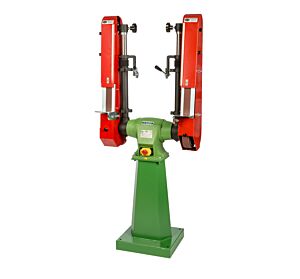
NEBES Elettromeccanica machines with two abrasive stations can keep different belts installed at the same time. One station may be assigned to roughing and the other to finishing, or the stations may be separated by material. A belt previously used on carbon steel should not be transferred to stainless steel because ferrous particles can contaminate the surface. Belts loaded with aluminium or other light alloys must also be managed separately from operations producing ferrous sparks. Dedicated abrasives improve finish quality and support safer dust management.
Where a grinding wheel is fitted, it can concentrate cutting action on a localised area to remove strong burrs and reduce small projections, while the belt subsequently blends and refines the surface. The wheel must be selected according to the workpiece material, operation, abrasive type, grit, grade, structure and bond. Its dimensions, bore, flange system and maximum permitted speed must be fully compatible with the machine. A wheel that is too hard may glaze and stop cutting effectively, while one that is too soft may wear rapidly and lose its profile.
Before installation, the grinding wheel must be inspected for cracks, chips, impact damage or other deterioration. It must be used only on its intended working surface; a conventional wheel must not be side-loaded unless specifically designed for side grinding. The workpiece should rest securely on the adjustable support and approach the wheel periphery without impact. The work rest must remain close to the wheel in accordance with the manufacturer’s safety clearance. Because the effective wheel diameter decreases through use and dressing, the adjustment must be checked regularly. Dressing restores cutting action and surface geometry but cannot make a damaged wheel safe.
When the second station is equipped with a rotary brush, it can remove light oxidation, surface residue and minor burrs or prepare components for polishing. Brush selection should consider wire material, construction, density, flexibility and required aggressiveness. Crimped-wire brushes provide a more progressive cleaning action, while twisted-wire types are more aggressive. A brush works primarily through the wire tips and should not be crushed against the component. Excessive pressure bends the wires, reduces efficiency and increases the risk of fragments being released.
Workpiece temperature should be controlled with a sharp abrasive, moderate pressure, short passes and continuous movement. Remaining in one location can cause discolouration, distortion, loss of metallurgical properties or damage to a surface treatment. If the component becomes too hot to hold safely, grinding must stop. Water or coolant may only be used when both machine and process are designed for wet operation; liquid must not be applied to equipment intended exclusively for dry working. Thin, hardened or thermally sensitive parts require particularly short contact times and frequent inspections.
The choice between a compact machine and an industrial pedestal configuration depends on component size and weight, cycle duration, frequency of use, amount of stock to be removed and the space required for handling. A compact deburring machine is suitable for small components and flexible work, provided it is installed on a rigid, stable support. A pedestal machine provides greater clearance and facilitates the handling of long or bulky workpieces. Twin-station configurations improve productivity in roughing and finishing sequences, while integrated or optional extraction assists dust management when correctly selected for the processed material.
Important purchasing considerations include structural rigidity, pedestal stability, smooth running, belt-tensioning and tracking adjustment, access for abrasive replacement, work-rest regulation, abrasive-unit positioning, roller guarding and the availability of replacement belts and spare parts. For continuous work, ergonomics, extraction, maintenance time and the ability to keep two complementary tools installed are also important. The machine should be selected according to the actual manufacturing process rather than belt size alone.
NEBES Elettromeccanica belt deburring machines are used in foundries, fabrication shops, machine shops, welding departments, tool and mould production, industrial maintenance and the automotive, motorcycle, railway, marine and energy sectors. They are also employed in the manufacture of pots, pans, trays, cutlery, handles, hinges, taps, lighting components, decorative products and metal household accessories. Steel, stainless steel, cast iron, aluminium, light alloys, brass and bronze can all be processed when the abrasive, pressure, operating sequence and extraction system are selected for the specific material.
Routine maintenance includes checking belt tension and tracking, joint condition, platen wear, roller cleanliness, guards and stopping devices. A frayed, distorted, clogged or damaged belt must be replaced. Aluminium and light-alloy dust must not be collected indiscriminately with ferrous dust and sparks. Operators must use the protective equipment identified by the workplace risk assessment, keep clothing, hair and loose objects away from moving components and never process a part that cannot be held securely.
Tadaah supports the selection of NEBES Elettromeccanica abrasive belt deburring machines by assessing workpiece material, geometry and weight, burr size and location, required finish, duty cycle, ergonomics and dust management. The correct solution results from a coordinated choice of machine, abrasive belt, optional grinding wheel or brush, work rests and processing sequence. This approach improves repeatability, limits overheating, optimises abrasive consumption and identifies the configuration most appropriate for each professional production requirement.