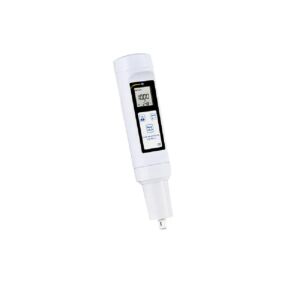
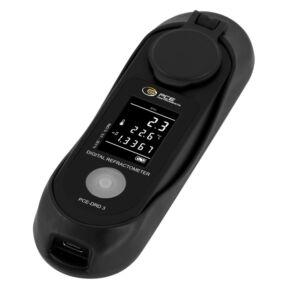
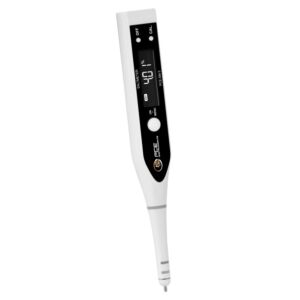
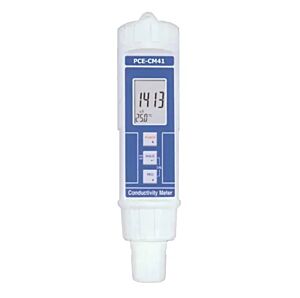
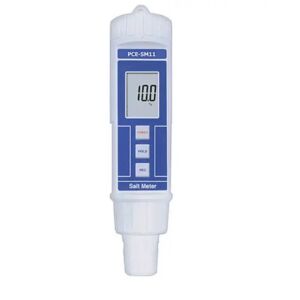
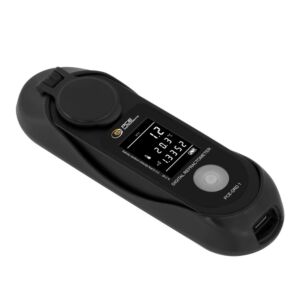
The Conductivity Meters and Salinity Meters category includes professional instruments designed to measure electrical conductivity, salinity, total dissolved solids, temperature and other parameters related to water and aqueous solution quality. These instruments are used in laboratories, industry, water treatment, food production, agriculture, livestock farming, aquaculture, horticulture, aquariology, maintenance, quality control and technical processes where salts, ions and dissolved substances directly influence liquid behaviour and process stability.
A conductivity meter measures the ability of water or a solution to conduct electrical current. This ability increases when dissolved salts, minerals, ions or conductive substances are present in the liquid. Conductivity is often used as a quick indicator of water quality, mineralisation level, purity, solution concentration or treatment effectiveness. A high value may indicate salts, contamination, residues, insufficient treatment or excessive concentration; a very low value may be required when using demineralised, purified or technical water for sensitive processes.
A salinity meter is specifically designed to measure salt concentration. It is used when the amount of salt in water or in food, aqueous or technical solutions must be known. It is very useful in aquaculture, livestock farming, food industry, salted product processing, brines, solution control, aquariology, agriculture, horticulture and processes where salt concentration must remain within a defined range. Incorrect salinity can affect preservation, taste, biological growth, process stability, corrosion, material compatibility and final product quality.
Combined EC/TDS/temperature instruments give the technician a more complete view of the sample. Electrical conductivity provides a reading of ionic content, TDS estimates the total dissolved solids and temperature helps interpret the measured value correctly. Temperature is important because conductivity changes with sample heat; for this reason many instruments include automatic temperature compensation, which makes measurements more stable and comparable when checks are performed in different environments or directly in the field.
Portable conductivity meters and salinity meters are especially practical for quick checks on plants, tanks, vats, process lines, washing water, nutrient solutions, technical water, swimming pools, aquariums, treatment systems, agricultural samples and industrial applications. Pocket models allow immediate measurement with compact dimensions, while waterproof instruments or models with IP protection are more suitable for humid environments, operational laboratories, water treatment plants and situations where the instrument may be exposed to splashes or demanding working conditions.
In water treatment, these instruments make it possible to verify inlet and outlet water quality, check demineralisation, reverse osmosis, softening, filtration, washing, rinsing and technical circuits. Conductivity is one of the most useful parameters for evaluating whether treatment is working correctly. If the value increases beyond the reference, it may indicate resin saturation, filter inefficiency, contamination, dosing error or passage of unwanted salts. In preventive maintenance, periodic recording of values makes it possible to detect progressive drift before it becomes a non-conformity or failure.
In the food sector, salinity meters and conductivity meters are used to check brines, washing solutions, process liquids, water used as an ingredient, preservation and salt concentration. Salinity can influence taste, safety, consistency, maturation, preservation and production repeatability. Quick control helps keep the process constant, reduce preparation errors, avoid incorrect dilution and document values during processing stages.
In agriculture, horticulture and professional cultivation, conductivity is used to check nutrient solutions, irrigation water and substrates. Conductivity that is too high may indicate salt accumulation and risk of plant stress; conductivity that is too low may indicate insufficient nutrient concentration. In hydroponic systems and greenhouses, EC control is essential to keep nutrient supply stable and allow more precise intervention in solution preparation. In soils or substrates, incorrect values can affect absorption, root development and crop quality.
In aquaculture, aquariology and livestock applications, salinity and conductivity directly influence the balance of the aquatic environment. Incorrect values can create biological stress, alter living conditions and compromise growth, reproduction and organism stability. For this reason, instruments must be practical, fast and easy to clean, but also precise enough to allow periodic checks that can be compared over time.
The correct conductivity meter or salinity meter must be selected according to measuring range, accuracy, resolution, parameter type, temperature compensation, robustness, protection rating, instrument size, probe type, ease of calibration, available units, sample type and frequency of use. Accuracy indicates how close the measured value is to the real or reference value, while resolution indicates the smallest variation readable by the instrument. In professional applications both parameters must be evaluated, because a digital display with many decimals does not automatically guarantee a correct measurement if the probe is dirty, uncalibrated or unsuitable for the sample.
Calibration is fundamental. To maintain reliability and repeatability, instruments must be checked with standard solutions suitable for the working range. Incorrect calibration can generate wrong readings and lead to wrong decisions on dosing, treatment, dilution or sample quality. After use, the probe must be rinsed, cleaned and stored correctly, avoiding salt residues, scaling, deposits or contamination between different samples. In professional checks, it is good practice to record temperature, sampling point, date, time, measured value and sample conditions.
To obtain reliable measurements, representative samples must be used, contaminated containers avoided, value stabilisation awaited, the instrument not immersed beyond its intended limit and air bubbles or residues on the measuring cell checked. In very dirty, viscous or particle-containing liquids, probe cleaning becomes even more important. In samples with variable temperature, automatic compensation helps, but it is still advisable to wait until the sensor reaches thermal equilibrium with the liquid.
In industrial quality control, conductivity meters and salinity meters verify process liquid compliance, check concentrations, monitor washing, validate treatments and document important production parameters. In a washing system, residual conductivity that is too high may indicate insufficient rinsing. In a technical solution, a change in value may indicate contamination or incorrect dilution. In a treatment plant, an out-of-specification value may indicate the need for maintenance or adjustment. The measured data therefore becomes an operational tool for improving quality, stability and traceability.
The connection with heights, transmission backlash, form errors and geometry is indirect, but it can be relevant in industrial processes. The quality of water and controlled solutions can influence corrosion, scaling, lubrication, washing, cooling and thermal stability. In a machine tool, a cooling or washing solution with incorrect conductivity, salinity or concentration may promote corrosion, deposits, altered surface finish, thermal variations and reduced dimensional stability. Over time, deposits and corrosion can influence fits, functional clearances, guideways, support surfaces and precision components.
In systems with pumps, valves, pipes, nozzles, cooling or washing circuits, a solution that is too saline or too rich in dissolved substances can cause scaling, clogging, wear, flow loss and reduced efficiency. These phenomena can modify operating conditions and indirectly influence precision, repeatability, process geometry and component life. Even though conductivity meters and salinity meters do not directly measure dimensions, heights or backlash, they help control parameters that can affect mechanical quality and system stability.
An important practical recommendation is always to define the application before selecting the instrument. If pure, demineralised or reverse osmosis water must be checked, an instrument sensitive enough for low conductivity is required. If brines, aquaculture or food applications are involved, a salinity meter with a scale suitable for the expected concentration is needed. If field work is required, a portable, robust and waterproof model is useful. If laboratory or quality checks are performed, calibration, repeatability, resolution and documentation capability are important.
Tadaah presents the Conductivity Meters and Salinity Meters category as a technical reference for companies, technicians, engineers, maintenance specialists, laboratories and quality departments that need to control conductivity, salinity, TDS and temperature in water and professional solutions. Choosing the correct instrument helps improve quality control, optimise treatments, prevent contamination, monitor processes, reduce dosing errors, check technical water and support decisions based on real, measurable and repeatable data.