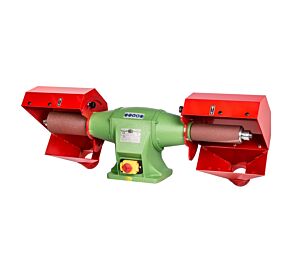
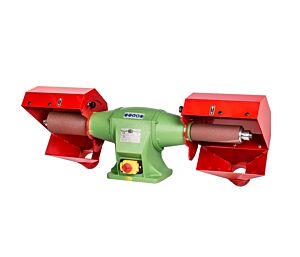
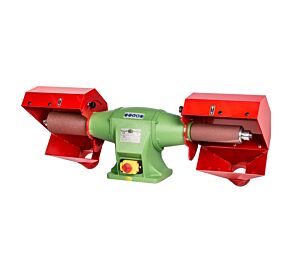
NEBES Elettromeccanica roller sanders for wood are stationary machines designed for manually sanding, cleaning and finishing edges, profiles, transitions, shaped surfaces and components used in joinery and furniture manufacturing. Their opposing twin-station construction allows different abrasive rollers to be installed on the same machine, making it possible to move quickly from rough sanding to finishing or configure each side for a different workpiece geometry.
The operating principle is based on pneumatic rollers mounted on the machine’s lateral shafts. A compatible abrasive is fitted to the roller, which rotates at working speed while the operator manually presents and guides the component. Unlike conveyor-fed drum sanders, NEBES Elettromeccanica roller machines do not automatically transport the workpiece beneath the abrasive. The operator controls position, angle, pressure and contact time according to the shape of the component.
Cast-iron construction promotes stability and vibration absorption. A rigid base is particularly important when rollers with different dimensions or characteristics are fitted to the two shafts because it helps maintain regular rotation and limits oscillations that could mark the surface. The NEBES Elettromeccanica machine should be securely installed on a stable bench with sufficient clearance around both working stations.
The pneumatic roller has a deformable working surface that follows gentle curves, transitions and profiles more effectively than a rigid cylinder. Internal pressure influences how the roller responds. A firmer roller provides more decisive contact on relatively regular surfaces, while a more compliant setting follows the component geometry and reduces concentration of pressure along a narrow line. Inflation must remain within the limits specified by NEBES Elettromeccanica.
Roller compliance should not be used to compensate for excessive manual pressure. Pushing too hard may deform the tool, round edges, create hollows, overheat the wood and wear the abrasive rapidly. Material should be removed progressively, with the component kept moving and the abrasive grains allowed to perform the cutting action.
The two working stations increase the flexibility of NEBES Elettromeccanica roller sanders. One roller can be prepared with an aggressive grit to remove saw marks, irregularities and small amounts of excess material, while the other can carry a finer abrasive for surface refinement and preparation for painting, oiling or bonding. Alternatively, rollers with different shapes or characteristics can be fitted for straight edges, curved elements and profiled components.
The rollers remain horizontally aligned with the machine shafts. The working angle is changed by orienting the workpiece in relation to the abrasive surface rather than arbitrarily tilting the shaft. A straight edge is normally presented parallel to the roller axis so that contact is evenly distributed. Curves and transitions require gradual rotation and movement following the component geometry without stopping in one position.
Workpiece position must be selected according to the direction of rotation. The component should be presented in the area where roller movement allows its reaction to remain controlled and does not tend to lift, pull in or throw the part towards the operator. Rotation at each station should be checked before work begins, and a test should be performed on scrap material. Hands must remain away from unguarded abrasive areas.
To sand a flat area, the component should be held securely and moved laterally along the roller so that abrasive wear is distributed across the available width. Remaining in one position produces a groove and prematurely wears a narrow abrasive section. NEBES Elettromeccanica roller sanders are particularly effective for local corrections and finishing, but are not intended to automatically calibrate the thickness of large panels.
Edges and ends require light pressure because their contact area is small and they can round rapidly. To preserve a sharp edge, contact must be distributed along the roller and the result checked frequently. When a rounded transition is required, the component can be rotated gradually with continuous movement, avoiding pauses that would create an uneven profile.
Concave surfaces can be processed when the component radius is compatible with the fitted roller’s diameter and compliance. Convex surfaces are generally easier to guide but still require smooth movement. Complex profiles should be approached in small sections while maintaining secure support and grip.
Small workpieces must not be brought directly to the roller if they cannot be held securely. Jigs, clamps or supports should be used to control the component while keeping hands away. Long and heavy workpieces also require appropriate support because their weight may suddenly change the contact angle and produce irregular removal.
Abrasive grit should be selected according to the working stage and material. Coarse grits are suitable for rough sanding, removing pronounced marks and correcting minor shape variations but leave deeper scratches. Medium grits remove the initial sanding marks and even the surface. Fine grits prepare the component for painting, oiling, polishing or bonding. A progressive sequence prevents deep scratches from remaining visible after finishing.
Wood-grain direction should be respected whenever component geometry permits. Sanding predominantly with the grain reduces the visibility of scratches. End grain removes differently and may develop more heat, requiring moderate pressure and frequent inspection. Soft and resinous timber can clog the abrasive more quickly and benefits from light passes and regular cleaning.
Adhesive residue must be completely cured before sanding. Soft or substantial deposits adhere to the abrasive and rapidly reduce its effectiveness. Larger excesses should be removed beforehand, leaving the roller to level only thin remaining residue. If the abrasive begins to burn the surface or requires increasing pressure, its cleanliness and wear condition must be checked.
Rollers and abrasives must be compatible with the provisions of the specific NEBES Elettromeccanica machine. Diameter, width, attachment system, permitted operating speed and intended application should all be verified. An accessory that is not centred or fully secured may generate vibration, reduce finish quality and increase operating risk. After replacement, the machine should be run briefly without load to check rotation.
NEBES Elettromeccanica configurations may differ in control system and motor characteristics. Before purchase, the available electrical supply, installation compatibility, expected duty cycle and preferred starting method should be assessed. Controls must remain easy to reach without crossing the rotating-tool area.
Dust extraction is essential because the rollers generate fine particles and discharge them tangentially. The machine should be paired with a system capable of capturing residue close to both stations. Poor collection reduces visibility, clogs abrasives and releases dust into the working environment. Guards and surrounding areas should also be cleaned regularly.
Maintenance includes inspecting pneumatic rollers, pressure, shafts, retention systems, guards, motor and extraction. A damaged or distorted roller, or one unable to maintain the required pressure, must be replaced. Abrasives with tears, damaged joints or missing grit should not be used. All maintenance must be performed with the NEBES Elettromeccanica machine disconnected and completely stationary.
Before purchasing a NEBES Elettromeccanica roller sander, consider workpiece geometry and dimensions, flat or shaped surfaces, the required number of abrasive stages, compatible roller types, required compliance, electrical supply, controls, extraction and availability of replacement accessories. The twin-station arrangement is especially effective for workshops alternating between rough sanding and finishing or processing different profiles without frequent tool changes.