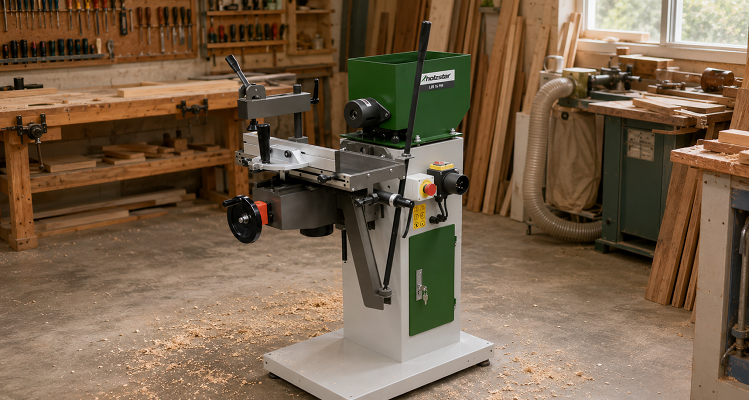
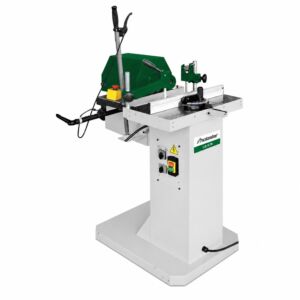
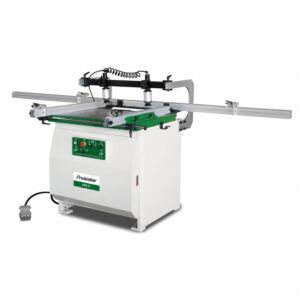
Holzstar wood mortising machines are professional machines designed for producing mortises, longitudinal slots, elongated holes and accurate joint recesses in rails, stiles, frames, doors, windows, chairs, tables and furniture components. The Holzstar machines in the category share the same construction and operating principle but may differ in electrical supply and other technical characteristics that should be selected according to workshop installation and intended use.
A Holzstar mortising machine uses a horizontally arranged chuck holding a rotating woodworking tool. The component is secured to the moving table and brought towards the cutter through controlled movements. Inward table travel determines mortise depth, lateral movement develops its length and vertical table adjustment establishes the mortise height relative to the workpiece reference face.
The cutter used on a Holzstar mortising machine is not a saw blade or a square hollow chisel. It is normally a mortising bit or slot-cutting tool with geometry suitable for plunging and, where specified, peripheral cutting. A conventional twist drill can produce round holes but must not be moved sideways unless designed for lateral cutting. Elongated slots therefore require a compatible mortising cutter suitable for the Holzstar chuck.
Cutter diameter determines mortise width. Usable cutting length and edge geometry affect possible depth, chip evacuation and wall quality. Before purchasing a tool, users should verify shank diameter, chuck capacity, clamping length, rotation direction and suitability for the timber species.
The shank must enter the Holzstar chuck deeply enough to provide stable holding without clamping over the cutting section or leaving unnecessary overhang. Excessive projection increases leverage on the shank, promotes vibration and may allow the cutter to deflect. The shank and chuck jaws must be clean and free from resin and dust.
Mortise position is established by adjusting the Holzstar table height relative to the spindle axis. The workpiece should always be placed on the same reference face, particularly when several matching components are being produced. Turning one component onto its opposite face can transfer variations in material thickness directly into mortise-position errors.
To centre a mortise through the workpiece thickness, a light test mark can be made on scrap material before the sample is turned over and marked again from the opposite face. If the two marks do not coincide, Holzstar table height is corrected by half the difference. This method accounts for the actual component thickness rather than relying only on a scale.
The moving table controls mortise depth and length independently. Adjustable stops should be set before machining to limit travel to the required dimensions. Longitudinal stops establish both ends of the slot, while the depth stop prevents the cutter from penetrating too far or unintentionally passing through the workpiece.
The component must be secured firmly with the Holzstar hold-down. Its seating surface must be flat and free from chips because even a small residue can tilt the workpiece and alter slot position. Clamping force should be applied over a stable area without deforming slender parts or damaging finished surfaces. A protective packing piece can distribute pressure more evenly.
Long components require support beyond the Holzstar table. An unsupported end creates leverage at the clamping point and may rotate or tilt the component. Additional supports must be aligned with the table and positioned so that they do not restrict longitudinal or inward movement.
An effective method is to define both mortise ends with controlled plunges and then progressively remove the intermediate material with a cutter designed for lateral cutting. Full depth should not be reached in a single pass when the slot is long or the timber is hard. Progressive cutting reduces load on the Holzstar spindle, improves chip removal and limits tool deflection.
Inward feed pressure should remain smooth. Forcing the Holzstar table suddenly against the tool can generate vibration, heat and cutter deviation. During deep operations, periodically retracting the cutter clears accumulated chips. Packed material inside the mortise increases friction and may burn the timber or jam the tool.
Lateral table travel must be used only with a mortising cutter suitable for peripheral cutting. Movement must follow the direction specified for the Holzstar machine and selected tool, avoiding a feed direction that causes the table to be pulled by the cutter. Lateral stock removal should remain moderate and suited to timber hardness.
Grain direction affects the quality of mortise walls and ends. Timber with knots, reversing grain or irregular fibres requires light passes and sharp tools. A sacrificial backing piece can be placed behind the workpiece where breakout is possible, supporting the exit fibres and reducing splintering.
Through mortises require a different approach from blind mortises. For a blind recess, the Holzstar depth stop must prevent the cutter from reaching the opposite face. A through mortise is often best approached from both sides using the same references instead of passing completely through in one operation. This reduces breakout at the exit face.
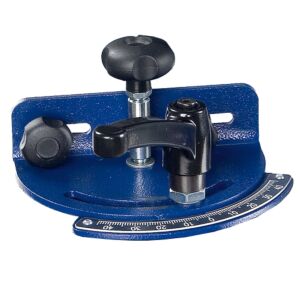
Angled mortises can be produced only with tooling that holds the component securely at the required angle. Because the Holzstar spindle remains horizontal, inclination is created by orienting the workpiece with a jig or angled support compatible with the table and hold-down. Improvised wedges or hand-held components do not provide a secure, repeatable reference.
An angled jig must provide a broad seating surface and prevent the component from rotating. Before machining, the complete Holzstar table movement should be checked for interference between the workpiece, hold-down, cutter and machine structure. Angled mortise depth must be assessed along the actual cutter axis rather than only from the outer component face.
For repeat production, Holzstar table height, longitudinal stops and depth stop should remain unchanged. Components should be marked clearly with their reference face and reference edge. This prevents orientation errors and places the mortises consistently even when nominal workpiece thickness varies slightly.
The mortise must correspond correctly to tenon width, length and depth. Excessive width produces a loose joint and reduces useful gluing contact, while a slot that is too narrow requires force during assembly and may split the component. A complete test joint should be produced in material of the same section before machining finished parts.
Holzstar mortising tools must remain sharp. A worn edge requires greater pressure, generates heat and tends to deviate through softer areas of the grain. Burning, difficult feeding, unusual noise and irregular walls indicate that the cutter, clamping and chip evacuation should be checked.
The Holzstar chuck should be inspected periodically to confirm that its jaws close evenly. Dust and resin can reduce concentricity and cause cutter run-out. Eccentric rotation enlarges the mortise beyond the selected tool diameter and produces uneven walls. Chuck cleaning must not damage its precision surfaces.
The floor-standing structure of a Holzstar mortising machine provides a stable station for joinery components. Installation requires adequate space around the table for handling long workpieces. The machine should stand on a firm surface and be levelled so that the table has no unwanted inclination.
Choosing between Holzstar variants requires consideration of the electrical supply available, expected duty and workshop organisation. Buyers should also assess chuck capacity, usable depth, table travel, vertical adjustment, hold-down stability, stop accuracy, support area and availability of compatible mortising cutters.
A Holzstar mortising machine is particularly useful for repeatable joints in doors, windows, frames, chairs, tables and solid-wood furniture. Mechanical adjustments retain mortise height, length and depth across several components. Final accuracy still depends on correctly prepared stock and consistent use of the same reference faces.
Maintenance includes cleaning the Holzstar table, guides, stops, hold-down and chuck. Chips and dust should not accumulate on sliding surfaces because they affect movement and accuracy. Abnormal play should be investigated before machining continues. Adjustment, cutter replacement and maintenance must be performed with the Holzstar machine disconnected and the spindle completely stationary.
Holzstar wood mortising machines provide joiners, door and window manufacturers, cabinetmakers, furniture builders and advanced hobbyists with a stable solution for producing blind or through mortises, longitudinal slots and repeatable joints. Correct coordination of cutter, clamping, table height, stops and controlled movements creates accurate recesses matched to the tenons used during assembly.