Bench grinders with dust extraction
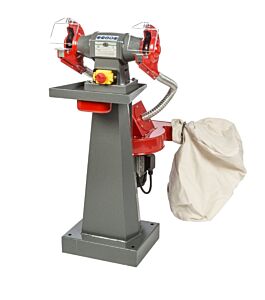
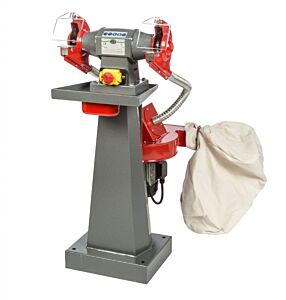
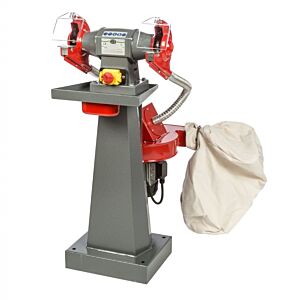
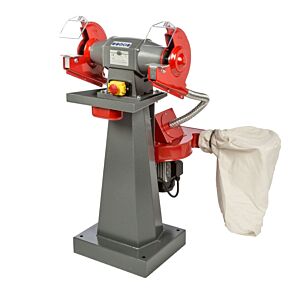
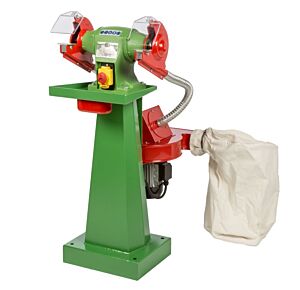
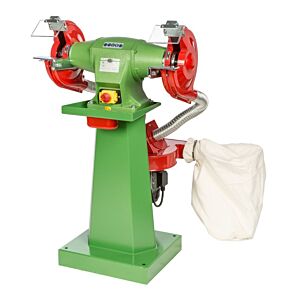
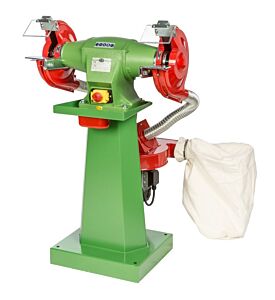
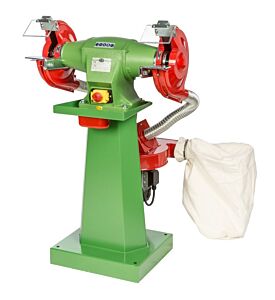
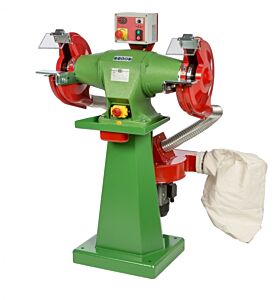
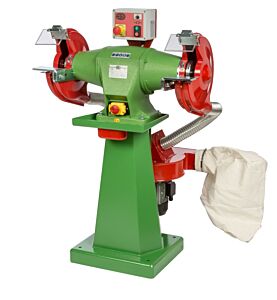
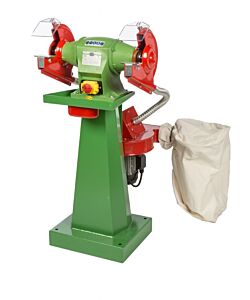
Bench grinders with dust extraction are stationary machines designed for grinding, deburring, edge finishing and sharpening while limiting the release of abrasive dust, metallic particles and processing residue into the workplace. Compared with standard bench grinders, they incorporate an extraction system connected to the grinding areas through dedicated ducts. Captured material is conveyed towards a collection system that may include a bag, container, separator or filtration element, depending on the machine configuration.
The machines within this category share the same operating principle but can differ in size, construction, electrical supply, motor characteristics, wheel arrangement, stock-removal capability, extraction performance, guard design and collection method. The range may include compact configurations for maintenance work and industrial pedestal-mounted machines suitable for frequent processing of castings, tools and metal components.
Pedestal construction provides an independent and stable workstation without occupying the main workshop bench. The rigidity and mass of the assembly help reduce vibration and movement during contact with the wheel. This is particularly important when processing heavy parts, irregular components or repetitive production batches requiring a consistent operator position. Secure floor mounting also helps keep the extraction unit, ducts and collection container in their intended positions.
Integrated extraction acts close to the point where dust and debris are produced. Wheel guards perform a mechanical protective function and also help guide the airflow and intercept material projected by the rotating wheel. Particles are drawn through extraction openings in the guards and transferred through ducting to the collection system. Performance depends on the position of the capture points, cleanliness of the ducts, tightness of the connections, condition of the collection bag or filter and compatibility of the complete installation with the processed material.
Integrated extraction improves workstation cleanliness and reduces deposits on the floor, machine and nearby equipment, but it should not automatically be considered sufficient for every process. Heavier particles, sparks and some airborne dust may be captured efficiently close to the source, while finer fractions can require specific filtration, centralised extraction or additional controls. Before purchase, it is essential to establish which materials and dust types the system is designed to collect.
During grinding, the component should be supported on the adjustable work rest and guided towards the front peripheral surface of the wheel. Contact must occur within the working area specified by the manufacturer, so the direction of rotation keeps the part against the rest rather than lifting or pulling it away. The side surface of a straight wheel must not be used unless the abrasive wheel is expressly designed to withstand side loading.
Whenever its size, shape and temperature permit, the workpiece should be controlled with both hands. The grip must be secure while allowing small corrective movements. Very small, thin, hot or awkward components require suitable pliers, holders or fixtures. Fingers must not be brought close to the abrasive area, and an unstable grip must never be compensated for by applying greater pressure.
When removing a burr from an edge, the component should be oriented so that the projection meets the abrasive progressively. Pointing the edge directly into the direction of rotation may cause catching or irregular removal. A constant inclination should be maintained when producing a chamfer, with frequent inspection of the profile. Broader surfaces and extended edges should be moved laterally across the wheel face to distribute abrasive wear.
Holding the component at a single point causes localised wheel wear, promotes groove formation and concentrates heat. Slow, even lateral movement uses the abrasive more effectively and produces a more regular finish. Pressure should allow the wheel to cut without significantly slowing the machine or generating abnormal heat. If considerable force is required, the wheel may be worn, loaded, glazed or unsuitable for the material.
The work rest must be rigid, securely locked and adjusted only while the machine is stopped. Clearance from the wheel should be kept as small as practicable while complying with the manufacturer’s instructions and applicable safety requirements. Excessive clearance may allow the component to become trapped between the rest and abrasive, while insufficient clearance may cause contact with the wheel. Because wheel diameter decreases through use and dressing, the setting must be checked regularly.
The height and inclination of the rest must suit the component geometry. A rest positioned too low can make it difficult to control the working angle, while an inappropriate setting may encourage the part to catch. For repetitive operations, it is helpful to establish a stable reference, lock the table and present every component with the same sequence of movements. The rest, guards and available clearance must be checked again whenever the workpiece, wheel or operation changes.
Operator position affects both workpiece control and extraction efficiency. The component should remain within the area covered by the guards and extraction openings. Working too far away from the capture point or moving the part into an unintended area reduces the ability to intercept dust and debris. The operator should maintain a stable stance, avoid standing directly in the wheel’s plane of rotation during startup and avoid obstructing ducts, containers or collection bags.
Wheel selection must be based on the work material and operation. Aluminium oxide abrasives are commonly used for steels. Silicon carbide or other abrasives explicitly approved by their manufacturers may be more suitable for cast iron, aluminium, brass, bronze and other non-ferrous materials. Wheel colour and appearance are not sufficient selection criteria. Abrasive type, grit, grade, structure, bond, shape, dimensions and permitted operating conditions must all be considered.
A coarse grit helps remove substantial burrs, casting remnants and excess material quickly, but leaves a more pronounced surface. An intermediate grit is suitable for general deburring and component preparation. A fine grit provides more controlled finishing and may be used for sharpening, but removes material more slowly and can generate heat if excessive pressure is applied. Wheel grade describes the ability of the bond to retain the abrasive grains and must be considered together with structure and workpiece material.
Extraction cannot correct the problems caused by an unsuitable wheel. A loaded or glazed abrasive produces more friction, heat and fine dust. The wheel must be kept clean, concentric and free cutting through appropriate dressing. A dressing tool restores the working surface, removes areas that are no longer cutting and reduces the need for high contact pressure. It cannot make a cracked, damaged or incompatible wheel suitable for use.
When fettling foundry castings, unwanted material must be identified before grinding. Parting lines, gates, feed-system remnants, flash, oxides and local irregularities must be removed without altering functional surfaces, radii, mating faces or areas intended for subsequent machining. Large projections should not be removed by forcing the casting heavily against the wheel. Short, progressive passes provide better control and allow the profile to be inspected frequently.
Cast-iron components can have hard surface scale, moulding residue and substantial flash. Cast-iron dust and graphite-rich debris require effective capture and regular maintenance of the extraction system. Aluminium and light-alloy parts are more likely to load the abrasive and can generate combustible dust. These materials require explicitly compatible wheels and confirmation that the extraction unit, collection system and disposal procedure are suitable.
Dust from aluminium, magnesium and certain light alloys must not be treated as ordinary inert residue. When sufficiently fine and dispersed in air, it can create a fire or explosion hazard. The presence of an extraction fan and collection bag does not automatically make the machine suitable for combustible metal dust. The workplace risk assessment must identify the hazard, and equipment specifically designed for the relevant dust must be used. Aluminium or light-alloy dust must not be mixed in the same collector with hot particles, sparks or ferrous grinding residue.
Brass and bronze also require an appropriate wheel and a collection system compatible with the resulting dust. Moderate pressure helps prevent grabbing, tearing and unwanted edge rounding. Where different materials are processed in the same department, it is preferable to dedicate wheels, ducts and collection systems to compatible material families. If separation is not possible, the suitability of the installation for the expected mixture must be confirmed with the manufacturer and workplace safety specialist.
In cookware, tableware, cutlery, handle, tap and household-accessory production, grinders with extraction can remove casting or stamping burrs, blend gate areas, soften sharp edges and prepare components for satin finishing, brushing or polishing. Integrated extraction is particularly helpful during repetitive work because it reduces residue accumulation and improves visibility around the working area.
Grinding is primarily a stock-removal and geometry-correction process. Final cosmetic finishing often requires flexible abrasives, belts, brushes or polishing wheels. If these accessories are to be fitted to the same machine, their compatibility with the guards, extraction system and operating conditions must be verified. Dust, fibres and debris generated by polishing can have different properties from particles produced by a rigid grinding wheel.
Workpiece cooling should be managed through short contacts, moderate pressure and frequent pauses. Where the material and process permit, the component may be cooled in a separate container, ensuring that water or coolant cannot reach the wheel, motor, guards, ducting or extraction unit. Wet material must not be introduced into a dry collection system unless expressly permitted, as moisture and residue can obstruct ducts, damage filtration components or create deposits that are difficult to remove.
Quenching is not suitable for every component. Hardened tools, thin sections and materials with specific metallurgical requirements may suffer thermal shock, distortion, cracking or changes in hardness. During sharpening, discolouration around the cutting edge may indicate overheating. A compatible, correctly dressed wheel used with light passes controls heat more effectively than excessive pressure followed by abrupt cooling.
The extraction system requires regular maintenance. The bag or container must be inspected and emptied according to the manufacturer’s instructions, before accumulated material restricts airflow. Ducts and connections must be checked for blockages, leaks and deposits. A collection bag that appears undamaged may have lost permeability because of embedded dust. Similarly, a partially blocked hose can substantially reduce capture performance even though the extraction motor continues to run.
Emptying must be performed with the machine isolated from its power supply and with procedures appropriate to the collected material. Compressed air should not be used in a manner that deliberately creates airborne dust. Residue must be stored and disposed of according to its properties, without combining incompatible materials. Where hazardous or combustible dust is generated, cleaning and maintenance procedures must form part of the workplace risk assessment.
Before starting, the operator should check wheel condition and installation, work-rest locking, guard position, duct connections and collection-system readiness. The extractor must be started in the sequence intended by the machine and allowed to operate as required to clear residual material from the ducts. Abnormal vibration, lateral wheel movement, unusual noise, loss of suction or visible dust leakage requires shutdown and inspection.
Transparent guards help intercept sparks and particles but do not replace safety glasses or a face shield. Depending on the material and risk assessment, hearing protection, close-fitting clothing, respiratory protection and supplementary extraction may also be required. Hair, jewellery and loose garments must be kept away from rotating parts. The area around the grinder must remain free from combustible materials and obstacles.
Purchase evaluation should cover the complete system formed by the wheel, guard, capture opening, ducting, extraction unit and collector. Ease of cleaning, access for inspection, spare-part availability, replacement of bags or filters, separation of different materials and compatibility with the workshop layout should all be considered. A system that is easy to inspect and service is more likely to retain its capture performance throughout its working life.
Bench grinders with dust extraction are used in foundries, engineering workshops, metal fabrication, toolrooms, valve and fitting production, automotive departments, industrial and agricultural maintenance, mould making, window and door manufacturing, cutlery production and the manufacture of cookware, handles, hinges, furniture accessories and decorative products. They are suitable for organisations seeking to combine grinding and residue collection in an organised, compact workstation.
The correct machine must be selected according to the materials, nature and volume of dust, component dimensions, operating frequency, required stock removal and production environment. A grinder with extraction should not be assessed only by its size or grinding performance, but also by the effectiveness and suitability of its capture system. Careful technical selection improves cleanliness, visibility and workstation organisation while reducing uncontrolled residue dispersion during professional grinding operations.