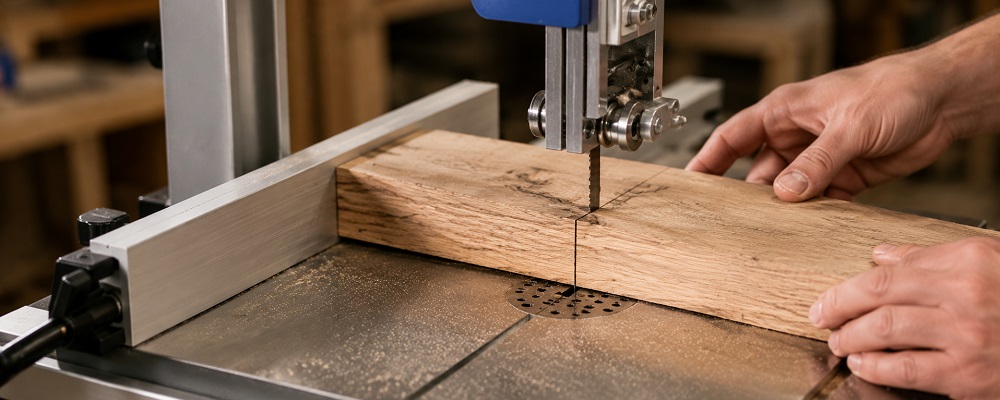
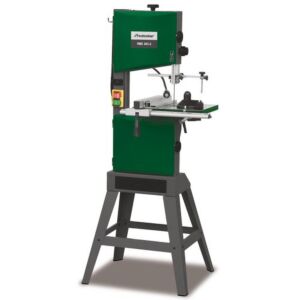
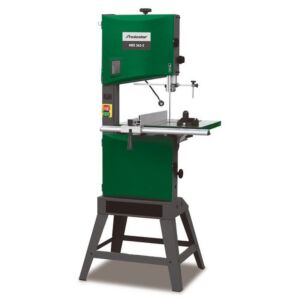
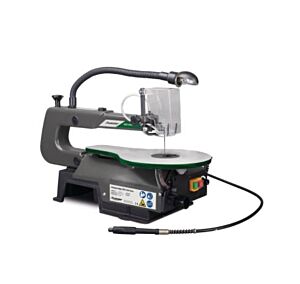
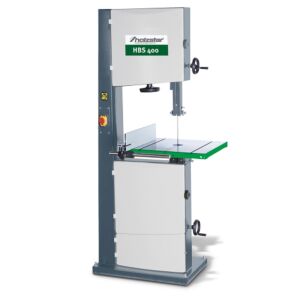
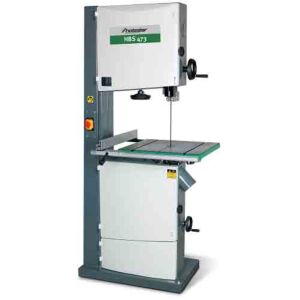
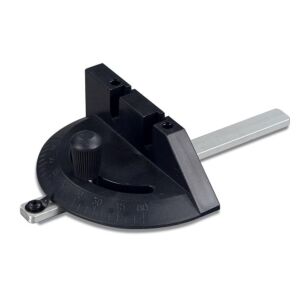
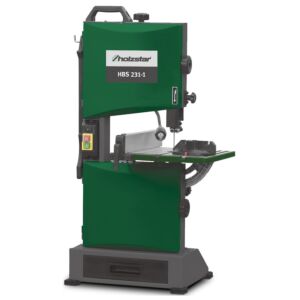
Wood band saws are vertical machines designed for straight, curved, rip, cross and angled cuts on boards, strips, panels and solid wood components. The category includes compact HOLZSTAR benchtop band saws and floor-standing models intended for larger workpieces and more continuous woodworking operations, as well as angle guides and band saw blades compatible with specific machines. The different band saws share the same operating principle but differ in their construction, table dimensions, cutting capacity, cutting height, throat capacity, adjustment options and compatibility with blades of different specifications.
The blade of a wood band saw forms a continuous loop and runs over two wheels located inside the machine structure. The working section of the blade travels vertically through the table and removes material by means of a continuous sequence of teeth. Compared with a circular saw blade, a band saw blade occupies less space in the cutting area and can be selected in different widths, allowing both straight cuts and curved work.
The blade of a band saw normally remains vertical and is not tilted to produce bevel cuts. The cutting angle is obtained by tilting the table, positioning the workpiece with an angle guide or using a suitable jig. Attempting to twist the blade sideways during cutting can cause deviation, overheating and mechanical stress that may damage the band.
The band saw table is the main reference surface for the workpiece. In its standard position, it is adjusted perpendicular to the blade in order to produce square cuts in relation to the supported face. Perpendicularity should be checked with an appropriate measuring tool and verified again after every table adjustment or maintenance operation. A table that appears to have returned to its original position may still retain a slight angular deviation if the stop is not correctly adjusted.
When the table is tilted, the workpiece remains supported on the inclined surface while the blade continues to run vertically. This configuration makes it possible to produce bevels, angled edges and compound cuts. Before starting the machine, the wheels should be turned manually or blade clearance should be checked in accordance with HOLZSTAR instructions, ensuring that the band does not interfere with the table insert, guide or other components.
During an angled cut, gravity tends to move the workpiece towards the lower side of the table. The component therefore requires more careful guidance and, whenever possible, should be positioned so that the fence supports the side towards which it tends to slide. Narrow or irregularly shaped workpieces require jigs and push devices that keep the operator's hands away from the blade.
The height of the upper blade guide on HOLZSTAR band saws should be adjusted just above the workpiece. Leaving an unnecessarily long section of blade exposed reduces lateral stability and increases the possibility of blade deflection. The blade guide should be lowered whenever the material thickness changes, while maintaining sufficient clearance for the workpiece to pass without contact.
HOLZSTAR band saws use side guides and rear thrust supports positioned above and below the table. The side guides limit lateral movement of the blade, while the rear support resists backward movement caused by feed pressure. These components should be positioned close to the blade without clamping it during free rotation.
The side guides must not contact the set section of the teeth, as this could damage the tooth geometry and affect kerf width. The rear thrust support should only come into contact when the blade is pushed backwards during cutting. Excessively tight adjustment generates friction and heat, whereas excessive clearance allows the blade to move backwards and wander from the cutting line.
Blade tension affects stability, cutting accuracy and service life. A HOLZKRAFT or HOLZSTAR blade with insufficient tension may wander through the workpiece, deviate from the cutting path and produce uneven or wavy surfaces. Excessive tension places unnecessary stress on the blade, bearings, wheels and machine frame. Tension should be adjusted according to the blade installed and checked in accordance with the manufacturer's instructions.
Blade tracking on the wheels must be checked before the guides are finally adjusted. The band should run in a stable position without moving towards the edge or backwards during manual rotation. Tracking adjustments should be made gradually. After every correction, the wheels should be rotated several times to verify that the blade position remains stable.
Blade width determines cutting flexibility. A narrow HOLZKRAFT blade can follow tighter curves but provides less stability during deep rip cuts. A wider blade maintains direction more effectively during trimming and resawing of thick boards but cannot be forced around small radii. The minimum cutting radius depends on blade width and tooth geometry.
When cutting a curve, the workpiece should be guided progressively without rotating it against the back of the blade. If the cutting line changes direction too quickly for the flexibility of the band, the blade becomes twisted and may leave the intended path. For complex profiles, relief cuts can be made from waste areas towards the final cutting line, allowing small sections of material to separate progressively during cutting.
A curved cut should not begin directly with the smallest radius when the workpiece contains a large amount of excess material. It is preferable to prepare a simpler external shape first and progressively approach the final profile. If it becomes necessary to remove the workpiece from an incomplete cut, it must not be pulled sharply backwards while the blade is moving, as the band may come off the wheels. The procedure should follow HOLZSTAR instructions and may require the machine to be completely stopped.
Tooth pitch should be selected according to material thickness and type. Several teeth should remain engaged in the material during cutting, but not so many that the available chip space is excessively reduced. A HOLZKRAFT blade with a coarser tooth pitch facilitates chip evacuation in thicker sections and rip cutting, while a finer tooth pitch produces a smoother cut on thinner materials but may clog when used in deep cuts.
Tooth shape and tooth set affect feed capacity, surface finish and kerf width. Alternately set teeth create a kerf wider than the blade body, reducing lateral friction. If the tooth set is uneven, the blade tends to drift towards the side that cuts more aggressively. HOLZKRAFT band saw blades with hardened tooth tips and a flexible back combine a wear-resistant cutting edge with a blade body capable of withstanding repeated flexing around the wheels.
During rip cutting along the grain, the blade must be able to evacuate larger chips while maintaining a stable cutting direction. The workpiece should be fed evenly, allowing the blade sufficient time to cut without excessive force. Excessive feed pressure causes deviation, overheating and possible burn marks. If cutting performance decreases, blade sharpness, tension, tooth pitch and residue build-up should be checked.
Trimming a board with an irregular edge requires a stable surface in contact with the table. A round or unstable workpiece must not be pushed directly against the blade. Logs, branches and cylindrical components should be secured in a cradle or jig that prevents rotation. Contact with the blade may otherwise pull an unstable workpiece suddenly towards the table.
For resawing tall boards, the HOLZSTAR rip fence should support the workpiece while still allowing small directional corrections when necessary. The blade should be sufficiently wide, correctly tensioned and equipped with a tooth configuration suitable for deep cuts. For long workpieces, infeed and outfeed roller supports should be aligned with the table without lifting the material.
Wood grain direction and internal stresses can cause the kerf to close behind the blade or force the workpiece sideways. The material should be observed continuously during feeding. If the cut begins to close or the workpiece becomes difficult to guide, feed force should not be increased. The operation should be stopped and the material evaluated before continuing.
Compact benchtop band saws are suitable for small workshops, model making, shaped components, decorative work and machining smaller workpieces. They should be secured to or placed on a rigid support structure that does not amplify vibration. Their portability should not compromise machine stability during cutting.
Floor-standing band saws provide a dedicated workstation, a larger working surface and a structure better suited to boards, panels and components with greater cutting height requirements. Larger models generally allow the use of longer blades and are better suited to more demanding work, but require more space around the machine and adequate support systems for long workpieces.
The worktable should be kept clean and smooth. Resin, dust and oxidation increase friction and make workpiece feeding less consistent. Suitable table maintenance products can improve sliding without contaminating wood intended for gluing or finishing. The insert surrounding the blade must be intact and correctly positioned.
Dust extraction on band saws should collect sawdust close to the lower section of the blade and inside the wheel housing, where residues are carried by the rotating wheels. Excessive build-up may contaminate running surfaces, reduce efficiency and conceal adjustment problems. The extraction system should provide sufficient airflow and filtration for wood dust.
A HOLZKRAFT blade should be inspected before installation. Cracks, irregular welds, missing teeth, permanent bends and corrosion make the band unsuitable for use. Installation must respect the correct tooth direction: on the cutting side, the teeth must travel downwards towards the table. If the teeth are facing the wrong direction, the blade must be removed and correctly reversed according to the specified procedure.
During blade replacement, the guides should be moved away before installing and tensioning the new blade. After positioning the blade on the wheels, tension and tracking are adjusted first, followed by adjustment of the upper and lower blade guides. Setting the guides before the blade is correctly tracked may conceal a tracking problem and force the band into an unnatural position.
Before purchasing a HOLZSTAR band saw, it is advisable to compare cutting height, throat capacity, table dimensions and tilt range, rip fence rigidity, availability of a mitre-guide slot, blade guide adjustment, blade tensioning and tracking systems, motor power, available speeds, dust extraction, benchtop or floor-standing construction and availability of compatible HOLZKRAFT blades.
Machine selection should be based on the workpieces that will actually be processed. Curved cuts and shaped components require compatibility with narrow blades and accurate blade guidance. Rip cutting and resawing require a rigid machine structure, adequate cutting capacity and wider blades. Users who frequently alternate between different operations should also consider how quickly and easily blades can be replaced and adjusted.
Maintenance includes cleaning the wheel housings, wheels, table and extraction system, checking blade tension, inspecting the blade guides and examining the blade condition. Resin and compacted sawdust should be removed without damaging the wheel tyres or running surfaces. All maintenance operations should be performed with the band saw disconnected from the power supply and the blade completely stationary.
HOLZSTAR wood band saws, combined with compatible HOLZKRAFT band saw blades and HOLZSTAR accessories, provide a flexible solution for professional woodworkers, cabinetmakers, furniture manufacturers, craftsmen and advanced woodworking enthusiasts. The correct combination of machine, blade width, tooth pitch, blade tension, blade guides, table angle and workpiece guidance system makes it possible to perform straight, curved and angled cuts with greater control, accuracy and repeatability.