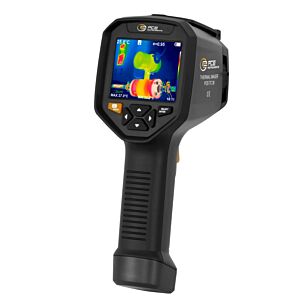
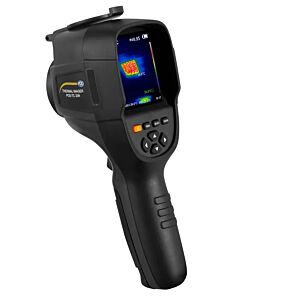
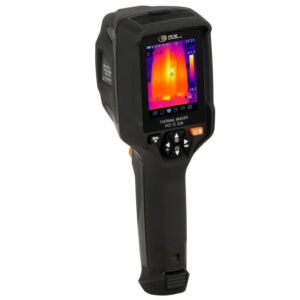
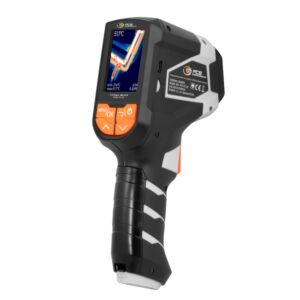
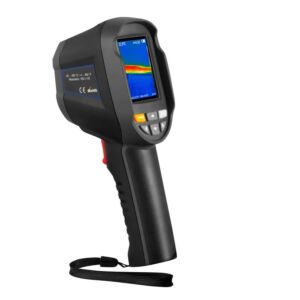
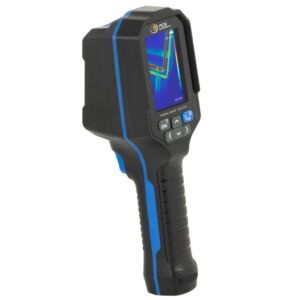
Professional thermal imaging cameras are advanced measuring instruments designed to detect, display and document temperature distribution on surfaces, components, systems and machinery. Unlike a traditional thermometer, which provides a single point value, a thermal camera generates a complete thermal image where temperature differences are represented through colour scales that are easy to interpret. This allows technicians to quickly identify hot spots, heat losses, overheating, insulation defects, abnormal friction, electrical overloads and operating issues that are often invisible to the naked eye.
In industrial applications, a thermal camera is an essential instrument for preventive maintenance and predictive maintenance. It can be used to inspect electrical panels, terminal blocks, switches, cables, motors, gearboxes, bearings, pumps, compressors, pipes, valves, moulds, ovens, process systems and mechanical components exposed to thermal load. A local temperature increase can indicate a faulty electrical contact, overload, lubrication problem, misalignment, worn bearing, transmission working with excessive friction or reduced system efficiency. For this reason, thermal imaging is widely used in production departments, workshops, quality control laboratories, maintenance companies and industries that need to reduce downtime and emergency repairs.
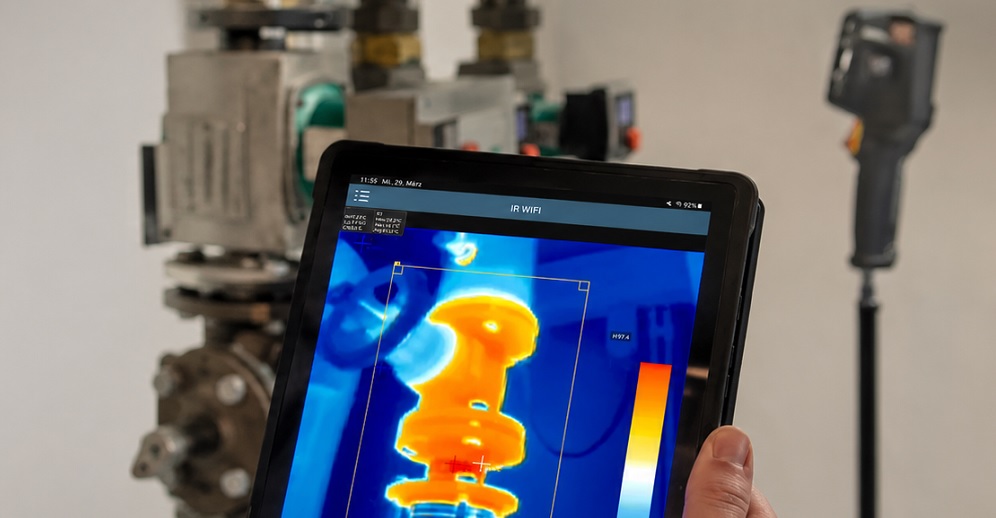
The thermal cameras available in the Tadaah temperature category include compact models for quick inspections and more advanced models for professional applications with higher IR resolution, image and video recording, internal or card memory, USB connection, WiFi, analysis software and reporting functions. Simpler models are suitable for immediate checks on electrical systems, panels, machines and technical environments, while more advanced versions are suitable for users who need documented analysis, comparison of measurements over time, storage of thermal images and creation of technical reports for maintenance, testing or quality verification.
Thermal resolution and IR sensor resolution are among the most important parameters when choosing a thermal camera. A higher IR resolution provides more detailed images and makes it easier to distinguish hot spots, thermal gradients and small temperature differences. Thermal sensitivity, often indicated as NETD, defines the instrument’s ability to detect minimal temperature variations. In applications such as detecting overheating on electronic components, checking heat loss or analysing bearings and motors, good sensitivity helps identify anomalies before they become evident failures.
The measuring range must be selected according to the application. For electrical maintenance, civil systems, HVAC and general inspections, intermediate temperature ranges are often sufficient, while ovens, moulds, industrial processes, heated metal components and high-temperature systems require thermal cameras with a wider range. In addition to the measuring range, it is important to evaluate accuracy, repeatability and adjustable emissivity, the parameter that describes how efficiently a surface emits infrared radiation. Shiny, metallic, reflective or angled surfaces can generate measurement errors if emissivity is not set correctly or if practical precautions are not followed during inspection.
A thermal camera is used by pointing the instrument at the area to be inspected and observing the temperature distribution on the display. The technician can analyse the hottest point, the coldest point, the average temperature of an area, the thermal profile of a surface or the heating trend during machine operation. Some models allow radiometric images to be saved, videos to be recorded, data to be transferred to a computer and dedicated software to be used for creating reports with images, temperatures, technical notes and comparisons. This function is particularly useful for companies that need to document maintenance work, periodic inspections, technical checks or commissioning activities.
In the electrical sector, thermal cameras make it possible to identify overheating on terminals, contactors, disconnectors, switches, transformers and connections. A hot spot may be caused by incorrect tightening, oxidation, a faulty contact or an unbalanced load. In these cases, the thermal camera helps operators act before shutdowns, damage or safety risks occur. In the mechanical sector, the instrument is used to check bearings, guides, gearboxes, pulleys, belts, motors, spindles, transmissions and moving parts. Abnormal temperatures may indicate excessive friction, insufficient lubrication, incorrect transmission clearances, misalignment or progressive wear.
Thermal cameras are also useful in quality control and production. They can be used to verify heating uniformity, component cooling, welding, bonding, moulding, heat treatments, drying processes and temperature distribution on technical surfaces. In these cases, thermal imaging does not measure dimensions, heights or form errors like a traditional metrology instrument, but it allows the operator to detect thermal anomalies that may be linked to geometric defects, uneven contact, deformation, assembly errors, heat transfer problems or incorrect process operation.
To obtain reliable measurements, the thermal camera must be used with a proper method. Before measurement, the expected temperature range should be checked, emissivity should be set correctly, reflections from metallic or shiny surfaces should be avoided, a distance consistent with the instrument resolution should be maintained and the thermal image should be interpreted according to the material, environment and operating conditions. Thermal imaging is especially effective when performed on systems in operation, because it shows the real behaviour of components under load. For comparisons over time, it is advisable to maintain the same distance, the same viewing angle, similar operating conditions and to save images or reports with clear references.
Choosing the most suitable thermal camera depends on the type of work to be performed. For quick maintenance checks, a compact model with a readable display and an adequate measuring range may be sufficient. For more advanced professional analysis, models with higher IR resolution, image memory, software, data connection, analysis functions and reporting capability are preferable. For electrical maintenance, industrial systems, fault finding, energy inspections and checks on machine tools, the thermal camera becomes a fast, safe and non-invasive diagnostic instrument that reduces intervention time and improves system reliability.
The Tadaah Thermal Cameras category is designed for technicians, engineers, maintenance operators, laboratories, quality managers, machine builders, industrial companies and professionals looking for reliable non-contact temperature control instruments. Tadaah offers solutions suitable for both routine maintenance and advanced technical inspections, with instruments designed to improve diagnostics, support technical sales and help users choose the most appropriate model. A correctly selected and properly used thermal camera allows operators to see what normally remains invisible, transforming temperature into immediate, documentable and useful technical information for faster and safer operational decisions.