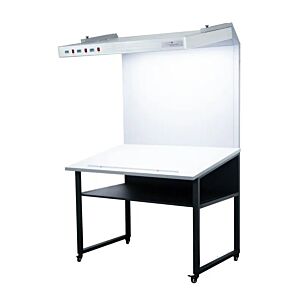
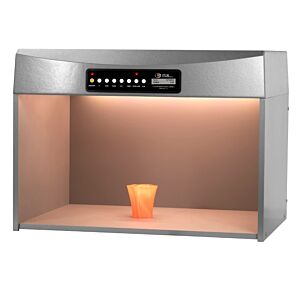
The Light Booths category includes professional instruments designed for visual colour control, colour comparison and evaluation of material appearance under controlled lighting conditions. A light booth allows samples, finished products, painted surfaces, plastic components, textiles, paper, cardboard, packaging, coatings and technical materials to be observed under standardised light sources, reducing the influence of ambient light and improving repeatability. In a quality department, laboratory or production environment, the light booth helps the technician check whether a colour matches the approved sample, whether a batch shows visible differences, whether a finish is uniform or whether a colour variation may become an aesthetic, functional or commercial issue.
Colour evaluation does not depend only on the material itself, but also on the type of lighting used. A surface may appear correct under simulated daylight but different under artificial light, cool light, warm light or retail lighting. This phenomenon is especially important in quality control because a product may be accepted in production but appear visually different at the point of sale, at the customer’s site or during final use. A light booth helps control this risk by creating a stable, repeatable and technically more reliable observation environment than a simple comparison made under uncontrolled lighting.
Professional light booths may include different light sources, such as simulated daylight, retail lighting, domestic light, cool light, warm light or specific sources for technical inspection. Some models are designed according to recognised industrial colour control procedures and reference methods. Benchtop versions are suitable for laboratories, quality offices and checks on small or medium samples, while larger booths or workstations with tables allow larger parts, panels, laid-out materials, assembled products or components requiring a wider viewing area to be analysed.
Using a light booth is simple, but it must follow a correct method. The sample to be checked and the approved reference must be placed in the viewing area in a stable, clean and representative way. The technician selects the required light source and compares the samples while maintaining a consistent viewing position. It is important to avoid shadows, reflections and random inclinations that may alter colour perception. When glossy, satin or matt surfaces are compared, the viewing angle and sample geometry may also affect the evaluation because gloss, texture and reflection modify colour perception.
In industrial quality control, light booths are used to check colour matching between standard sample and production. This is essential in sectors such as painting, plastics, rubber, automotive, furniture, packaging, printing, textiles, paper, cardboard, coated metals, coatings, profiles, windows and aesthetic components. Even a minimal colour difference can be visible when several parts are assembled together or when a product must comply with a precise visual identity. A light booth helps detect these differences before shipment, reducing complaints, rework, waste and customer acceptance problems.
In painting and surface treatment, the light booth helps check colour continuity between batches, finish appearance, differences between surfaces, correct coating application and uniformity of the result. Colour may vary due to pigments, coating thickness, substrate, drying temperature, humidity, application method, surface orientation or final gloss. For this reason, visual inspection in a light booth is an important complement to instrumental measurements performed with colourimeters, spectrophotometers and gloss meters.
In plastics and technical materials, checking in a light booth makes it possible to detect differences caused by masterbatch, additives, moulding process, temperature, ageing, light exposure, part thickness or surface finish. Two components may have the same formulation but appear different if the surface is glossier, rougher, more transparent or if the thickness changes light transmission. The light booth helps the technician evaluate the result in a more controlled way and distinguish a real colour difference from an effect caused by texture, reflection or part geometry.
In packaging, paper, cardboard and printing, the light booth is useful for comparing colour proofs, labels, packaging, print samples, cards, laminated surfaces and coupled materials. Colour is often a critical element of product identity and must remain consistent across different productions, suppliers and substrates. The light booth makes it possible to check colour rendering under repeatable conditions, evaluate metamerism and verify whether the printed sample matches the approved standard.
The choice of a light booth must consider internal dimensions, number and type of light sources, lighting uniformity, ease of light selection, source stability, booth structure, neutral interior colour, ergonomics, available space, type of samples to be observed and required level of control. Dimensions are important because the sample must be positioned correctly inside the illuminated area without being outside the viewing zone or too close to the walls. For small products, a compact benchtop booth may be sufficient, while panels, assembled components, textiles, laid-out materials or large parts require a wider booth or workstation.
Precision in colour control also depends on lighting quality and procedure repeatability. Although a light booth does not measure directly like a spectrophotometer, it creates the conditions required for controlled visual evaluation. In this context, “resolution” is not a digital value of the instrument, but the ability of the method to reveal subtle differences in hue, lightness, saturation, gloss and uniformity. To obtain reliable results, it is important to keep the booth clean, check the condition of the light sources, avoid contamination, replace lamps or components according to the manufacturer’s instructions and always use the same observation procedure.
Light booths are also useful for comparing instrumental measurement with visual perception. Colourimeters and spectrophotometers provide numerical data, such as colour differences and colour coordinates, but visual inspection remains important because the final customer evaluates the product with their eyes. The light booth connects technical data with real perception, helping determine whether a numerical difference is visually acceptable or whether a seemingly small difference is clearly perceived. This balance between instrumental data and visual evaluation is essential in advanced quality control processes.
The connection with heights, transmission backlash, form errors and geometry is indirect but technically relevant. A light booth does not measure mechanical play or geometric errors, but part geometry affects how light is reflected and perceived. A non-flat surface, deformed panel, curvature, height difference, non-constant inclination or form error may create shadows, reflections or gloss variations that change colour perception. When assembled components are checked, assembly clearances, misalignments or height differences may make colour discontinuities or finish differences more visible. For this reason, the light booth must be used while considering sample position, orientation and geometry.
In industrial applications, light booths also help reduce the subjectivity of evaluation. Without a controlled environment, colour may be judged differently depending on department lighting, time of day, sample position, operator or place of observation. A light booth creates a common comparison condition, useful for communication with suppliers, customers, production and laboratory teams. This is especially important when approving samples, resolving complaints, defining visual tolerances or comparing materials from different suppliers.
For correct use, it is advisable to establish an internal procedure. The standard sample must be stored protected from dirt, scratches, intense light or agents that may change its colour over time. Samples to be compared must be clean, dry, representative and observed in the same position. Light sources must be selected according to the type of inspection required and, when necessary, the comparison should be repeated under several light sources to check metamerism. The operator should avoid rushed evaluations and, in critical checks, it may be useful to have the sample observed by several qualified people following the same procedure.
Tadaah presents the Light Booths category as a technical reference for companies, laboratories, quality departments, technicians, engineers and professionals who need to verify colour in a repeatable and professional way. Choosing the correct light booth improves the reliability of visual inspection, reduces evaluation errors, detects colour differences, verifies metamerism, supports quality documentation and strengthens technical communication between production, suppliers and customers. To select the most suitable product, it is advisable to evaluate dimensions, light sources, uniformity, required standards, sample type, frequency of use, ergonomics and the required level of control.