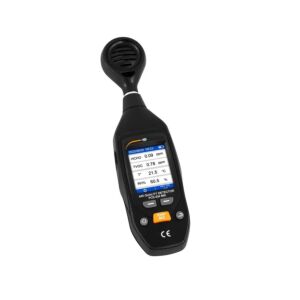
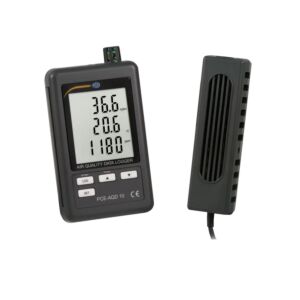
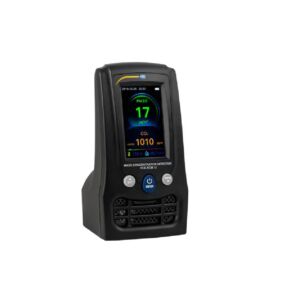
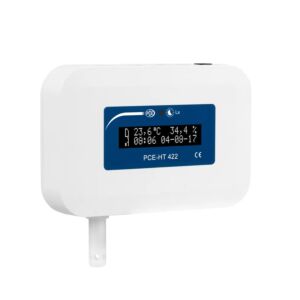
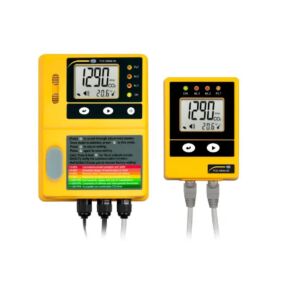
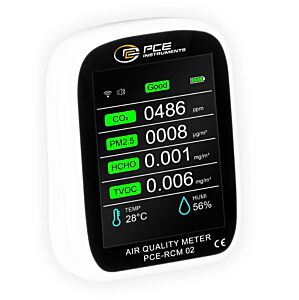
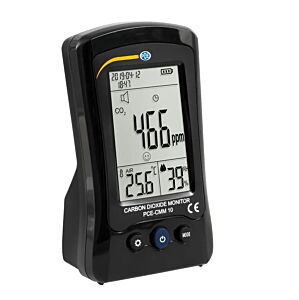
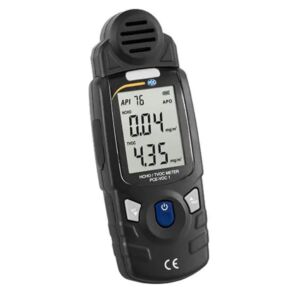
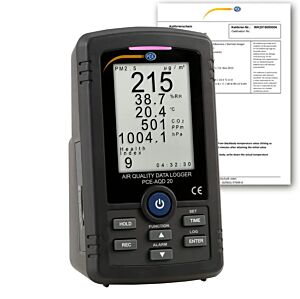
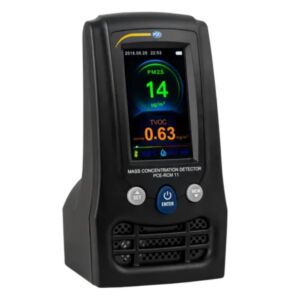
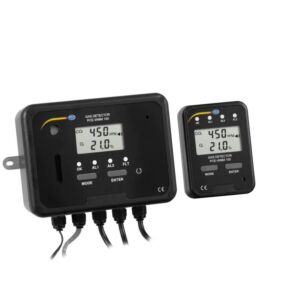
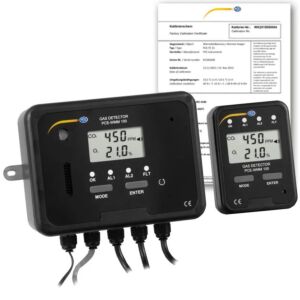
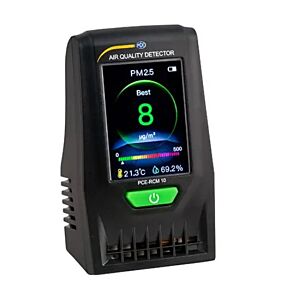
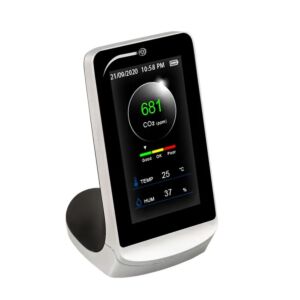
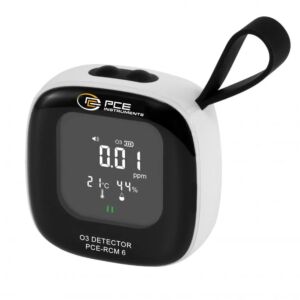
The Air Quality and CO2 category includes professional instruments designed to measure, monitor and document the main parameters of indoor air and technical environments. This category includes CO2 meters, environmental thermo-hygrometers, PM2.5 and PM10 detectors, VOC and HCHO instruments, data loggers, wall-mounted transmitters, alarm monitors, devices with remote units, portable instruments and systems for continuous control of ventilation, comfort and air quality. These instruments are essential when it is necessary to verify whether an environment is properly ventilated, whether CO2 concentration is acceptable, whether fine particles or volatile organic compounds are present and whether temperature and humidity remain within values required by the process or by operational comfort.
CO2 is one of the most commonly used parameters for evaluating air exchange in indoor environments. High concentration may indicate insufficient ventilation, overcrowding, poor air renewal, unbalanced HVAC operation or incorrect environmental management. In offices, schools, laboratories, meeting rooms, production departments and public environments, CO2 monitoring helps determine when ventilation must be increased, air exchange improved, the system adjusted or air treatment systems checked. Models with adjustable alarms warn the operator when a set threshold is exceeded, making control more immediate and practical.
Instruments for temperature and relative humidity complete air quality monitoring. Temperature affects comfort, material stability, system performance and working conditions. Humidity can influence condensation, electrostatic charges, product preservation, instrument stability, mould growth, drying, production processes and sample quality. Humidity that is too high may promote condensation, degradation, mould and corrosion; humidity that is too low may cause dryness, electrostatic charges, instability of some materials and problems in sensitive processes. For this reason, thermo-hygrometers and environmental data loggers are useful for both comfort control and technical applications.
PM2.5 and PM10 meters check fine particles and suspended particulate matter in the air. These parameters are important in workshops, laboratories, warehouses, production departments, urban environments, schools, offices, dusty areas, processing operations, ventilation and filtration. High concentration may indicate process dust, insufficient ventilation, ineffective filtration, external contamination, poor cleaning or aerosol presence. Particle monitoring helps evaluate breathable air quality, check filter efficiency and identify critical conditions before they become an operational or safety problem.
Instruments for VOC, TVOC and HCHO detect volatile organic compounds and formaldehyde, important parameters in environments where paints, solvents, adhesives, chemicals, plastics, detergents, furniture, processing operations or emission sources are present. These instruments are useful for checking indoor air quality, monitoring environments after interventions, assessing material emissions, controlling laboratories and identifying conditions that require improved ventilation or extraction. In industrial applications, VOC control helps connect air quality to the activities being performed and evaluate whether technical corrections are required.
Gas transmitters and wall-mounted monitors are suitable for continuous control. They can be installed in environments where the value must always be visible or where alarms, relays, analogue outputs or signals to ventilation systems must be activated. In HVAC systems, a CO2 transmitter can help manage ventilation according to real air quality, avoiding both insufficient air exchange and excessive ventilation. In laboratories or technical environments, continuous monitoring makes it possible to record drift, peaks, seasonal variations and non-compliant conditions.
The correct instrument must be selected according to the parameter to be measured, measuring range, accuracy, resolution, sensor type, alarms, data memory, analogue output, relays, power supply, portability, fixed or mobile installation, display, autonomy, USB interface, certification and operating environment. Accuracy indicates how close the measured value is to the real or reference value, while resolution indicates the smallest variation readable by the instrument. In professional checks both parameters must be evaluated, because a very detailed reading does not automatically guarantee correct measurement if the sensor is not stabilised, if the instrument is badly positioned or if the environment is not representative.
Reliable measurements require correct instrument positioning. A CO2 or air quality meter should not be placed too close to windows, doors, ventilation outlets, heat sources, operators, machines, cold walls or non-representative points. Installation height must be consistent with the breathing zone or measurement objective. A sensor mounted too close to an air supply outlet may show better values than the actual occupied zone; an instrument near an emission source may show higher values than the average environment. To compare data over time, it is important to maintain the same measuring point.
In preventive maintenance, air quality and CO2 instruments help identify problems before they become critical. A progressive increase in CO2 may indicate dirty filters, insufficient air exchange, unbalanced ventilation, higher room occupancy or HVAC malfunction. An increase in particulate matter may indicate saturated filters, process dust, poor extraction or entry of external contaminants. Abnormal humidity values may indicate condensation, infiltration, dehumidification problems or mould risk. Data recording makes it possible to build a history and compare environmental behaviour before and after interventions.
In corrective maintenance, these instruments support the diagnosis of existing problems. If an environment feels uncomfortable, if operators report heavy air, if condensation forms, if a laboratory does not maintain stable conditions or if an HVAC system does not guarantee the expected result, monitoring CO2, temperature, humidity, particulate matter and VOC helps determine whether the problem comes from ventilation, filtration, air exchange, internal sources, system adjustment or external environmental conditions. The measured data becomes objective support for deciding how to intervene.
In quality control and laboratories, air quality monitoring is important when environmental conditions affect products, samples, instruments or processes. Temperature and humidity can influence sensitive materials, weighing operations, tests, electronic instruments, hygroscopic samples, drying processes, preservation and stability. Particles and VOCs can interfere with surfaces, coatings, adhesives, electronic components, optical instruments or laboratory processes. For this reason, controlling air does not only mean improving comfort, but also protecting quality and repeatability of technical work.
The connection with heights, transmission backlash, form errors and geometry is indirect but technically important. Air quality, temperature and humidity can influence machines, materials and components. Thermal variations can cause expansion, modify dimensions and influence geometric stability. High humidity can promote corrosion on guideways, planes, instruments and metal components, altering support surfaces, sliding and couplings over time. Dust and particles can settle on guideways, sensors, encoders, measuring instruments, surface plates and mechanical parts, contributing to wear, friction, loss of smooth movement, clearance variation and precision problems.
In a workshop, metrology laboratory or production department, uncontrolled air can therefore indirectly influence product quality. Dust on measuring surfaces can generate dimensional errors. Unstable humidity and temperature can affect instruments, samples and components. Inconsistent environmental conditions can reduce repeatability of inspections, assemblies and machining. Air quality and CO2 instruments do not directly measure geometries or mechanical backlash, but they help control environmental parameters that can affect dimensional stability, reliability and system life.
An important practical recommendation is to distinguish between quick monitoring and continuous monitoring. An instant measurement is useful for an immediate check, but it does not always describe environmental behaviour throughout the day. A data logger or continuous monitor makes it possible to see peaks, variations, cycles, differences between time periods, the effect of occupancy and HVAC response. For technical environments, schools, crowded offices, laboratories and production departments, it is often useful to record for several hours or days in order to identify the real problem and not only the value at a single moment.
Tadaah presents the Air Quality and CO2 category as a technical reference for companies, technicians, engineers, maintenance specialists, laboratories, technical offices and quality departments that need to monitor indoor air, ventilation, particulate matter and environmental parameters professionally, reliably and in a documentable way. Correct selection of CO2 meters, thermo-hygrometers, PM2.5 and PM10 detectors, VOC instruments, data loggers and wall-mounted transmitters helps improve comfort, safety, HVAC maintenance, quality control, environmental stability and technical management of indoor spaces.