Holzstar and NEBES Elettromeccanica cylindrical sanding machines for wood include different operating systems designed to even out surfaces and thicknesses, remove previous machining marks, finish edges and profiles and prepare components for painting, oiling, bonding or coating. The category covers conveyor-fed drum sanders and manually operated sanding and polishing machines with pneumatic rollers, providing solutions for flat boards and panels as well as shaped parts, edges, profiles and furniture components.
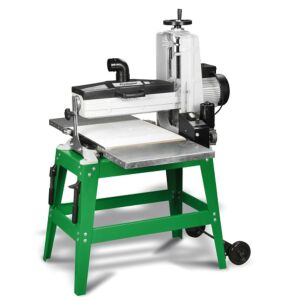
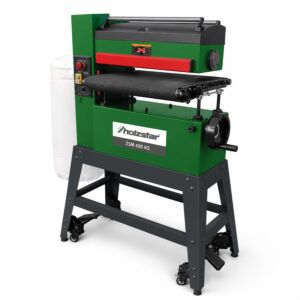
Holzstar drum sanders use a rotating abrasive-covered cylinder positioned above a conveyor belt. This configuration is suitable for boards, glued panels, cabinet doors, shelves, worktops, solid-wood elements and components requiring an even surface and consistent thickness. Vertical adjustment sets the distance between drum and conveyor, while the feeding system controls how long the abrasive acts on the surface.
The primary purpose of a Holzstar drum sander is to remove limited amounts of material progressively and consistently. It should not be used like a thickness planer for heavy stock removal in a single pass. Excessive depth can slow the drum, overheat the wood, clog the abrasive and overload the motor. Light, repeated passes improve surface consistency, reduce burning and extend abrasive life.
The Holzstar sanding drum must remain parallel to the conveyor. Unlike other abrasive units, it is not normally tilted to produce bevels because its function is to maintain consistent workpiece thickness across the working width. Available adjustments change the working height and correct parallelism. Incorrect alignment can produce a component that is thinner on one side or leave an unevenly sanded strip.
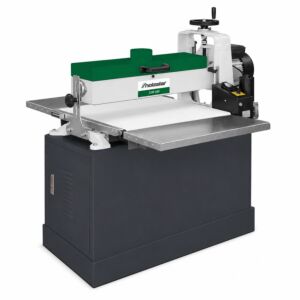
Open-sided Holzstar configurations can process panels wider than the directly covered sanding area by using complementary passes according to the manufacturer’s procedure. Stable support and accurate drum alignment are essential because an incorrect setting may leave a ridge or visible line where the two passes overlap. Test pieces and shallow passes are recommended before finished panels are processed.
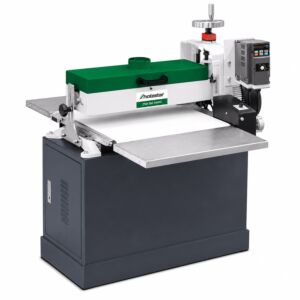
Closed-sided machines are intended for components within the usable working width and provide more symmetrical lateral support. Models with an integrated cabinet offer a stable working position and can simplify workshop organisation. Choosing between open and closed construction depends on panel width, available space, operating frequency and required accuracy.
Holzstar drum sanders may incorporate adjustable conveyor feeding. A slower feed increases abrasive contact and produces more intensive sanding, but it also generates more heat. A faster feed improves productivity and reduces the time beneath the drum, although coarse grit or excessive depth may leave more visible marks. Feed speed, grit and sanding depth must therefore be adjusted together.
Before sanding, the workpiece should have at least one sufficiently flat and stable face resting on the conveyor. A bowed board may be compressed during passage and return to its original shape after leaving the machine without being genuinely flattened. Holzstar sanders refine and even a surface that can already be supported correctly; they do not replace the process required to create the first reference face on a severely distorted component.
The conveyor belt must remain clean, centred and correctly tensioned. Dust, resin and adhesive residue can reduce grip and cause the workpiece to wander. The component should enter straight without lateral pushing and be supported at the exit without being lifted. Long boards and panels require extensions or roller supports aligned with the conveyor so that their weight does not change the entry or exit angle.
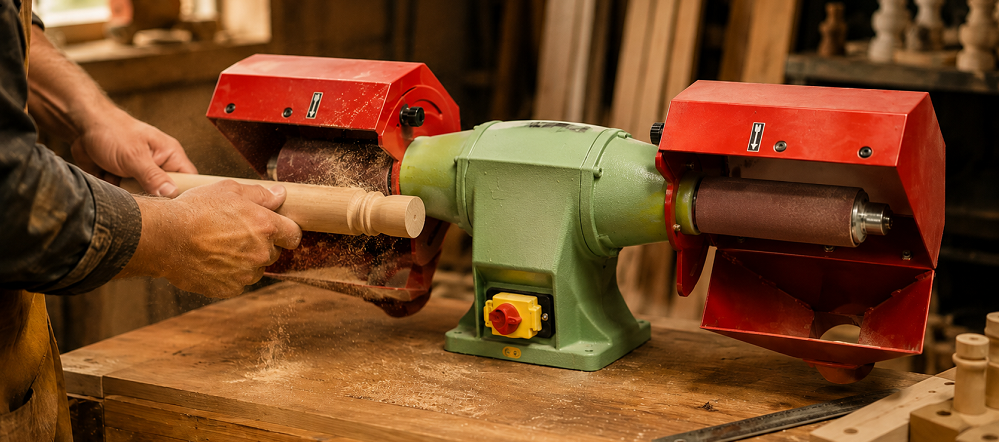
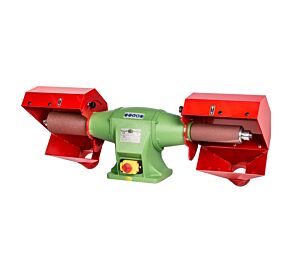
NEBES Elettromeccanica sanding and polishing machines use cylindrical pneumatic rollers fitted with abrasives suitable for the intended operation. The workpiece is manually guided against the roller rather than automatically transported beneath it. This arrangement is suitable for edges, profiles, curved components, transitions, localised surfaces and parts that cannot be processed effectively on a conveyor-fed drum sander.
A NEBES Elettromeccanica pneumatic roller can conform to the workpiece more effectively than a rigid drum. Internal pressure and covering flexibility allow the abrasive to follow gentle curves and minor irregularities without concentrating all force along one line. Higher pressure provides a firmer working surface and more decisive action, while lower pressure increases conformity. Adjustment must always remain within the manufacturer’s specified limits.
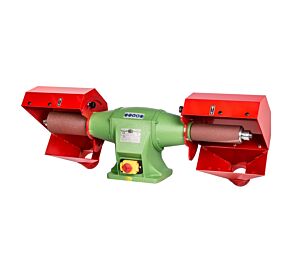
NEBES Elettromeccanica machines with two working stations can be prepared for different processes on the same unit. Different abrasive grits can be fitted so that one side performs initial sanding and the other finishing, or the rollers can be configured for flat, shaped or profiled surfaces. This reduces tool changes and speeds up movement between preparation and final finishing.
During use, the component must be held securely and presented to the NEBES Elettromeccanica roller in an orientation that allows the abrasive reaction to remain controlled. The workpiece must not be positioned where rotation could pull it in, lift it or throw it towards the operator. Rotation direction should be checked before sanding, and the roller sector that tends to keep the component under control should be used.
Straight edges can be processed with the component maintained parallel to the roller axis, while profiles and transitions require gradual movements following the workpiece geometry. Contact should be distributed and the component kept moving to prevent hollows. Ends should not remain against the abrasive longer than the rest of the surface because they can round very quickly.
Holzstar drum sanders and NEBES Elettromeccanica pneumatic-roller machines therefore meet complementary requirements. Holzstar machines are intended for controlled calibration and surface levelling of flat components, while NEBES Elettromeccanica machines provide greater freedom for manually finishing edges, curves, profiles and local areas. The correct choice depends on workpiece geometry, required stock removal, repeatability and the need to maintain uniform thickness.
Abrasive grit should be selected for the working stage. Coarse abrasives remove marks, fully cured adhesive residue and minor level differences quickly but leave deeper scratches. Medium grits refine the surface after rough sanding, while fine grits prepare the component for finishing. Progressive grit changes prevent deep scratches from remaining visible beneath paint, oil or coating.
Grain direction should be considered on both Holzstar and NEBES Elettromeccanica machines. Wherever possible, sanding should follow the grain. Glued panels and components with changing grain directions require lower pressure and shallow passes. End grain and resinous timber need particular care because they can overheat or clog the abrasive quickly.
The abrasive used on a Holzstar drum is normally wrapped uniformly around the cylinder and secured at both ends using the machine’s retention system. Overlaps, folds and irregular spacing may cause vibration and repeated surface marks. After replacement, the abrasive should be checked and the machine tested without a workpiece. Changing grit can alter the effective abrasive thickness and require a new height setting.
Only abrasives compatible with the dimensions, attachment system, speed and intended use should be fitted to NEBES Elettromeccanica shafts and pneumatic rollers. An incorrectly centred accessory can generate vibration and uneven removal. Rollers, sleeves and retention systems must be inspected for condition and correct installation before starting.
Excessive pressure does not increase productivity proportionally. On Holzstar machines it can overload the drum and conveyor; on NEBES Elettromeccanica equipment it may deform the pneumatic roller excessively, round the component or overheat the surface. Abrasive grains should perform the cutting action through a steady feed and moderate pressure.
Dust extraction is essential because both systems generate fine particles. Holzstar drum sanders require effective collection across the working width, while NEBES Elettromeccanica machines need extraction capable of capturing dust produced at the front working stations. Insufficient extraction clogs the abrasive, raises temperature, reduces visibility and releases more dust into the working environment.
Maintenance includes cleaning abrasives, conveyor belts, rollers, retention systems and extraction ports. Holzstar machines require checks of drum parallelism, conveyor tracking and feed regularity. NEBES Elettromeccanica units require inspection of pneumatic rollers, shafts, guards and fitted accessories. All maintenance must be performed with the machine disconnected and completely stationary.
Before purchasing, consider the operation, workpiece dimensions, flat or shaped surfaces, calibration requirements, feeding method, rigid or conformable sanding action, available adjustments, electrical supply, extraction and abrasive availability. Holzstar provides conveyor-fed drum sanding for boards and panels, while NEBES Elettromeccanica offers flexible pneumatic-roller machines for manually cleaning and finishing edges, profiles and shaped wooden components.