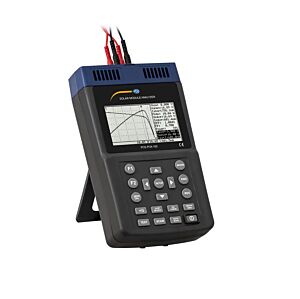
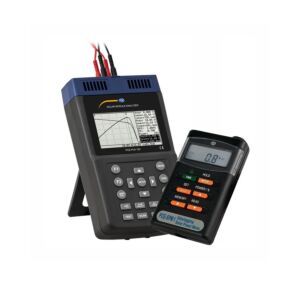
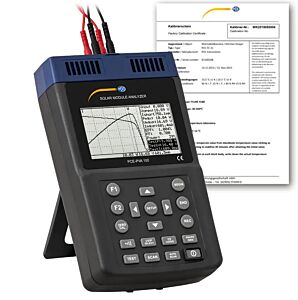
The Photovoltaic Meters category includes professional instruments designed to check, measure and document the electrical and functional behaviour of solar panels, photovoltaic modules, strings, PV systems and DC installations. These instruments are used to verify voltage, current, power, solar irradiance, module yield, operating conditions and real system performance. In a photovoltaic system, it is not enough to know that the panel is connected and producing energy; it is necessary to understand whether it is producing correctly in relation to available sunlight, whether the string is operating consistently and whether losses, faults, shading, defective connections or differences between modules are present.
A photovoltaic meter is used during installation, commissioning, preventive maintenance, corrective maintenance and technical diagnosis. During installation, it verifies that modules are correctly connected, electrical values match the design and no wiring, polarity, contact or connection faults are present. During maintenance, it allows system performance to be compared over time, production drops to be identified, suspicious strings to be checked and the technical condition of the system to be documented. In laboratories and quality departments, these instruments make it possible to compare modules, verify samples and analyse electrical behaviour under controlled conditions.
Instruments in this category may include solarimeters, photovoltaic module testers, DC measuring instruments, panel checking devices, tools with ISO certificate, kits with multiple measuring units and accessories for irradiance control. A solarimeter is particularly important because it measures the solar radiation available on the test surface. Without this value, low production could be wrongly interpreted as a panel fault, while it may simply depend on poor light conditions, incorrect inclination, cloudy sky, dirt, shading or unfavourable orientation.
Accuracy and resolution are essential elements. Accuracy indicates how close the measured value is to the real value, while resolution indicates the smallest variation readable by the instrument. In photovoltaic applications these parameters are important because small differences in voltage, current or irradiance can reveal connection problems, module degradation, differences between strings, performance loss or uneven operation. An instrument with good resolution allows finer variations to be observed, but measurements must always be interpreted according to environmental conditions and test method.
When checking a photovoltaic system, the technician must consider several factors: panel orientation, inclination, module temperature, irradiance intensity, shading, surface dirt, cable condition, connectors, inverter, protections and string continuity. A non-compliant electrical value may be caused by a faulty module, but also by an oxidised cable, loose connector, shaded cell, exposure difference, damaged bypass diode or leakage. A photovoltaic meter helps transform these checks into technical data rather than simple visual evaluations.
In preventive maintenance, these instruments allow the system to be checked periodically and performance drops to be identified before they become significant production losses. A dirty panel, degraded module, string with lower current than the others, unstable connection or unexpected shadow can reduce overall yield. Regularly measuring current, voltage and irradiance makes it possible to create a history, compare measurements over time and schedule cleaning, repair, replacement or more detailed electrical inspections.
In corrective maintenance, a photovoltaic meter is useful when the system produces less than expected, when the inverter reports an anomaly, when a string is not operating correctly or when a module shows different performance compared with the others. The technician can compare measurements between strings, verify available current, check open-circuit voltage, evaluate solar radiation at the time of the test and distinguish an electrical problem from an environmental condition. This reduces diagnostic time and allows more targeted interventions.
The connection with heights, transmission backlash, form errors and geometry is indirect but relevant in the context of installation and system yield. Photovoltaic meters do not directly measure mechanical play or geometric errors, but panel performance can be influenced by inclination, mounting height, structural flatness, orientation, support deformation, module misalignment and frame stability. An incorrectly installed structure may create shading, dirt accumulation, mechanical stress on modules, exposure differences and therefore production variations. In this sense, electrical data can also help highlight issues related to the physical installation of the system.
In industrial applications, photovoltaic meters are used on systems installed in factories, warehouses, production areas, ground-mounted plants, rooftop systems, canopies and technical installations where energy production continuity is important. They are useful for installers, maintenance technicians, energy managers, electrical technicians and engineers who need to check production, optimise yield and document operating conditions. In professional contexts, providing measured data improves the quality of technical service and helps explain to the customer the cause of a problem or the need for intervention.
An important practical recommendation is to perform measurements under conditions that are as stable and documented as possible. It is useful to record date, time, irradiance, temperature, weather conditions, panel orientation, inclination, measuring point and detected values. Measurements taken at different times of day may not be comparable if irradiance changes. Temperature also affects module behaviour: as temperature increases, panel voltage may decrease. For this reason, when comparing modules or strings, tests should be performed under the same conditions or interpreted correctly according to context.
Tadaah presents the Photovoltaic Meters category as a technical reference for companies, technicians, engineers, maintenance specialists, installers, laboratories and quality departments that need to check solar panels and PV systems professionally, reliably and in a documentable way. Choosing the correct instrument helps improve commissioning, preventive maintenance, fault diagnosis, performance verification, irradiance control and technical documentation quality. To select the most suitable product, it is advisable to evaluate the parameters to be measured, voltage and current range, accuracy, resolution, certification, accessories, test mode, ease of use and real system conditions.