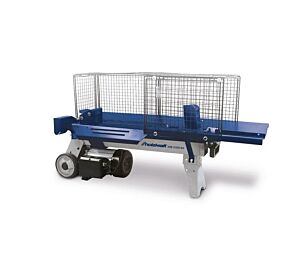
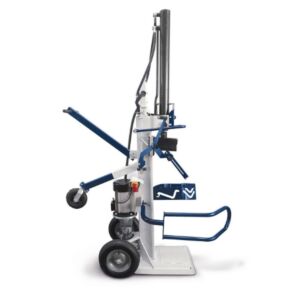
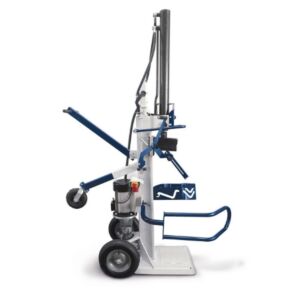
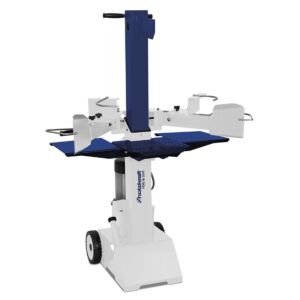
HOLZKRAFT and HOLZSTAR log splitters are designed to divide logs and timber sections along the grain, supporting firewood preparation and the recovery of suitable trunks and wood offcuts. The category includes portable horizontal HOLZKRAFT log splitters, heavy-duty vertical HOLZKRAFT machines and compact vertical HOLZSTAR splitters. These configurations use the same principle of a splitting wedge driven by mechanical or hydraulic force but differ in working position, capacity, size and loading method.
A log splitter does not remove material in the same way as a saw, planer or milling cutter. The wedge on a HOLZKRAFT or HOLZSTAR splitter penetrates the log and concentrates force over a narrow area, progressively opening the fibres. The timber separates according to grain direction, existing cracks, knots and variations in its internal structure.
Workpiece position depends on machine configuration. On a horizontal HOLZKRAFT splitter, the log lies lengthwise on the cradle or working beam between the wedge and ram. On vertical HOLZKRAFT and HOLZSTAR splitters, the log stands on its cut end on the base or support table while the wedge acts vertically along its length.
The horizontal HOLZKRAFT configuration makes loading manageable logs straightforward because the component remains supported by the beam throughout the cycle. This arrangement is suitable for domestic firewood preparation, garden and property maintenance and moderate quantities of timber. Side supports and protective structures help contain the split sections as they separate.
Vertical HOLZKRAFT splitters allow more demanding logs to remain on a low base rather than being lifted onto a raised horizontal beam. Robust vertical machines are suitable for frequent firewood production, agricultural use, grounds maintenance and difficult hardwood or irregular timber.
Compact vertical HOLZSTAR splitters provide an intermediate solution for workshops, homes, farms and users who require reduced machine dimensions while preferring an upright working position. Side tables support the separated portions and simplify repositioning for further splitting.
The wedge on a HOLZKRAFT or HOLZSTAR machine is normally perpendicular to the support surface and should penetrate along the main grain direction. Its position or angle must not be modified arbitrarily. Wedge geometry converts ram movement into lateral force that widens the opening and separates the fibres.
Correct log orientation is essential. The component should stand or lie on an end cut sufficiently square to prevent tilting under pressure. A strongly angled end may allow the log to slide sideways as the wedge engages. The end should be recut or another stable position selected where permitted.
Existing natural cracks can provide effective starting points. Aligning the HOLZKRAFT or HOLZSTAR wedge with a visible split often reduces initial resistance. On logs containing large knots, forks or twisted grain, the entry point should avoid the centre of the knot whenever practical.
Large-diameter timber does not always need to be split through its centre first. Progressive splitting from the outer edge can remove smaller sections with more controlled resistance. After the first opening, the log is repositioned for additional divisions. Repositioning is performed only with the HOLZKRAFT or HOLZSTAR wedge stationary and returned to the specified position.
Logs must be processed individually. Stacking two pieces or positioning them unstably side by side may cause sudden movement and ejection. Loose packing should not be used to compensate for crooked ends. Only supports and accessories approved for the HOLZKRAFT or HOLZSTAR machine should be fitted.
Two-hand controls, where provided, require both hands to remain on the levers during splitting. This reduces the possibility of reaching towards the wedge or the pressurised log. Controls must never be tied, blocked or modified for one-handed operation.
Before the cycle starts, the log must be stable and aligned with the force direction. It must not be corrected manually while the wedge is moving. If the piece tilts or shifts, the controls should be released and the component repositioned only after all movement and pressure have stopped.
Wedge or ram return travel affects productivity. When a HOLZKRAFT or HOLZSTAR model allows the return position to be limited, it can be set according to the usual log length to avoid unnecessary full travel. The setting must still provide enough clearance for safe loading and removal.
Splitting force is an important purchasing factor but should not be considered alone. Required force depends on log diameter, length, moisture, species, knots and grain. Straight, knot-free wood may separate readily, while a smaller log with interlocked fibres may require substantially more effort.
Log dimensions must remain compatible with the HOLZKRAFT or HOLZSTAR structure. An excessively long component may not enter the working area or allow full wedge return. An oversized log can become unstable on the base, exceed the supports or be too heavy to handle safely.
Green and seasoned timber can behave differently. Some species split more readily at a particular moisture level, while others become more brittle after seasoning. Selection of a HOLZKRAFT or HOLZSTAR splitter should therefore consider species and material condition as well as average dimensions.
A log trapped on the wedge must not be struck or pulled while the machine is running. The operator should follow the manufacturer’s release procedure, return the system to its safe position and use only the specified method. Hands, feet and improvised tools must never enter a pressurised zone.
Wheels allow HOLZKRAFT and HOLZSTAR splitters to be moved within the workplace, but transport wheels do not automatically make a machine suitable for road towing. Before moving, the wedge, cylinder, controls and support tables must be placed in their transport positions. The route should be firm and clear, especially for tall vertical machines.
The installation surface must be solid, level and capable of carrying the machine and forces generated during splitting. A HOLZKRAFT or HOLZSTAR splitter should not operate on unstable, steeply sloping or soft ground. Sufficient room is required for unprocessed logs and split sections without obstructing access to the controls.
Electrical compatibility must be checked before installation. Cables and extensions must suit the machine and working environment, remain protected from moving logs and not create trip hazards. The electrical configurations available across HOLZKRAFT and HOLZSTAR machines allow selection for domestic, workshop or professional supplies.
The hydraulic system requires regular inspection. Leaks, damaged hoses, loose fittings and irregular movement require the machine to be stopped. High-pressure leaks must never be searched for with bare hands. Hydraulic oil, service intervals and inspection methods must follow HOLZKRAFT or HOLZSTAR instructions.
The wedge must remain intact, clean and free from deformation. It is not sharpened like a saw blade; its profile must open the fibres without becoming excessively thin or fragile. Work on the HOLZKRAFT or HOLZSTAR wedge must preserve its specified geometry. Unauthorised welding, extensions and modifications may alter strength and load distribution.
Before purchasing, users should compare horizontal or vertical configuration, splitting force, acceptable log dimensions, working stroke, cycle speed, return adjustment, loading height, side supports, guarding, two-hand control, transport wheels, overall dimensions, electrical supply, structural stability and spare-part availability. Selection between HOLZKRAFT and HOLZSTAR should reflect timber volume, common species and the operator’s ability to handle the logs.
A horizontal HOLZKRAFT splitter suits manageable logs and users seeking a portable, straightforward machine. A compact vertical HOLZSTAR splitter supports work in restricted areas and easy repositioning of split sections. Heavy-duty vertical HOLZKRAFT machines are intended for more difficult logs and more intensive operating cycles.
Maintenance includes cleaning the beam or base, inspecting the wedge and guides, checking the hydraulic circuit, testing the controls and keeping the motor clear. Bark and splinters must not accumulate around sliding areas. Work must be performed with the HOLZKRAFT or HOLZSTAR splitter switched off, disconnected and relieved of residual pressure according to the specified procedure.
HOLZKRAFT and HOLZSTAR log splitters provide differentiated solutions for homeowners, farmers, grounds-maintenance operators, forestry users, firewood suppliers, joinery businesses and workshops recovering suitable timber offcuts. Correct selection of horizontal or vertical operation, stable log placement and proper use of the controls enable regular firewood preparation with reduced manual effort.