Complete Guide to Abrasive Wheels
Abrasive wheels are fundamental tools in manufacturing, where precision, efficiency, and durability are critical factors for final product quality. This manual aims to provide a detailed overview of different types of abrasive wheels, analyzing their composition, applications, operational parameters, and maintenance best practices.
The correct wheel selection depends not only on the material being processed but also on the type of machining, required surface finish, and specific operating conditions. A poorly chosen abrasive can lead to unsatisfactory results, premature equipment wear, or, in the worst cases, damage to the workpiece. Therefore, this guide explores not only the technical characteristics of each wheel but also the risks associated with their use, such as loading, overheating, and loss of flatness.
Special attention is given to dressing, an often-underestimated but essential operation for maintaining optimal wheel performance. Proper dressing ensures stable machining, reduces downtime, and extends the abrasive's service life.
This manual is structured to offer quick reference through summary tables while also providing in-depth explanations for those needing a comprehensive understanding of the processes. From automotive and aerospace applications to non-ferrous metals and ceramics, each chapter covers specific aspects with practical examples and operational advice.
Whether you are a technician, machine operator, or designer, this guide serves as a reliable technical reference to optimize production processes and improve machining quality.
White Aluminum Oxide (WA)
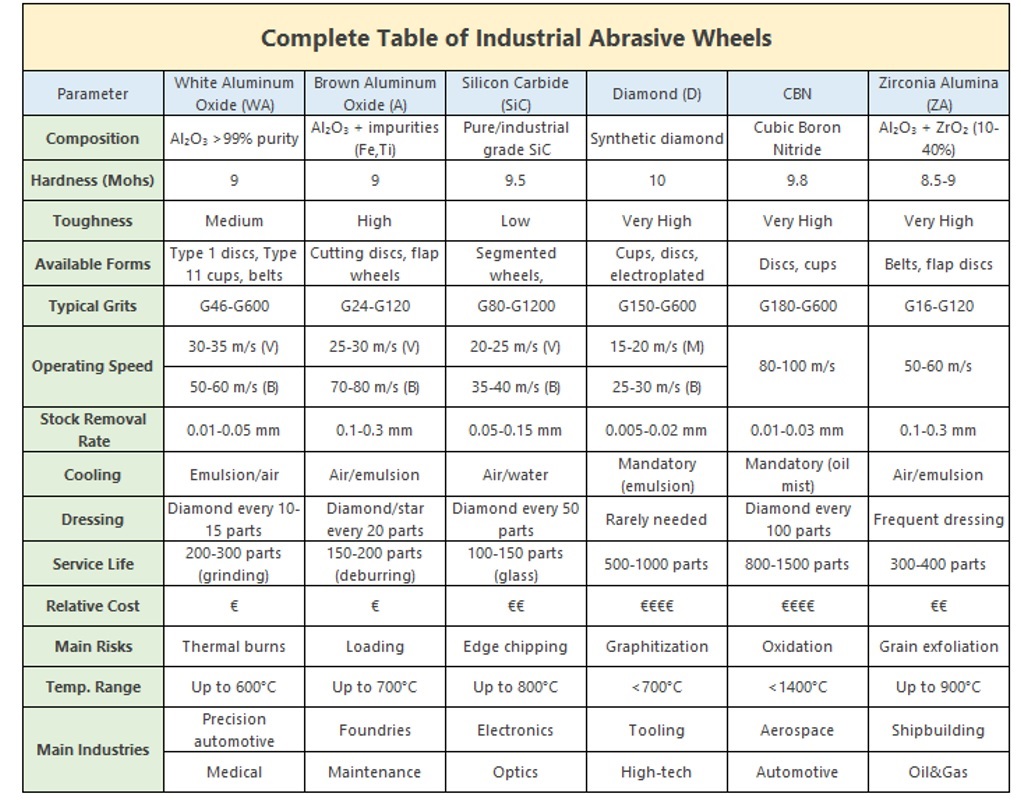
White aluminum oxide, composed of high-purity aluminum oxide (Al₂O₃ > 99%), is used in industries where precision and thermal control are critical, such as automotive and medical. In camshaft or valve grinding, it ensures a surface finish below Ra 0.8 μm due to its friable structure, which keeps grains sharp. However, if not periodically dressed with diamond tools, the wheel dulls, increasing machining temperatures and the risk of thermal burns (especially on hardened steels). For HSS tool sharpening (e.g., drills, milling cutters), the optimal stock removal is 0.01–0.05 mm/pass, with grit sizes G80–G220 depending on the desired finish.
In aerospace, where titanium or nickel-chromium alloys are machined, white aluminum oxide is preferred for minimizing thermal stress. However, prolonged use without dressing reduces hardness and causes uneven wear, compromising component flatness. For this reason, CNC grinders use automatic dressing cycles every 10–15 parts.
Brown Aluminum Oxide (A)
Due to its higher toughness, brown aluminum oxide is widely used in foundries for deburring cast iron or steel parts, where dimensional tolerances are less strict but mechanical stress is high. In shipyards or railway maintenance, resinoid cutting discs enable heavy-duty grinding, with stock removal up to 0.2 mm/pass on rough welds.
A typical risk is loading (metal buildup) when pressure is excessive or the grit is too fine for the material. For example, undressed G60 wheels on cast iron can accumulate metal on the abrasive surface, reducing cutting efficiency and increasing energy consumption. To prevent this, star dressers and wheel concentricity checks are essential after each use.
Silicon Carbide (SiC)
Ideal for non-ferrous metals and ceramics, silicon carbide is key in electronics for silicon wafer dicing and in optics for lens grinding. Its brittle nature makes it unsuitable for high-strength steels but excellent for glass, brass, and tungsten carbide. In granite polishing, metal-bonded wheels (G220–G500) remove 0.05–0.1 mm/pass, ensuring uniform finishes.
The main risk is grain fracture under heavy loads, leading to flatness loss in optical machining. For tempered glass, electroplated diamond wheels are preferred, while SiC is reserved for pre-polishing.
Diamond (D) & CBN
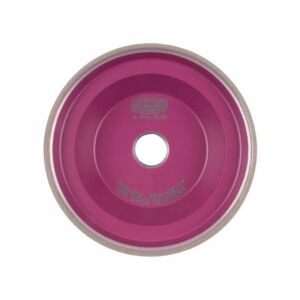
These superabrasives dominate high-tech sectors: diamond for carbides/ceramics, CBN for steels >50 HRC. For tooling inserts, metal-bonded diamond wheels remove 0.005–0.02 mm/pass with micron-level precision. However, inadequate cooling causes diamond graphitization (>700°C), while CBN oxidizes above 1,400°C.
In automotive, crankshaft grinding with CBN (G180–G320) requires 80–100 m/s speeds and wear monitoring to avoid microcracks. Loading is rare, but chip accumulation in wheel pores can affect finishes.
Zirconia Alumina (ZA)
Used for aggressive grinding of stainless steel and nickel alloys, ZA offers extended life due to its self-sharpening properties. In shipbuilding, G40 ZA belts remove up to 0.3 mm/pass in surface prep for painting. Excessive pressure may cause grain shedding, reducing wheel life.
Dressing of Abrasive Wheels
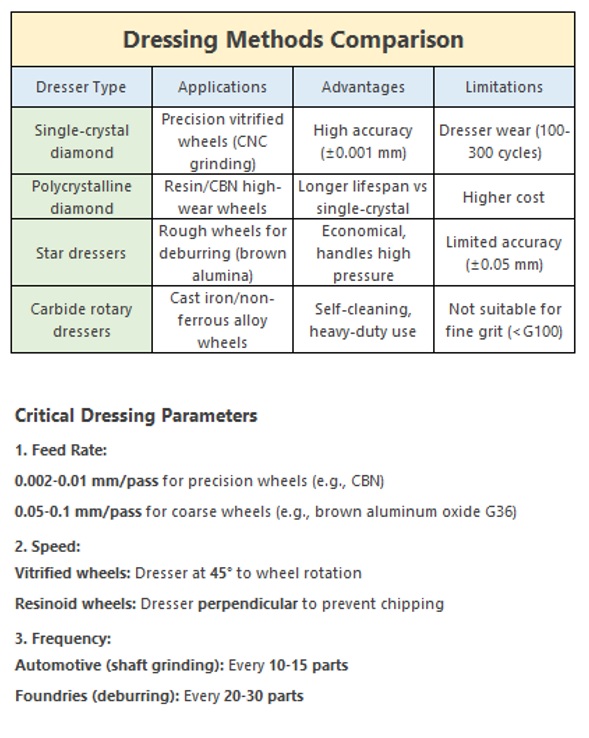
Dressing is a fundamental operation in abrasive wheel machining, consisting of restoring the wheel's geometry, flatness, and cutting ability when it becomes worn, dull, or clogged.
A proper dressing operation determines 70% of a wheel's performance. Perfect dressing can increase a wheel's average lifespan by 50%, while also improving workpiece quality.
Dressing is performed to sharpen and reshape a wheel through the following actions:
- Removal of dull grains (exposed but no longer sharp)
- Elimination of loading (accumulations of workpiece material embedded in the wheel)
- Restoration of porosity (to allow chip evacuation)
If dressing is not performed, several issues arise:
- Reduced performance: Decreased material removal rate and overheating
- Poor quality: Irregular surfaces, thermal burns (on steels)
- Safety risks: Dynamic imbalances that may fracture the wheel
Common Errors to Avoid in Dressing
Due to insufficient precision in dressing, the following problems may occur:
- Insufficient dressing: The wheel appears "glazed" but does not cut (sign of still-dull grains)
- Excessive pressure: Chipping of abrasive grains
- Asymmetric dressing: Uneven wear causing vibrations
Proper dressing is essential for maintaining optimal cutting efficiency, surface finish, and wheel longevity.