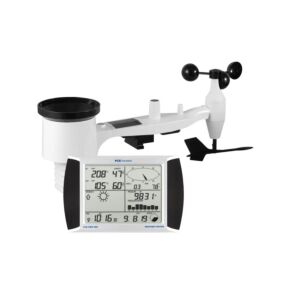
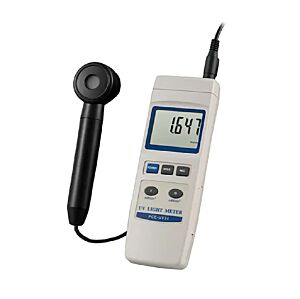
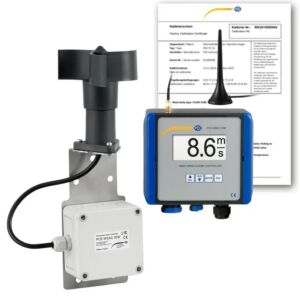
The Weather Stations and Wind Sensors category includes professional instruments designed to measure, monitor and record environmental and meteorological parameters such as wind speed, wind direction, temperature, relative humidity, atmospheric pressure, rainfall, air conditions and local climate variations. These instruments are used in industrial, agricultural, environmental, plant engineering, construction, logistics, energy and laboratory applications whenever objective data on atmospheric or microclimatic conditions is required.
A professional weather station can detect multiple parameters at the same time and convert environmental behaviour into measurable data. Wind can affect safety, dust dispersion, ventilation, cooling, drying, structural stability, material handling and operation of outdoor systems. Temperature and humidity can modify production processes, material storage, comfort, sensor performance, fluid behaviour and dimensional stability. Atmospheric pressure and rainfall can be relevant for environmental monitoring, agriculture, logistics, construction sites and control systems in open areas.
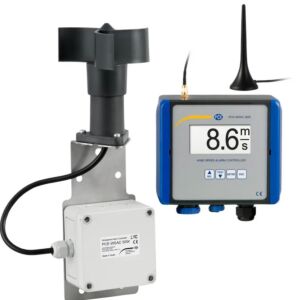
Wind sensors are designed to measure wind speed and wind direction. They can be used in fixed installations, automation systems, outdoor plants, environmental monitoring, construction sites, roofs, cranes, exposed structures, photovoltaic plants, greenhouses, agricultural systems, HVAC systems and applications where wind can affect safety or operation. Wind direction is often measured in degrees from 0 to 360°, while speed can be expressed in m/s, km/h, knots or other units depending on the instrument. In professional systems, wind measurement must be evaluated considering installation height, obstacles, turbulence, sensor position and real environmental conditions.
Weather stations with data logging record parameter trends over time. This function is very important when an instantaneous value is not enough and it is necessary to understand how conditions change during a day, week, season or production cycle. Recording makes it possible to identify wind peaks, temperature variations, humidity cycles, pressure changes, rainfall events and abnormal conditions. Historical data are useful for maintenance, environmental analysis, technical documentation, reports, process checks and comparison before and after interventions on systems or structures.
Portable environmental instruments are useful when technicians need to perform quick checks at different points. They can be used to verify ventilation, air currents, temperature, humidity, comfort, working conditions, HVAC system behaviour or local conditions in a production area. Compared with a fixed station, a portable instrument offers flexibility and allows different areas of the same environment to be compared. This is useful in warehouses, factories, laboratories, production areas, technical rooms, greenhouses, construction sites and plants where conditions may change from one zone to another.
The correct instrument must be selected according to the parameter to be measured, measuring range, accuracy, resolution, robustness, installation type, protection against weather conditions, data logger availability, autonomy, signal output, compatibility with external systems, display readability and data export capability. Accuracy indicates how close the measured value is to the real or reference value, while resolution indicates the smallest variation readable by the instrument. In wind sensors, good resolution helps distinguish even small changes in speed or direction, while accuracy is essential when data are used for safety, system control or documentation.
Reliable measurements depend strongly on positioning. A wind sensor installed too close to walls, trees, machines, parapets, roofs, air outlets, obstacles or surfaces generating turbulence may provide non-representative values. Installation height must be consistent with the measurement objective. If the technician needs to evaluate wind at an operating point, the sensor must be placed in a truly meaningful area. If general meteorological conditions must be monitored, it should be installed in a free and stable position. Direction sensor orientation must also be correct, because a reference error can make the data less useful.
In industry, weather stations and wind sensors are useful for monitoring conditions that can affect outdoor systems, emissions, extraction, ventilation, material handling, operator safety and machines. In the presence of dust, vapours, lightweight substances or outdoor operations, wind can modify dispersion and require more careful control. In cooling systems, greenhouses, warehouses and plants, temperature and humidity can affect products, materials, storage, stability and energy performance.
In agriculture and environmental applications, these instruments monitor greenhouses, crops, irrigation, local climate conditions, wind, humidity and temperature. Wind can affect evaporation, distribution of treatments, plant stress, structural safety and opening management. Temperature and humidity are fundamental parameters for growth, preservation, fungal diseases, crop comfort and production cycle control. A weather station allows more technical decisions to be made, rather than relying on approximate perception.
In preventive maintenance, weather monitoring helps identify critical conditions before they cause problems. Wind gusts above a threshold may require equipment shutdown or structural inspection. High humidity may promote condensation, corrosion or material degradation. Extreme temperatures can affect electronics, batteries, fluids, seals and control systems. Data recording makes it possible to connect failures or anomalies to specific environmental conditions, improving diagnosis and maintenance planning.
In corrective maintenance, these instruments help reconstruct the conditions that caused a problem. If a structure has been stressed by wind, if an outdoor system has not operated correctly, if an environment shows condensation, if a sensor gives unstable values or if a process is affected by climate, meteorological data can support diagnosis. Comparing recorded values with operating conditions helps determine whether the anomaly is caused by wind, temperature, humidity, pressure, rain or a combination of factors.
The connection with heights, transmission backlash, form errors and geometry is indirect but technically important. Wind, temperature and humidity can affect structures, machines and components. Wind can generate vibrations, oscillations and stress on supports, antennas, sensors, panels, covers, pipes and lightweight structures. If a structure is not properly fixed or has play, wind can amplify movement and vibration. Temperature can cause expansion and dimensional changes, affecting dimensions, alignment and geometry. Humidity can promote corrosion, modify friction and degrade components.
In an outdoor machine or system, uncontrolled environmental conditions can therefore influence precision and service life. A sensor installed at the wrong height may provide non-representative data. A support with play can generate vibrations and unstable readings. A wind vane or anemometer mounted off-axis can introduce measurement errors. A station fixed on a deformable structure can be affected by oscillations or turbulence. For this reason, installation, alignment, support rigidity and position are integral parts of measurement quality.
An important practical recommendation is always to define the monitoring objective before selecting the instrument. If general atmospheric conditions must be checked, a multiparameter weather station is suitable. If the main parameter is wind, a specific sensor for speed and direction is preferable. If events must be analysed over time, a data logger is important. If technicians need to perform checks at several points, a portable instrument may be more suitable. If the system must interface with automation or plant control, outputs, interfaces and electrical compatibility must be evaluated.
Tadaah presents the Weather Stations and Wind Sensors category as a technical reference for companies, technicians, engineers, maintenance specialists, laboratories, agriculture, environmental monitoring and quality control departments that need to monitor meteorological and environmental conditions professionally, reliably and in a documentable way. Correct selection of weather stations, wind sensors, data loggers and environmental instruments helps improve safety, preventive maintenance, plant control, environmental analysis, energy management and reliability of technical decisions.