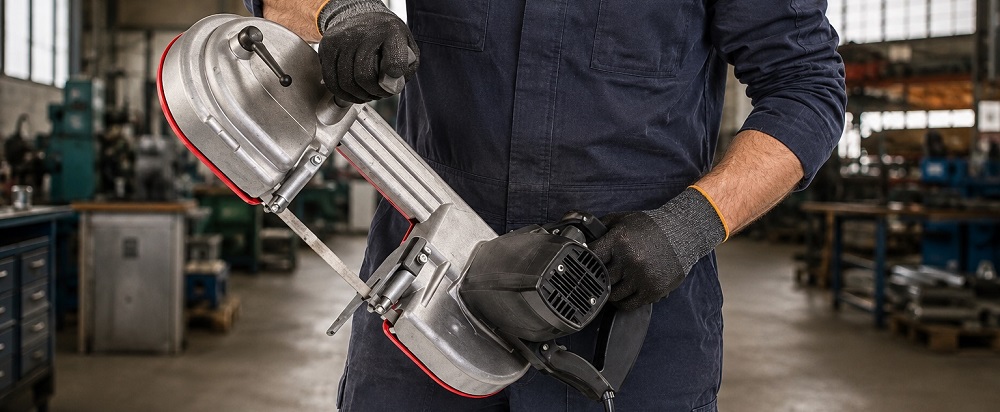
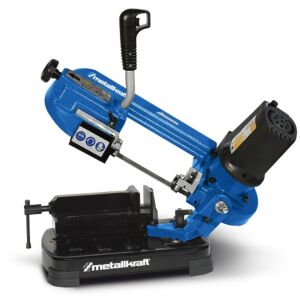
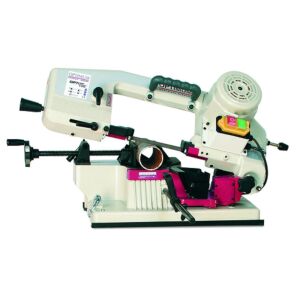
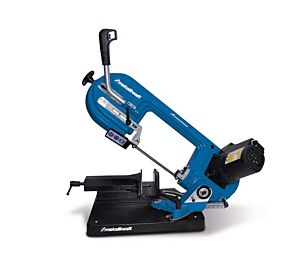
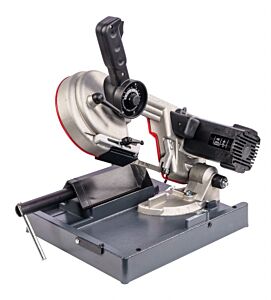
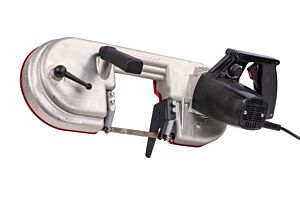
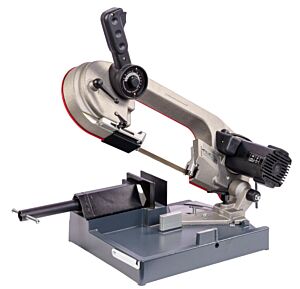
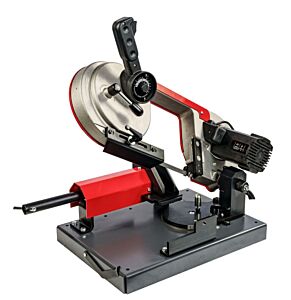
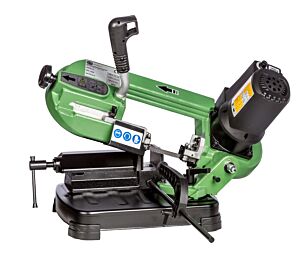
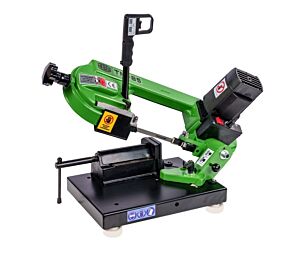
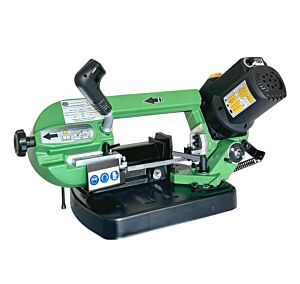
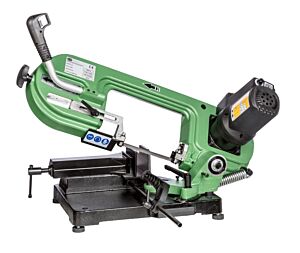
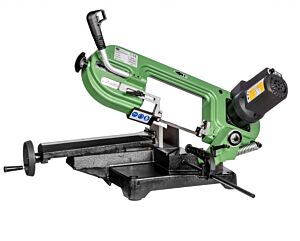
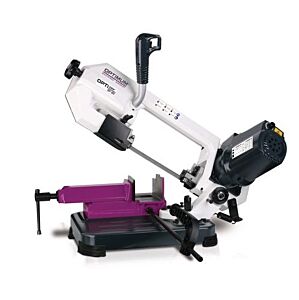
METALLKRAFT, NEBES Elettromeccanica and OPTIMUM portable metal-cutting band saws are compact machines designed to cut bars, tubes, profiles and metal components in workshops, on construction sites, in maintenance departments or close to the structure being manufactured or repaired. Although they belong to the same product category, the machines differ in construction, cutting capacity, speed-control system, vice configuration, mitre-cut capability and operating method. The range includes transportable saws with a base and vice, compact bench machines and models that can be used by hand or installed on the support specified by the manufacturer.
Compared with a stationary industrial saw, a portable machine occupies less space, can be moved more easily between workstations and allows cutting to be performed near the material. The cutting principle remains that of a continuous band blade: the blade travels around the wheels, is guided close to the workpiece and removes material through a regular succession of teeth. Continuous movement limits the impacts associated with reciprocating cutting and produces accurate sections with a smaller heat-affected area than abrasive cutting processes.
A saw with a base should be placed on a stable, rigid and appropriately sized bench. Before cutting, the workpiece must be cleaned of dirt, loose scale and residue that could impair vice grip. The bar, tube or profile should be positioned with the cutting line correctly aligned to the blade and its most stable surface resting on the base. The vice must clamp the material close to the cutting area without deforming thin-wall tubes or hollow profiles. Long components require roller stands or supports at the same height as the machine table so that their external weight does not cause inclination, twisting or closure of the cut around the blade.
When cutting angle, channel, T-section or box profiles, orientation affects stability, vibration and the number of teeth simultaneously engaged. The component should be arranged so that the blade encounters a section that changes as gradually as possible, avoiding sudden transitions from a thin wall to a much wider area. Round tubes must be clamped so that they cannot rotate in the vice. A length stop can improve repeatability in small batches. Bundles may only be cut when the clamping system immobilises every element and prevents movement between individual pieces.
On hand-held models, both handles should be held firmly and the blade should reach operating speed before contacting the workpiece. Machine weight and moderate operator pressure should guide the cut without twisting the blade or forcing the saw frame. When a model is suitable for both hand-held and stand-mounted use, only the support and configuration approved by the manufacturer should be employed. Hand-held operation is useful for installed pipework, structures already in place, components that are difficult to move and maintenance work, whereas a base and vice provide better repeatability and geometric control.
Mitre cutting depends on the individual machine configuration. Depending on the design, the saw head, vice or complete cutting reference may rotate. Before adjustment, chips should be removed from supporting surfaces, the angle set using the intended scale or reference and all moving elements securely locked. The component must remain fully supported when the vice is angled. For joints requiring accurate alignment, the first mitre-cut section should be checked with a square or angle-measuring tool and any deviation corrected before the full batch is produced.
Blade selection must consider material, hardness, solid section size, wall thickness and profile shape. Tooth pitch that is too coarse for a thin-wall tube may leave too few teeth engaged and cause snagging, vibration or tooth breakage. Tooth pitch that is too fine for a large solid bar provides insufficient gullet space for chip evacuation and can cause loading, heat and cutting deviation. The correct pitch keeps several teeth engaged while allowing each tooth gullet to carry the chip out of the cutting zone.
Variable-pitch blades are versatile for tubes, profiles and mixed sections because they reduce contact periodicity, vibration and noise. Bimetal blades are a professional choice for common steels, alloy steels, stainless steel and many other metals. Particularly hard, abrasive or difficult-to-machine materials may require specialised or carbide-tipped blades, provided the saw is suitable for them. Blade length, width, thickness, tooth direction and weld quality must correspond exactly to the selected METALLKRAFT, NEBES Elettromeccanica or OPTIMUM machine.
Blade speed must suit the workpiece material. Hard steels, stainless steel and tough alloys generally require a lower speed and controlled feed, while aluminium, brass and more easily machined materials may permit higher speeds within the blade and machine specifications. Models with electronic or inverter speed control make it easier to adapt the cutting action to different alloys and sections. Speed control should not be used merely to shorten cycle time: correct speed protects the teeth, supports proper chip formation and improves cut straightness.
Feed pressure must also suit the section. Insufficient pressure can cause the teeth to rub without forming an effective chip, promoting wear and work hardening. Excessive pressure can overload the blade, cause cutting deviation and damage the teeth, guides or wheels. Chip appearance provides useful information: fine dust can indicate insufficient pressure or a worn blade, while heavily coloured, welded or deformed chips may indicate excessive heat, speed or feed.
A new blade requires a controlled break-in period. Initial cuts should be made under reduced load so that the cutting edges can stabilise without microscopic chipping. Feed can then be increased progressively to normal working conditions. This procedure is particularly important for bimetal blades and can significantly extend blade life. Even a correctly selected blade may fail prematurely if it is immediately used at maximum capacity or if its first cut is made in a hard, uneven or heavily scaled surface.
Cooling depends on machine design. Many portable band saws operate dry and rely on the correct combination of blade, speed and feed. Liquids must not be added to these machines unless their use is explicitly permitted. Where a saw is equipped for coolant, the fluid should reach the blade-entry area and assist cooling, lubrication and chip evacuation. Certain dry-cutting operations may allow a specific lubricant applied in accordance with the manufacturer’s instructions, avoiding products that trap excessive chips or damage wheels, coatings and electrical parts.
Blade guides should be positioned close enough to the workpiece to leave only the blade length required for the cut unsupported. Excessive distance between the guides increases blade deflection, vibration and cutting deviation. Guide bearings, pads or inserts must be clean, aligned and adjusted without clamping the blade. Blade tension must also be correct: insufficient tension encourages wandering, whereas excessive tension overloads the blade weld, bearings and wheels. Adjustments must be carried out with the machine stopped and isolated from its power source.
An out-of-square cut is not always caused by vice alignment. Incorrect tooth pitch, uneven blade wear, insufficient tension, widely spaced guides, excessive feed or poor workpiece support can produce the same result. These factors should be checked before changing the machine geometry. Once a blade has started to cut off line, it tends to follow the groove already created, so entry into the material must be progressive, impact-free and made with the component fully immobilised.
Routine maintenance includes removing chips from the vice, base, blade guides, wheels and blade compartment; checking blade tension; inspecting the weld and teeth; and verifying cables, controls, guards and stopping devices. Chips must not be removed by hand, and the machine must not be cleaned while the blade is moving. If a blade-cleaning brush is fitted, it should remain correctly adjusted because packed chips in the tooth gullets can damage the blade and wheels. The blade must be replaced when teeth are missing, cracks are present, the weld is damaged, the band is distorted or cutting performance has deteriorated significantly.
Before purchasing, buyers should assess the largest and smallest sections to be cut, materials, operating frequency, need for hand-held or stand-mounted work and mitre-cut requirements. Frame rigidity, base stability, vice quality, clamping speed, speed regulation, blade-tensioning system, guide accuracy, blade-change access, weight and transportability are also important. For mobile work, handle design, overall dimensions, transport restraint and protection of exposed machine parts should be considered.
METALLKRAFT, NEBES Elettromeccanica and OPTIMUM portable metal-cutting band saws are used by metal fabricators, steel erectors, locksmiths, installers, maintenance technicians, toolmakers, mechanics and structural-steel professionals. They are suitable for machine shops, toolrooms, construction sites, plant maintenance, machine-tool rebuilding, automotive workshops, metal window and door production and the manufacture of railings, frames, supports and pipework. Compatible steels, stainless steels, aluminium, brass, copper and other alloys can be cut in the form of solid bars, tubes, structural profiles and mechanical components.
Portable saw versatility results from the ability to move the machine, match blade speed and tooth pitch to the material, produce straight or mitre cuts according to the model and process components of different sizes. Actual precision depends on the complete system formed by blade, tension, guides, vice, workpiece support and operator technique. A correctly configured compact machine can deliver professional results, reduce secondary machining and improve the quality of components prepared for welding, assembly and subsequent mechanical operations.
Tadaah supports the selection of METALLKRAFT, NEBES Elettromeccanica and OPTIMUM portable metal-cutting band saws by evaluating material, section, cutting frequency, transport requirements, mitre work and the required level of accuracy. Correct selection considers the machine, blade, tooth pitch, speed control, clamping system and material support together. This approach helps identify a band saw genuinely suited to professional workshop, construction-site and maintenance requirements.
URL: portable-metal-cutting-band-saws
Meta title: Professional Portable Metal-Cutting Band Saws
Meta description: Portable metal-cutting band saws for bars, tubes and profiles in workshops and on site, with straight or mitre cutting according to the model.
Keywords: portable metal-cutting band saws, portable metal band saw, transportable metal band saw, compact bench band saw, tube cutting band saw, profile cutting band saw, solid bar cutting saw, steel cutting band saw, stainless steel band saw, aluminium cutting band saw, fabrication band saw, workshop band saw, jobsite metal saw, inverter band saw, variable-speed band saw, mitre-cutting band saw, handheld metal band saw, bimetal band saw blade, portable band saw blades, METALLKRAFT band saws, NEBES Elettromeccanica band saws, OPTIMUM band saws