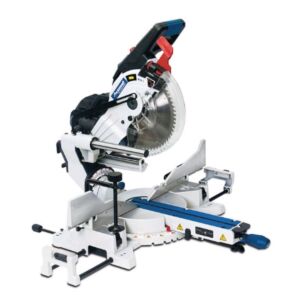
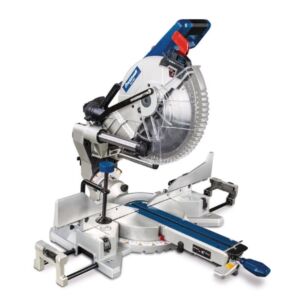
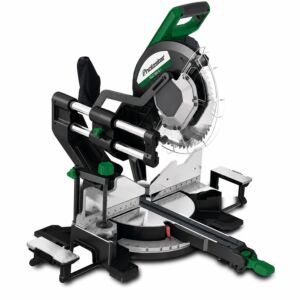
Sliding compound mitre saws for wood are designed to produce accurate and repeatable crosscuts, mitre cuts, bevel cuts and compound cuts. They are used in joinery workshops, furniture production, interior fitting, flooring installation, frame construction and professional or advanced hobby woodworking. Unlike a conventional fixed-head mitre saw, the sliding mechanism allows the blade and motor unit to travel along guide rails, increasing the maximum width that can be cut. This makes it possible to process not only narrow strips and mouldings but also boards, shelves, skirting boards, frames, panels and wider furniture components.
The category includes HolzKraft KGZ Vario sliding mitre saws equipped with 250 and 305 mm blades. Blade diameter primarily affects vertical cutting capacity, overall machine dimensions and the range of workpieces that can be handled. A saw with a 250 mm blade provides a versatile balance of cutting capacity, handling and footprint for strips, frames, mouldings and medium-sized panels. A model with a 305 mm blade is more suitable when taller or thicker components must be cut, including substantial boards, beams, wide profiles and larger structural or furniture parts.
The sliding action combines the vertical movement of the saw head with horizontal travel along the rails. To cut a wide workpiece correctly, the raised head is normally drawn towards the operator, lowered and then guided progressively through the material towards the rear fence, always following the operating sequence specified by the manufacturer. Travel should remain smooth and controlled. Excessive feed pressure can deflect the blade, overload the motor and produce an irregular surface, while moving too slowly may increase friction and leave burn marks on the wood.
When the sliding unit is locked in its designated position, the machine can be used as a compact mitre saw for narrow strips and sections. Releasing the slide allows the full travel to be used for wider boards and panels. This dual operating capability improves flexibility and allows the setup to be matched to the workpiece dimensions. To maintain precision, the rails should remain clean, should move smoothly and should be free from lateral play.
The rotating table changes the cutting line in relation to the rear fence and is used to make mitre cuts. With the table in its central position, the machine produces a 90-degree crosscut for sizing boards, strips and profiles. Rotating the table to the right or left creates the angles needed for frames, skirting boards, furniture structures, wall coverings and corner joints. Frequently used angles may be equipped with positive stops for faster setup, while the graduated scale allows intermediate positions to be selected for customised work.
Tilting the saw head moves the blade away from its vertical position and produces a bevel in relation to the upper face of the workpiece. This adjustment is used for chamfered edges, sloping joints and parts that must meet along non-perpendicular surfaces. Combining table rotation with blade-head tilt produces a compound cut. Compound settings are particularly useful for decorative mouldings, frames, cornices and joints where two different angles must be created in a single operation.
Cutting capacity is reduced during compound cuts because the blade travels through a greater effective material section. Before cutting, the operator must confirm that the workpiece fits within the capacity permitted for the selected mitre and bevel combination. It is also necessary to check that the blade cannot contact the rear fence, table insert, clamp or any other machine component. After changing the setup, a complete dry movement with the machine disconnected and the blade stationary helps verify the cutting path.
Vario models allow the rotational speed to be adapted to the characteristics of the material and blade within the limits specified by the manufacturer. Variable speed is useful when moving between softwood, hardwood, engineered wood products and sections with different surface finishes. Correct speed selection can help control burning, splintering and heat generation, but it must always be combined with a suitable blade. Blade diameter, arbor hole, kerf, tooth count, tooth geometry and maximum permissible speed must all match the machine.
Blades with fewer teeth generally support faster cutting and more efficient chip evacuation. They are suitable for rapidly preparing solid timber and for work in which the edge will subsequently be planed or finished. Higher tooth counts are preferable for clean crosscuts, visible mouldings, coated profiles and furniture components. A fine-tooth blade alone does not guarantee an accurate finish. Feed rate, workpiece rigidity, blade cleanliness, machine adjustment and the absence of play remain equally important.
The workpiece must rest fully on the table and remain in contact with the rear fence. Bowed, twisted or uneven material can move as the blade passes through it. Clamps stabilise the workpiece and are particularly important for short components, bevel cuts and repetitive production. Side extensions support long boards and mouldings, preventing their weight from lifting or rotating the material during the cut. A length stop can improve repeatability when producing several identical parts, provided that the arrangement does not trap an offcut between the stop and blade.
Machine accuracy should be checked periodically with test cuts on scrap material. A 90-degree crosscut can be examined with an accurate square, while mitre accuracy can be assessed by joining two complementary cut pieces. If the joint shows a gap, both table rotation and head tilt should be checked. Small angular errors in individual frame parts accumulate during assembly, making accurate calibration particularly important for picture frames, cabinet components and decorative mouldings.
A laser cutting guide, when fitted, provides a useful positioning reference but should be checked against the actual kerf produced by the blade. Depending on the machine setup, the laser may indicate the left edge, right edge or another reference point in relation to the cut. A test cut should therefore be made before processing a finished component. Tooth width must also be taken into account when cutting precisely to a marked line or preparing a series of components to the same length.
Cutting quality depends on a consistent and controlled movement. The blade should reach operating speed before entering the material, and the head should be guided without sudden impacts. After completing the cut, the operator should keep the head down until the blade has stopped or follow the exact sequence specified by the manufacturer. Raising a rotating blade through the workpiece can damage the finished edge or move a loose offcut. Waste pieces should not be removed while the cutting unit is moving.
Efficient dust extraction improves visibility of the cutting line and reduces sawdust accumulation around the rails, rotating table and blade guard. A sliding mitre saw produces dust beneath the table and behind the blade, especially during radial travel. Connection to a suitable dust extractor therefore helps keep the machine clean and limits airborne dust in the workshop. Extraction should be supported by periodic cleaning of pivots, graduated scales, locking devices and sliding mechanisms.
The choice between a 250 mm and a 305 mm model should be based on the actual workpiece sections, available workshop space and frequency of use. A larger blade offers greater capacity but normally requires a larger machine and involves a heavier and more expensive blade. For frames, strips, skirting boards and medium-sized panels, a 250 mm machine may be the more efficient option. For thick boards, beams, tall profiles and larger furniture components, a 305 mm version provides additional capacity. In both cases, the sliding action substantially increases crosscut width compared with a non-sliding saw.
The machine should be mounted on a stable bench with sufficient clearance behind and at the sides for slide movement and workpiece support. The power supply must be disconnected before changing the blade, making adjustments or cleaning the machine. The blade guard, handle, mitre and bevel locks, clamps and stop mechanisms should be inspected regularly. A correctly selected, adjusted and maintained sliding compound mitre saw provides repeatable cuts, accurate joints and greater productivity when preparing components for joinery, furniture and interior construction.