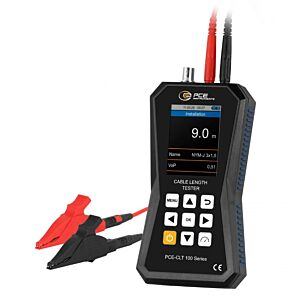
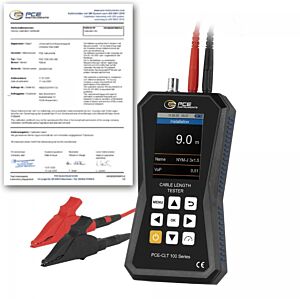
The Cable and Wiring Detectors category includes professional instruments designed to locate cables, electrical conductors, hidden wiring, concealed lines, interruptions, non-visible routes, metal elements and components inside walls, ducts, panels, ceilings, electrical cabinets, cable channels, civil installations and industrial systems. These instruments are used when it is necessary to find a cable without opening a wall unnecessarily, trace the route of a line, identify a conductor among several wires, check wiring continuity or verify the presence of hidden elements before drilling, cutting, fixing or working on a structure.
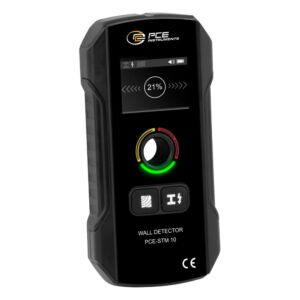
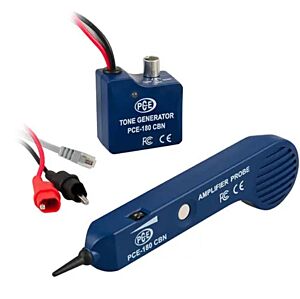
A cable detector can operate with different technologies depending on the application. Models with a tone generator and receiver probe, such as CableTrackers, send a signal through the cable or line to be identified; the receiver probe then makes it possible to follow the route or recognise the conductor inside bundles, ducts, panels or complex wiring. Wall scanners use dedicated sensors to detect electrical cables, metal, wood or hidden materials, providing visual and acoustic indications through a display, bar graph, LED or alarm. In both cases, the purpose is to convert a non-visible element into useful technical information, reducing search time and risk of error.
In industrial applications, these instruments are used on electrical cabinets, machines, automation lines, distribution systems, machine wiring, control networks, conduits and systems where documentation may be incomplete or outdated. In civil and installation work, they are useful for checking cables in walls, ceilings, technical floors, junction boxes and hidden passages. Before drilling or fixing a bracket, the detector helps reduce the risk of hitting an electrical cable, metal line or unexpected structural element.
The accuracy of a cable detector depends on several factors: cable depth, wall material, conductor type, live or de-energised condition, distance between cables, shielding, humidity, interference, local electromagnetic field, coating thickness and correct instrument adjustment. Accuracy refers to the ability to locate the cable or hidden element consistently with its real position, while resolution can be understood as the ability to distinguish nearby signals, separate adjacent cables and provide a stable reading. In complex wiring, this ability is essential to avoid identifying the wrong conductor.
Correct use requires a methodical approach. Before measuring, it is important to define what must be found: a live cable, a de-energised cable, a specific conductor, an interruption, a short circuit, a telephone line, data wiring, a metal pipe or a hidden structure. According to the objective, the most suitable mode is selected and sensitivity is adjusted. Excessive sensitivity can generate false signals or detect nearby elements, while insufficient sensitivity may fail to detect the cable correctly. Several passes, cross-scanning and signal verification from different points are recommended.
Detectors with tone generators are especially useful when the technician must identify a cable inside a bundle or follow an undocumented line. The transmitter is connected to the conductor or circuit to be traced and the receiver probe detects the signal along the route. This method is very useful in electrical panels, telephone systems, data networks, civil wiring, plant maintenance and broken-line searches. Result quality depends on correct transmitter connection, circuit continuity, presence of grounds or shielding and possible proximity of other conductors.
Wall scanners are useful in installation work, technical construction, maintenance and operational safety. Depending on the model and selected mode, they can detect electrical cables, metals, wood or other hidden elements. Before drilling a wall, installing a support, fixing a cable duct, mounting a panel or making a chase, the technician can check the area and identify critical points. This does not replace operator competence, but reduces blind interventions, system damage and repair time.
In preventive maintenance, cable and wiring detectors allow routes to be checked, lines to be identified, unlabelled wiring to be controlled, technical documentation to be updated and errors during future work to be prevented. A system modified over time may contain unidentified cables, undocumented branches or hidden passages. Tracing and recognising these lines improves order, safety and system management. In corrective maintenance, the instrument becomes essential for locating faults, broken cables, incorrect conductors, inconsistent connections or routes that are difficult to follow visually.
The connection with heights, transmission backlash, form errors and geometry is indirect but relevant in machines and systems. A cable detector does not directly measure dimensions, mechanical play or geometric errors, but it helps identify wiring and connections that may influence sensors, actuators, limit switches, encoders, motors and control systems linked to position, working height and functional machine geometry. A broken or incorrectly connected cable can cause position errors, incorrect movements, missing safety consent, sensor anomalies or apparent dimensional variations. In such cases, the cause is not necessarily mechanical, but may be electrical or wiring-related.
In systems subject to vibration, movement or mechanical transmission, a damaged, crushed, pulled or incorrectly positioned cable can generate intermittent faults that are difficult to find. Wiring that passes close to moving parts, guideways, cable chains, transmissions or clamping points may wear and cause anomalies. Identifying the cable route and checking its continuity helps the technician correlate electrical behaviour with the mechanical behaviour of the machine.
To obtain reliable results, it is advisable to calibrate or zero the instrument according to the manufacturer’s instructions, maintain constant scanning speed, avoid rushed readings, verify the signal from several directions and interpret the result according to wall or structure material. In the presence of metal reinforcement, nearby cables, pipes, humidity or intense electric fields, false signals may appear. In these cases, sensitivity should be reduced, several measurement modes compared and the result confirmed with other checks when the intervention involves risk.
Tadaah presents the Cable and Wiring Detectors category as a technical reference for companies, electricians, installers, maintenance specialists, engineers, laboratories, construction companies and industrial departments that need to locate and trace cables professionally, safely and reliably. Choosing the correct instrument reduces diagnostic time, prevents damage, improves preventive maintenance, supports fault finding, checks hidden routes and allows safer work on civil and industrial systems.