Bench grinders with tool sharpeners
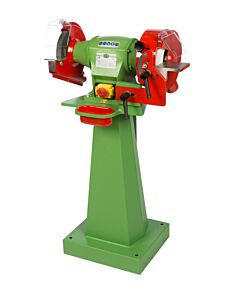
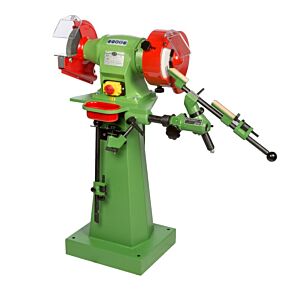
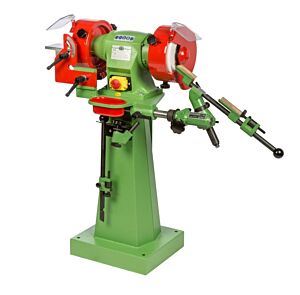
Bench grinders with tool sharpeners are stationary machines that combine grinding, deburring, edge finishing and cutting-tool restoration in a single workstation. Compared with a standard bench grinder, they are distinguished by adjustable tables, orientable work rests, tool guides or holding devices that help the operator maintain a stable and repeatable position during sharpening. Depending on the machine configuration and fitted accessories, they can be used for workshop tools, twist drills, chisels, lathe tools, blades, engraving tools and other compatible cutting edges.
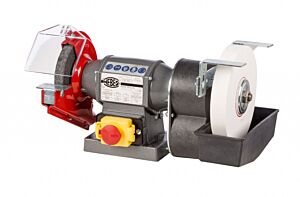
Machines in this category share the same general purpose but can differ in size, construction, supporting structure, wheel arrangement, adjustment system and suitability for occasional, professional or regular production work. Some configurations are primarily intended for general grinding and deburring, with an additional station for sharpening. Others place greater emphasis on tool preparation and incorporate articulated guides, graduated tables or dedicated rests for setting the cutting geometry. Combined machines may also include a conventional grinding wheel together with a slower or specially cooled sharpening station.
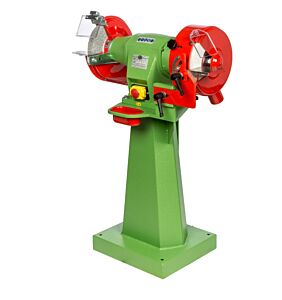
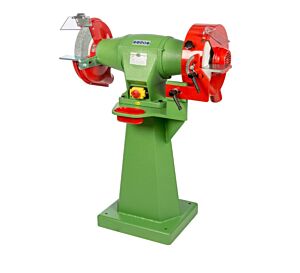
Pedestal-mounted construction provides a stable, independent workstation for workshops, production departments and foundries where the grinder is used frequently. The integrated stand allows the machine to be positioned in a dedicated working area without occupying the main workbench. Bench-mounted versions are easier to install in smaller maintenance areas. In either case, rigidity, weight and secure mounting directly influence the result. A stable machine reduces vibration, improves workpiece control and helps produce more regular surfaces and cutting edges.
Selection should begin with the operations that will actually be performed. If the principal task is removing flash and remnants from foundry castings, priority should be given to structural rigidity, stock-removal capability, available working space and easily adjustable rests. If sharpening is the main requirement, the accuracy of the orientable tables, stability of the guides, angle-setting capability and repeatability of tool positioning become more important. Where both functions are required, it is useful to choose a configuration that keeps the rough-grinding wheel separate from the wheel used for cutting tools.
During manual grinding, the component should be supported on the work rest and guided towards the front peripheral surface of the wheel. Contact must occur within the working area specified by the manufacturer, with the component stable and fully controlled. The side surface of a straight wheel must not be used unless the wheel has been expressly designed for side loading. Applying pressure to an unsuitable side can damage the abrasive wheel and create an unsafe operating condition.
The component should be positioned so that the direction of rotation tends to hold it against the rest rather than lifting or pulling it away. Whenever its size, shape and temperature permit, it should be controlled with both hands. Small, thin, irregular, hot or difficult-to-hold parts require suitable pliers, holders or fixtures. The operator must not bring fingers close to the wheel or compensate for an unstable grip by applying greater pressure.
When removing a burr from an edge, the workpiece should be presented so that the projection meets the abrasive progressively. Pointing the edge directly into the wheel rotation can cause catching or irregular stock removal. A constant angle should be maintained when producing a chamfer. Larger surfaces and extended edges should be moved laterally across the usable wheel face to distribute wear and prevent grooves from forming.
The work rest must be rigid, securely locked and adjusted only when the machine is stopped. Its clearance from the wheel should be kept as small as practicable while complying with the manufacturer’s instructions and applicable safety requirements. Excessive clearance can allow a workpiece to become trapped between the rest and wheel, while insufficient clearance may allow the rotating abrasive to touch the rest. Because the wheel becomes smaller through use and dressing, the setting must be inspected and corrected regularly.
The vertical position and inclination of the rest directly affect workpiece control. A rest positioned too low can make it difficult to maintain the required angle, while a setting that does not match the component geometry can encourage catching. For repetitive operations, it is good practice to establish a consistent reference, lock the table securely and present every component with the same sequence of movements. Rest, guards and available clearance must be checked again whenever the wheel or workpiece type changes.
During tool sharpening, the support must do more than hold the tool: it must help preserve the cutting geometry. Before starting, the operator should inspect the tool, identify the surface requiring restoration and distinguish normal wear from chipping, distortion or heat damage. The objective is not to remove a large amount of material, but to rebuild the cutting edge while sacrificing as little usable tool material as possible.
When sharpening a chisel, blade or lathe tool, the surface being ground should be supported securely and presented at an angle consistent with the original geometry. Contact should be brief and distributed along the cutting edge. Applying more pressure to one side creates an asymmetrical result, while uncontrolled rocking can round a surface that should remain flat. When the tool must be turned over or ground on several faces, consistent references are required to maintain balanced geometry.
Twist-drill sharpening requires particular care. The cutting lips must remain balanced and the point must remain centred. Dedicated guides support the drill, control its approach and assist the movement required to restore the profile. The drill should not simply be rotated against the wheel without a reference. The operator must follow the motion intended by the sharpening device and alternate between the cutting lips, removing only small amounts of material. Incorrectly balanced lips can produce oversized holes, wandering at the start of drilling, vibration, increased feed force and premature wear.
Graduated tables and articulated supports improve repeatability but do not replace operator inspection. Before locking any adjustment, the supporting surfaces must be clean, the tool must be secure and the area to be sharpened must reach the wheel correctly. For repetitive work, the chosen settings can be recorded or reproduced with mechanical references, reducing setup time and maintaining consistent geometry across similar tools.
Wheel selection depends on the tool material and the required operation. Aluminium oxide abrasives are commonly used for steels. Carbide and particularly wear-resistant tool materials may require specialised abrasives selected according to the wheel and machine manufacturers’ instructions. Silicon carbide, ceramic abrasives, diamond and cubic boron nitride have different fields of application and are not automatically interchangeable. Compatibility with the work material, bond, wheel shape, structure, grit and permitted operating conditions must always be checked.
A rough-grinding wheel must maintain an effective cutting action while removing burrs and excess material. A sharpening wheel should favour control, consistency and reduced heat generation. An aggressive grit removes material rapidly but leaves deeper marks and makes small errors more difficult to correct. A finer grit provides a smoother cutting edge but may generate heat if excessive pressure is applied or the wheel surface has become glazed. Removal rate, required finish and the thermal sensitivity of the tool must therefore be evaluated together.
The wheel must remain clean, concentric and free cutting. When its surface becomes smooth, shiny, loaded or irregular, it tends to rub instead of cut. Dressing restores the working profile, opens the abrasive surface and exposes effective grains. A correctly dressed wheel requires less pressure, cuts more coolly and improves sharpening accuracy. Dressing cannot make a cracked, damaged or incompatible wheel safe.
Temperature control is essential during both grinding and sharpening. Heat should be limited through short contacts, moderate pressure and frequent pauses. Where the work material and procedure allow, the tool may be cooled in a separate container, ensuring that water or coolant cannot reach a dry-running wheel, guards or electrical components. A wheel must never be wetted unless the machine and abrasive are specifically designed for wet operation.
Wet-sharpening configurations help control temperature and are useful for cutting tools that are sensitive to overheating. Coolant must reach the wheel in the manner intended by the manufacturer. The wheel should not be left immersed under conditions that could cause uneven absorption and imbalance. The tray, supports and working area must be cleaned regularly to prevent deposits of abrasive and metallic residue.
Hardened tools require especially careful thermal control. Discolouration around the cutting edge may indicate overheating and a possible loss of hardness. Merely polishing the affected surface may not restore the tool, because the heat-altered area may extend below it. A suitable, correctly dressed wheel used with light passes reduces the risk of burning, microcracking and loss of cutting performance.
When fettling foundry castings, unwanted material must be distinguished from surfaces that must remain intact. Parting lines, gate remnants, flash, oxides and local irregularities should be removed through progressive passes, with frequent inspection of the profile. A substantial projection should not be removed by forcing the casting heavily into the wheel. Excessive pressure produces heat, overloads the machine and increases the risk of altering the component geometry.
Cast-iron components may have hard surface scale and residues requiring a free-cutting wheel. Aluminium and light-alloy castings are more likely to load the abrasive and must be processed with wheels explicitly suitable for those materials. Brass and bronze require moderate pressure to prevent grabbing, tearing and unwanted edge rounding. Different materials should not be processed indiscriminately on the same wheel, especially where contamination or mixed dust may create additional risks.
In the production of cookware, tableware, cutlery, handles, taps and household accessories, these machines can remove casting or stamping burrs, blend attachment areas, soften sharp edges and prepare components for satin finishing, brushing or polishing. A rigid abrasive wheel is particularly effective for localised stock removal and geometry correction. Final cosmetic finishing normally requires flexible abrasives, belts, brushes or dedicated polishing wheels.
Before starting, the wheel must be checked for damage, correct installation and compatibility. Work rests, guards and sharpening accessories must be secured. After a wheel has been fitted or adjusted, the machine should be run without load while the operator remains outside its plane of rotation. Abnormal vibration, lateral movement or unusual noise requires immediate shutdown and inspection. Transparent guards help intercept particles and sparks but do not replace safety glasses or a face shield.
Purchase evaluation should also consider the availability of compatible wheels, dressers and spare parts; the rigidity of tables and articulated supports; the simplicity and stability of adjustments; the effectiveness of guards; and the possibility of collecting dust and debris. A machine with stable adjustments reduces errors and accelerates repetitive operations. A rigid, securely mounted structure improves both casting cleanup and the regularity of sharpened cutting edges.
Bench grinders with tool sharpeners are used in engineering workshops, foundries, maintenance departments, fabrication shops, toolrooms, mould making, valve and fitting production, automotive manufacturing, agricultural maintenance, window and door fabrication, cutlery production and the manufacture of cookware, handles, hinges, furniture fittings and decorative articles. The same workstation can deburr components, prepare edges and restore tools, provided that every operation is performed with the correct wheel, support and accessory.
Selecting the correct machine requires a clear definition of its principal function, the materials to be processed, component size, operating frequency, required stock removal and types of tools to be sharpened. A grinder used mainly for foundry work should prioritise rigidity and cutting capacity. A machine dedicated to sharpening should offer accurate adjustments and repeatable supports. A combined solution must allow the operator to move between operations without compromising cleanliness, safety or quality. Careful technical evaluation increases tool life, reduces rework and provides a workstation genuinely suited to professional requirements.