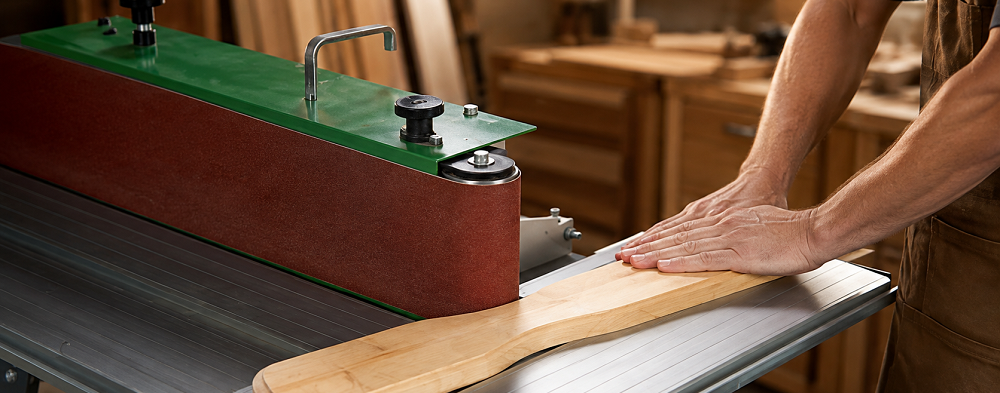
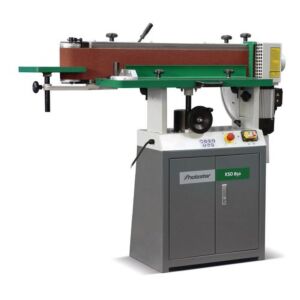
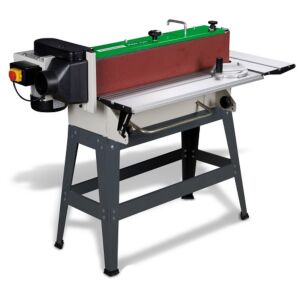
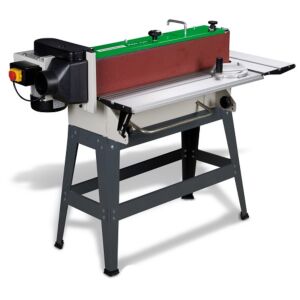
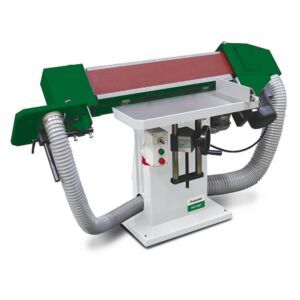
Holzstar woodworking belt sanders are stationary machines designed for flattening, finishing and preparing boards, panels, strips, edges, frames, cabinet doors and furniture components. Material is removed by a continuous abrasive belt travelling over guide rollers and working against a supporting platen. Compared with manual sanding, Holzstar belt sanders provide better workpiece support, more consistent pressure and greater uniformity when processing long parts or repeated production runs.
Holzstar configurations differ in belt size, available abrasive surface, table dimensions, base construction, electrical supply, power and sanding-unit adjustment. Compact models are suitable for strips, small frames, shelves and craft work, while machines with rigid structures, extended tables and longer belts are better suited to professional joinery and workshops processing panels, doors, long boards or repeated components.
On Holzstar oscillating belt sanders, the continuous abrasive movement is combined with controlled transverse travel. Oscillation distributes contact over a larger belt area, reduces concentrated wear and limits the formation of longitudinal grooves. It also helps control heat in the workpiece and abrasive, supporting a more uniform finish on long edges, visible surfaces and components intended for painting, oiling or veneering.
Belt length affects the available abrasive area and heat dissipation. A longer belt distributes wear more effectively during extended work, while belt width determines the height of the surface that can be processed in a vertical position. When selecting a Holzstar belt sander, the usual workpiece dimensions, operating duration and required amount of material removal should therefore be considered.
With the belt arranged vertically, the workpiece rests on the table and is fed against the abrasive surface. This position is suitable for straight edges, minor dimensional corrections, removing saw marks and preparing bonding or finishing surfaces. The component should remain fully supported to prevent tilting, edge rounding or excessive removal at one end.
On Holzstar models with an adjustable sanding unit, the belt can be inclined or moved towards a more horizontal position. This flexibility simplifies the processing of wide components, bevels, angled edges and surfaces requiring a different support arrangement. The selected position must be locked securely before starting. Clearance between the table and abrasive should also be checked, together with possible interference involving guards, rollers, fences and extraction ports.
Tilting the table or sanding unit changes the direction of the force acting on the material. The workpiece may tend to slide towards the lower side and therefore requires careful guidance. For components intended for assembly, the angle should be checked with a square or angle gauge and confirmed on scrap material. Accurate adjustment is especially important for frames, joined panels and parts that must meet without visible gaps.
The worktable of a Holzstar belt sander must provide a stable reference and remain correctly aligned with the abrasive. A large surface improves support for panels, doors and boards, although very long components also require external support. Extensions, trestles or roller stands must be aligned with the table to prevent the weight of the workpiece from changing the contact angle.
A longitudinal fence helps maintain component position and provides a reference for repetitive sanding. Where the Holzstar configuration permits, the table or fence can be repositioned to use different areas of the belt. Periodically changing the working zone distributes abrasive wear and prevents one section from deteriorating prematurely.
The platen behind the belt keeps the abrasive sufficiently rigid when sanding flat surfaces. A stable backing makes stock removal more predictable and helps preserve flatness. In unsupported belt areas, the abrasive can adapt slightly to the component geometry, which is useful for gentle transitions and shaped surfaces. Pressure should remain moderate to prevent unintended rounding of edges and corners.
Areas close to the rollers may be used, where designed for this purpose, for transitions, curved profiles and concave surfaces. The workable radius depends on roller geometry and abrasive flexibility. The workpiece should be guided with short, controlled movements without lateral pressure that could alter belt tracking. Small components require holders or supports that keep hands away from the abrasive area.
Abrasive grit determines stock-removal rate and surface quality. Coarse abrasives remove saw marks, residue, misalignment and obvious irregularities but leave deeper scratches. Medium grits refine the surface after initial sanding, while fine grits prepare the wood for painting, oiling, veneering or bonding. A progressive grit sequence provides a more consistent finish than moving directly from aggressive stock removal to very fine sanding.
Wood-grain direction should be considered, particularly during the final passes. Sanding with the grain makes residual scratches less visible. End grain and transverse edges may require lighter pressure and faster movement to control heat. The workpiece should remain in motion because prolonged contact in one position can produce hollows, burn marks or colour changes.
Excessive pressure does not increase productivity proportionally. It can slow the belt, overload the motor, increase temperature and wear the abrasive prematurely. Holzstar belt sanders should be operated with a smooth feed and controlled pressure, allowing the abrasive grains to perform the cutting action. If sanding performance decreases, belt condition, resin and dust deposits, tension, tracking and grit selection should be checked.
Correct tension keeps the belt stable on the rollers. Insufficient tension can cause slipping and lateral movement, while excessive tension increases the load on bearings and the abrasive joint. After belt replacement, any specified running direction must be observed and tracking checked before sanding begins. The abrasive should remain in its intended position without contacting the guards or passing beyond the roller edges.
A belt showing tears, permanent creases, abrasive separation or a raised joint must be replaced. Length, width, backing and abrasive characteristics must be compatible with the specific Holzstar machine. A rigid backing supports flatness on straight surfaces and edges, while a flexible backing follows curves and transitions more effectively.
Dust extraction is essential because sanding generates very fine particles. Holzstar belt sanders may have one or more extraction ports close to the main dust-generation areas. The extractor must provide suitable airflow and filtration for wood dust. Poor collection reduces visibility, clogs the abrasive, increases heat and releases more dust into the workshop.
Routine maintenance includes cleaning the table, fences, rollers, extraction ports and accessible internal areas. Resin and dust adhering to the belt reduce the cutting action and may make a usable abrasive appear worn. When compatible, a dedicated belt cleaner can help remove deposits. Cleaning, adjustment, tracking and belt replacement must always be performed with the Holzstar machine disconnected and completely stationary.
Before purchasing a Holzstar belt sander, compare belt dimensions, usable sanding area, table size and adjustment, tilt capability, oscillation system, structural rigidity, electrical supply, tensioning system, tracking adjustment, extraction connections and replacement-abrasive availability. A correctly selected machine can process straight and bevelled edges, flat surfaces, chamfers, transitions and shaped components, improving joinery and furniture quality while reducing preparation time.