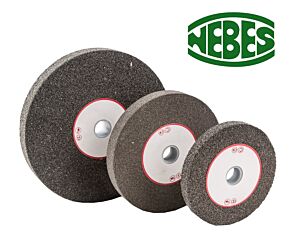
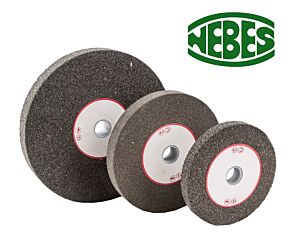
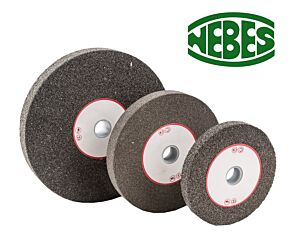
Grinding wheels for bench grinders
Grinding wheels for bench grinders are bonded abrasive tools used for grinding, deburring, geometry correction, finishing and sharpening metal components. They consist of abrasive grains held together by a bond, with spaces that allow grinding debris to escape and the cutting surface to renew itself. Although wheels may appear similar, they can differ substantially in abrasive type, grit size, grade, structure, bond and intended application. Correct selection must therefore consider the grinder, workpiece material and required result.
A grinding wheel does not cut with a single edge. Each abrasive grain acts as a small cutting point that penetrates the material and produces a chip. As grains become dull, they should fracture or be released by the bond so that new cutting edges become available. When this renewal occurs correctly, the wheel continues cutting efficiently. If worn grains remain in the surface, the wheel can become glazed and begin rubbing, increasing pressure, heat and the risk of workpiece damage.
A wheel specification contains considerably more information than its colour. Markings normally identify the abrasive family, grit, grade, structure, bond and permitted operating conditions. Coding systems can vary between manufacturers, so a replacement must not be selected only by appearance or by one part of its designation. The full marking must be compared with the grinder instructions and intended operation.
Aluminium oxide abrasives are commonly used for carbon steels, tool steels and other ferrous materials with relatively high tensile strength. More friable aluminium oxide grains renew readily and may be suitable for sharpening and operations requiring controlled heat generation. Light-coloured wheels often associated with high-speed steel sharpening must still be chosen by their complete specification rather than colour alone.
Silicon carbide has very hard and sharp grains and may be suitable for cast iron, non-ferrous metals, lower-tensile materials and certain applications involving carbide or non-metallic materials. Suitability depends on the complete wheel formulation and the manufacturer’s declared use. Ceramic abrasives, zirconia, diamond and cubic boron nitride have different operating characteristics and should be used only in applications compatible with the material, grinder and mounting arrangement.
Grit size influences both stock removal and surface finish. Coarse grains provide more space for chips, penetrate readily and remove substantial burrs, casting remnants and excess material efficiently. They leave deeper marks and offer less control where geometry must be preserved carefully. An intermediate grit is versatile for general deburring. A fine grit produces a smoother surface and is suitable for finishing and sharpening, but may generate heat if pressure is excessive or the wheel does not remain open.
Wheel grade does not describe the hardness of the abrasive grain. It indicates how strongly the bond retains the grains. A comparatively soft-grade wheel releases worn grains more easily and exposes fresh cutting points, which can be advantageous on hard materials. A harder-grade wheel retains its shape and may suit softer materials or processes requiring reduced wheel wear, provided loading does not occur. Contact area, pressure, cooling and machine rigidity also influence the correct choice.
Structure describes the spacing between abrasive grains. An open structure provides more chip clearance, limits loading and can reduce heat. It may be useful on soft, ductile materials, broad contact areas and operations where debris evacuation is important. A denser structure provides more cutting points and can support a uniform finish, but requires suitable working conditions to avoid clogging.
The bond holds the abrasive grains and structure together and contributes to strength, resilience and wheel behaviour. Vitrified wheels are widely used for bench grinding because of their stability and ability to hold form. Other bonds are used where resilience, impact resistance or specialised characteristics are required. Bond type also affects mounting, inspection and dressing; wheels with different bonds must not automatically be handled in the same way.
Before purchase, wheel shape, outside dimensions, width, bore, bushing and compatibility with the spindle, flanges and guard must be checked. Dimensions must correspond to the grinder manufacturer’s instructions. An excessively wide wheel may interfere with the guards or prevent correct clamping. An incorrect bore must never be forced onto the spindle or modified. Bushings and adapters must be approved for the specific wheel and must not impose abnormal stress on the abrasive body.
The maximum operating speed marked on the wheel must be compatible with the grinder spindle speed. A wheel must never be operated beyond its declared conditions. Even when dimensions and bore appear correct, an incompatible speed makes the wheel unsuitable. This check is particularly important when purchasing a replacement for a grinder other than the one for which the wheel was originally supplied.
Grinding wheels should be transported and stored carefully, protected from impact, falls, moisture, unusual temperatures and unstable support. They should not be stacked in a way that creates concentrated loads or distortion. Before mounting, both faces, the periphery and the area around the bore must be inspected for cracks, chips, deformation, contamination and impact marks. A damaged wheel must not be installed.
Where the wheel shape, material and bond permit, inspection may include a ring test performed according to the appropriate procedure by a competent person. An abnormal sound can indicate cracking. The method is not suitable for every wheel and does not replace visual inspection, manufacturer instructions or trained judgement.
Spindle, flange, blotter and wheel contact surfaces must be clean and free from foreign material. The wheel should fit freely on the spindle and must never be hammered or forced into place. Compatible, flat and correctly matched flanges distribute clamping pressure evenly. Where required, compressible blotters placed between the wheel and flanges help distribute pressure and accommodate minor irregularities. They must not be omitted or replaced with improvised material.
The retaining nut should be tightened only enough to hold the wheel securely. Excessive tightening can create stress and damage the abrasive body. After mounting, guards, eye shields, upper guards and work rests must be correctly repositioned. The grinder should then be run without load while the operator remains outside the plane of rotation. Vibration, wobbling or abnormal noise requires immediate shutdown.
During grinding, the workpiece is supported on the adjustable rest and guided towards the front peripheral surface of the wheel. Contact must take place in the area specified by the machine manufacturer. The side face of a straight wheel must not be used unless the wheel is specifically designed for side loading. The component should be brought into contact smoothly and must not be forced hard enough to slow the grinder significantly.
The work rest must be rigid, stable and adjusted only while the machine is stopped. Clearance from the wheel should be kept as small as practicable while complying with the manufacturer’s instructions and applicable safety requirements. Excessive clearance can allow a workpiece to become trapped, while insufficient clearance can cause contact between the rotating wheel and rest. As wheel diameter decreases through use and dressing, the rest must be readjusted regularly.
The rest should support the workpiece at the actual contact point. A position that is too low makes angle control difficult, while an arrangement that does not match the component shape can encourage catching. For repetitive work, it is useful to establish a stable reference, lock the rest securely and present each part with a consistent sequence of movements.
When removing a burr, the component should be oriented so the projection meets the abrasive progressively. Pointing an edge into the direction of rotation may cause catching or irregular removal. A consistent angle should be maintained when producing a chamfer. Extended edges should be moved laterally across the wheel face to distribute abrasive wear.
Holding the workpiece against one point creates a groove in the wheel and concentrates heat. Controlled lateral movement preserves wheel geometry and produces a more uniform finish. Small, thin, hot or difficult-to-hold components require suitable holders. Fingers must not be brought near the wheel, and very small parts should not be processed without a secure holding method.
When fettling foundry castings, unwanted material must be distinguished from functional surfaces. Parting lines, gates, feed-system remnants, flash, oxides and irregularities should be removed progressively. Forcing a casting heavily against the wheel increases heat, wheel wear and the risk of altering geometry. Small amounts should be removed with frequent inspection of radii, edges and mating surfaces.
Cast iron may have hard scale, moulding residue and substantial flash, while its dust and graphite-rich debris can reduce wheel efficiency. A compatible abrasive should be used and kept open through dressing. Aluminium and light alloys require wheels expressly approved for materials that can load the abrasive spaces. A clogged wheel generates friction and heat and must not be restored through improvised methods.
Brass and bronze require compatible abrasives and moderate pressure. Aggressive contact can cause grabbing, tearing and unwanted edge rounding. Where different materials are processed, dedicating wheels to individual material families helps limit contamination and maintains predictable wheel behaviour. Particular care is required when managing combustible metal dust and separating it from ferrous debris and sparks.
In cookware, tableware, cutlery, tap, handle, hinge and household-accessory production, grinding wheels can remove casting or stamping burrs, blend gate areas, soften edges and prepare parts for satin finishing, brushing or polishing. A rigid grinding wheel is primarily intended for stock removal and geometry correction. Final cosmetic finishing normally requires more flexible and specialised accessories.
Workpiece cooling should be controlled through short contacts, moderate pressure and frequent pauses. Where the material permits, the part may be cooled in a separate container, ensuring that water or coolant cannot reach a dry-running wheel or the grinder’s electrical components. A wheel must not be used wet unless its manufacturer and the machine manufacturer permit that process.
Quenching is not suitable for every workpiece. Hardened tools, thin components and materials with particular metallurgical requirements may suffer thermal shock, distortion, cracking or loss of hardness. During sharpening, discolouration around the cutting edge can indicate overheating. A compatible, correctly dressed wheel used with light passes provides a cooler cutting action than a glazed wheel subjected to heavy pressure.
Dressing restores wheel concentricity, flatness and cutting ability. The dressing tool must be suitable for the wheel and supported securely. It should be moved progressively across the working face without impact or excessive local removal. After dressing, the rests and adjustable guards must be reset to compensate for the reduced wheel diameter.
A wheel should be replaced when it reaches the grinder’s permitted wear limit, can no longer be guarded or adjusted correctly, shows damage, vibrates abnormally or cannot maintain a functional surface. Its life must never be extended by removing guards, modifying rests or using unapproved adapters. Purchase cost should be considered together with service life, removal rate, surface quality and the time required for dressing and replacement.
Before ordering, the user should identify the grinder, work material, operation, duty, required finish, cooling method and dressing process. A combination grinder may require a wheel specification different from that used on a conventional bench grinder. Sharpening may require different characteristics from foundry deburring. The correct wheel improves productivity, control, tool life and component quality while reducing heat, vibration and rework.
Grinding wheels for bench grinders are used in engineering workshops, foundries, toolrooms, fabrication, mould making, valve and tap production, industrial and agricultural maintenance, automotive manufacturing and the production of cutlery, cookware, tableware, handles, hinges, furniture fittings and decorative articles. Professional selection means matching the grinder, abrasive, work material and required result rather than choosing a wheel that is only dimensionally interchangeable.