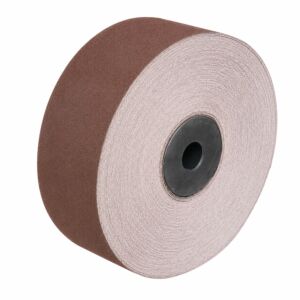
NEBES Elettromeccanica and Holzstar abrasive belts and rollers are tools and replacement components for sanding, cleaning, calibrating and structuring wooden boards, panels, edges, profiles and furniture parts. The category includes replacement pneumatic rollers, abrasive sleeves, flap rollers, nylon rollers, wire-brush rollers and abrasive supplied in roll form for preparation according to the machine. Each solution produces a different working action and must be selected according to the operation, material, component shape, required finish and equipment compatibility.
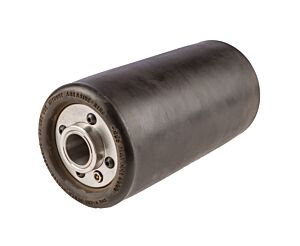
NEBES Elettromeccanica pneumatic rollers provide the flexible support on which abrasive sleeves are fitted for roller sanding and polishing machines. Their deformable surface follows gentle curves, transitions and irregularities more effectively than a rigid cylinder. This allows edges, profiles and shaped components to be finished while distributing contact over a broader area and reducing concentrated pressure along a narrow line.
The internal pressure of a NEBES Elettromeccanica roller affects abrasive behaviour. A firmer roller provides more decisive and stable contact for relatively regular surfaces. A more compliant setting follows curves and profiles more closely but may round edges and details more easily if excessive manual pressure is applied. Inflation must remain within the manufacturer’s limits and should be checked before the abrasive sleeve is fitted.
NEBES Elettromeccanica abrasive sleeves are installed over the pneumatic roller and secured by expansion of the support. They must fit evenly without folds, twisting or loose areas. Incorrect installation may generate vibration, lateral movement or repeated surface marks. Before starting, the abrasive must be centred and confirmed clear of guards and fixed machine components.
Different roller and sleeve diameters and widths allow NEBES Elettromeccanica machines to be adapted to the working surface. A larger roller provides broader and more regular contact for long edges and gentle curves. A smaller diameter follows tighter transitions and compatible concave profiles. Width should provide sufficient workpiece support without creating overly localised contact, while remaining compatible with the shaft and guarding.
Twin-station NEBES Elettromeccanica machines can carry two different abrasive arrangements. One side may use a coarse grit to remove saw marks, irregularities and small amounts of excess material, while the other performs finishing with a finer abrasive. Alternatively, different rollers may be installed for straight edges, transitions and shaped surfaces. This reduces tool changes and improves workflow continuity.
During operation, the component is manually guided against the NEBES Elettromeccanica sleeve. The working angle is obtained by orienting the workpiece relative to the roller axis, not by arbitrarily changing shaft position. Straight edges require distributed contact, while profiles and curves are followed with progressive movement. The workpiece must remain in motion to prevent hollows and local abrasive wear.
Workpiece position must account for the direction of rotation. The roller area where movement keeps the component controlled should be used, avoiding positions that may lift, pull in or throw the part towards the operator. Rotation should be checked at each station and the movement tested on scrap material. Small pieces require jigs or holding devices that keep hands away from the abrasive.
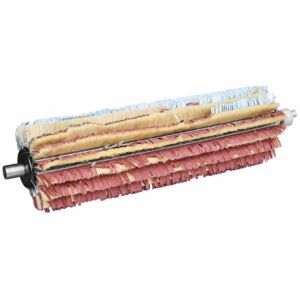
Holzstar abrasive flap rollers consist of abrasive elements arranged around a cylindrical support. The flexible flaps follow minor irregularities, profiles, edges and structured surfaces with a less rigid action than a fully coated drum. They are suitable for intermediate sanding, evening shaped components and preparing surfaces where the geometry should be maintained without excessive flattening.
The flexibility of Holzstar flaps allows them to reach shallow grooves and profile variations, but pressure must remain controlled. Excessive force bends the flaps, increases heat and may round details that should remain defined. The roller should work through progressive passes, distributing contact across the usable width and following the grain where possible.
Holzstar nylon rollers provide a gentler action than conventional coated abrasives. Subject to machine and material compatibility, they can be used to even surfaces, remove raised fibres, clean light residue and prepare wood between finishing stages. Their three-dimensional structure conforms to shapes without aggressively removing edges.
A Holzstar nylon roller is particularly useful for creating an even finish on machined or lightly structured surfaces. It is not intended to correct substantial dimensional differences because its primary role is cleaning, blending and finishing. The grade should be selected according to timber hardness, previous treatment and required result.
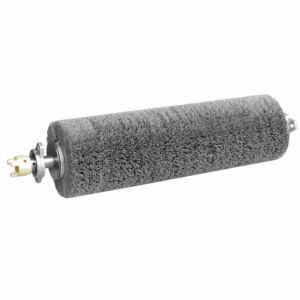
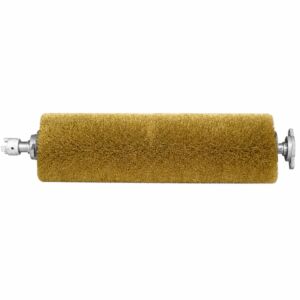
Holzstar wire-brush rollers are intended for brushing and texturing wooden surfaces. The wires can selectively remove softer fibres, emphasising the grain and producing a rustic or aged appearance. The result varies significantly with timber species, grain orientation, feed and pressure. A test on a sample of the same material is essential before finished components are processed.
The Holzstar wire brush should operate with moderate pressure and steady feed. Excessive action can create deep grooves, tear fibres or produce an irregular texture. After brushing, a nylon roller or fine abrasive may be used to remove loose fibres and improve the feel while preserving the intended three-dimensional effect.
Wire brushes should not be used on timber containing unchecked nails, screws or other metallic elements. The component must be inspected beforehand. Compatibility between wire material and the subsequent finish should also be considered, particularly on tannin-rich species or surfaces intended for transparent coatings, because contamination may affect appearance.
Holzstar abrasive supplied in roll form is intended for preparing belts or strips for compatible drum sanders and woodworking machines. Roll material allows the required length to be cut according to the drum development and retention system. Cutting must be accurate and use the correct angle for helical wrapping around the drum.
When fitting Holzstar abrasive to a sanding drum, the strip must be wrapped with consistent tension and without overlaps, folds or irregular gaps. The ends must be secured correctly in the machine’s retention system. Uneven wrapping alters contact, generates vibration and may leave repeated lines across the panel. After installation, the machine should be run without a workpiece to confirm stability.
Abrasive running direction must be observed where marked on the backing. Some belts have a joint or construction intended for one direction only. Reverse installation may lift the joint and cause premature failure. Sleeves and complete rollers must likewise be installed in accordance with NEBES Elettromeccanica or Holzstar instructions and the machine’s direction of rotation.
Grit selection determines stock-removal rate and final quality. Coarse grit rapidly removes saw marks, fully cured residue and irregularities but leaves deep scratches. Medium grit refines the result after rough sanding. Fine grit prepares the surface for painting, oiling, veneering or bonding. A progressive grit sequence is preferable to moving directly from a very aggressive abrasive to a fine finish.
Backing material affects rigidity and conformity. A robust backing provides greater stability on flat surfaces and during calibration. A flexible backing follows curves, transitions and profiles more effectively. Sleeves fitted to NEBES Elettromeccanica pneumatic rollers use the compliance of the underlying support, while Holzstar flap and nylon rollers provide progressively more adaptable contact.
Timber species must also be considered. Hard wood requires abrasive capable of maintaining cutting efficiency without glazing, while soft and resinous timber tends to clog spaces between abrasive grains. Open-coat products, light passes, consistent feeding and efficient dust extraction are useful in these conditions. If cutting action decreases, additional pressure should not be applied; the tool should be cleaned or replaced.
Adhesive residue must be fully cured. Soft adhesive and heavy deposits adhere to belts and rollers and may make them unusable rapidly. Larger excesses should be removed beforehand, leaving the abrasive to level thin residue. Existing paint and finishes must also be assessed to confirm that removal will not create loading or dust incompatible with the extraction system.
Heat is a major cause of abrasive wear. High pressure, slow feeding, clogged abrasive and concentrated contact increase temperature and may burn the wood. The workpiece should remain moving and contact distributed over the usable surface. On NEBES Elettromeccanica rollers, excessive deformation of the pneumatic support should be avoided; on Holzstar rollers, flaps, nylon fibres and metal wires should not be over-deflected.
Dust extraction keeps the abrasive and workpiece surface clean. Dust trapped between abrasive and timber reduces efficiency, raises temperature and may create random scratches. Machine extraction ports must remain clear and be connected to a suitable filtration system. Flap, nylon and wire rollers can discharge residue tangentially and require correctly positioned guards and extraction.
Maintenance includes compatible abrasive cleaning, inspection of pneumatic rollers, joints, sleeves, flaps and attachment systems. A NEBES Elettromeccanica roller that cannot retain pressure or shows deformation must be replaced. A Holzstar abrasive with tears, separation, missing flaps or damaged backing should not be used. All inspections must be performed with the machine disconnected and completely stationary.
Before purchasing, verify machine manufacturer and model, shaft diameter and width, attachment system, roller or belt dimensions, permitted speed, grit, backing, direction of rotation and intended process. NEBES Elettromeccanica replacement components are designed for the corresponding pneumatic-roller sanding machines, while Holzstar products must be matched with drum sanders and other machines expressly identified as compatible. Correct matching prevents vibration, irregular wear and unsuitable results.