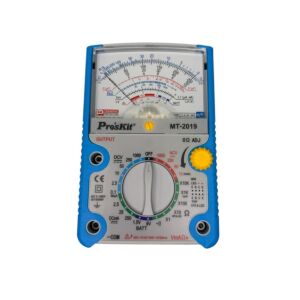
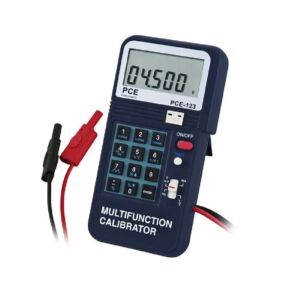
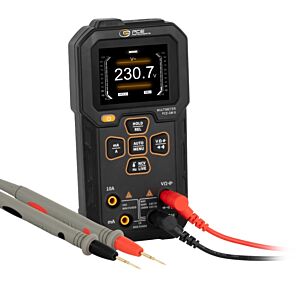
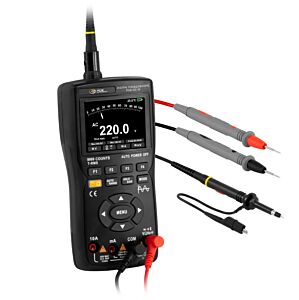
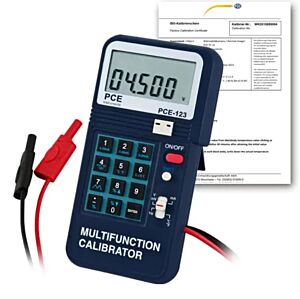
The Digital Multimeters category includes professional instruments designed to measure and check fundamental electrical quantities such as voltage, current, resistance, continuity, frequency, capacitance, temperature and other electrical parameters useful for diagnosing circuits, systems, machines, electrical panels, electronic equipment and automation systems. A digital multimeter is an essential tool for technicians, engineers, maintenance specialists and laboratories because it allows them to quickly and accurately verify whether a circuit is correctly powered, whether a component operates within the expected values, whether a connection is intact or whether an electrical anomaly is present.
Unlike traditional analogue instruments, a digital multimeter displays the value on a numerical screen, reducing reading uncertainty and making the result easier to interpret even in complex operating conditions. Professional models may include autoranging, memory, HOLD function, True RMS measurement, diode test, acoustic continuity signal, frequency measurement, capacitance measurement, thermocouple temperature measurement, overload protection, backlit display, protection rating and safety categories suitable for electrical installations. Some instruments are multifunctional and can be used on electronic circuits, industrial systems, control panels, motors, inverters and power supply systems.
A digital multimeter is used by connecting the test leads to the instrument and selecting the correct measuring function. Voltage is measured in parallel with the point to be checked, current may require series connection or suitable instruments and accessories, while resistance and continuity are normally measured with the circuit de-energised. Choosing the correct function and measuring range is essential to avoid errors, protect the instrument and ensure operator safety. In autoranging models, the instrument automatically selects the most suitable range, while in manual models the technician must set the correct range according to the expected value.
In preventive maintenance, digital multimeters allow periodic checks of supply voltages, voltage drops, wiring continuity, component resistance, fuse condition, connections, terminals, power supplies, sensors and electrical signals. Unstable voltage may indicate a degrading power supply, defective contact, excessive load or line problem. Out-of-range resistance may indicate a damaged component or incorrect connection. Intermittent continuity may anticipate a fault caused by vibration, damaged cables, loose terminals or oxidised connectors.
In corrective maintenance, the multimeter is often the first tool used to identify the cause of a malfunction. If a machine does not switch on, if a sensor does not transmit a signal, if a motor does not start, if an electrical panel shows anomalies or if an electronic circuit does not respond, the multimeter checks the presence of voltage, polarity, continuity, resistance value, component integrity and signal consistency. This initial diagnosis quickly distinguishes a power supply problem from a wiring, component, board, protection or adjustment fault.
In quality control and laboratories, digital multimeters are used to check components, wiring, finished products, electronic boards, power supplies, sensors and electrical devices. The ability to read precise values, check frequency, voltage, resistance and continuity makes it possible to validate products, compare batches, verify repeatability and document technical tests. On test benches, the multimeter can be used to check reference signals, power supplies, voltage drops and operating conditions during testing.
The choice of a digital multimeter must be based on type of use, measuring range, accuracy, resolution, safety category, display type, available functions, robustness, overload protection, test lead quality and compatibility with the working environment. Accuracy indicates how close the measured value is to the real value, while resolution indicates the smallest variation readable by the instrument. In a laboratory it may be important to read very detailed values, while in industrial maintenance robustness, safety, speed and measurement reliability may be more important.
Safety category is a fundamental aspect. A multimeter used on industrial electrical systems, distribution panels or power lines must be suitable for the voltage and type of environment in which it is used. Using an unsuitable instrument may be dangerous for the operator and may damage the instrument. It is therefore important to check the CAT category, maximum allowed voltage, condition of the test leads, integrity of internal fuses and presence of protection against overloads or connection errors.
True RMS measurement is particularly useful when working with signals that are not perfectly sinusoidal, such as those found on inverters, switching power supplies, electronic regulators, controlled motors and modern industrial systems. A non-True RMS multimeter may provide incorrect values when the waveform is distorted. For professional applications on automation, machine tools, electrical panels and power electronics systems, choosing a True RMS multimeter can improve diagnostic reliability.
The connection with heights, transmission backlash, form errors and geometry is indirect but technically important in machines and industrial systems. A multimeter does not directly measure dimensions, play or geometry, but it can check electrical signals generated by position sensors, encoders, limit switches, transducers, load cells and control systems that influence movements, heights and adjustments. If an axis does not reach the correct position, if a working height changes, if an actuator does not move or if a system shows repeated errors, electrical measurement can help determine whether the problem comes from the sensor, wiring, power supply or control system.
In a machine tool, a faulty limit switch, poorly powered proximity sensor, disturbed encoder signal or broken cable may generate position errors that are interpreted as mechanical problems. In reality, the cause may be electrical. The multimeter verifies power supplies, signals, continuity and voltage drops, supporting diagnosis between electrical and mechanical faults. In systems with transmission backlash, vibration or repetitive movements, a damaged cable or unstable connector may generate intermittent anomalies that are difficult to identify without targeted measurements.
To obtain reliable measurements, a methodical approach is required. Before measuring, the correct function must be selected, the test leads must be inserted into the correct sockets, the instrument condition must be checked and the type of circuit must be understood. In voltage measurements, polarity and range must be respected; in current measurements, incorrect connections that could cause short circuits must be avoided; in resistance and continuity measurements, the circuit must be de-energised. It is advisable to note the measured values, compare them with expected values and repeat the measurement when the result appears unstable.
A practical recommendation for industrial maintenance is not to limit the check to whether voltage is present, but also to measure the real value under load. A power supply may show correct voltage without load but drop when the circuit is active. A contact may appear continuous in static conditions but open under vibration or movement. A sensor may be correctly powered but provide an inconsistent signal. When used correctly, the multimeter makes it possible to identify these differences and make diagnosis more precise.
Tadaah presents the Digital Multimeters category as a technical reference for companies, technicians, engineers, maintenance specialists, laboratories and quality departments that need to perform electrical measurements professionally, safely and reliably. Choosing the correct multimeter improves preventive maintenance, fault diagnosis, testing, quality control, system verification, electronic repair and operational safety. To select the most suitable product, it is advisable to evaluate the quantities to be measured, accuracy, resolution, safety category, available functions, True RMS capability, robustness, test leads, display and real operating conditions.