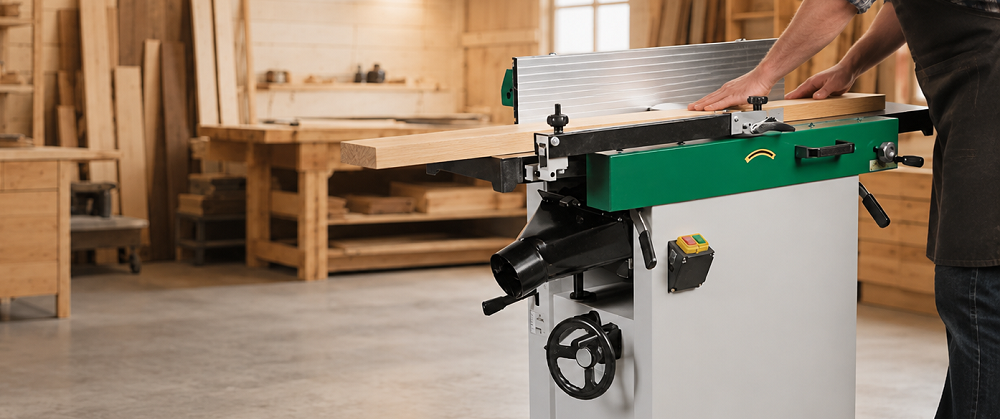
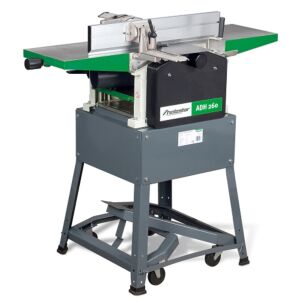
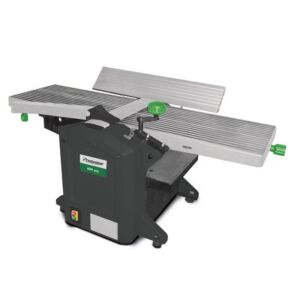
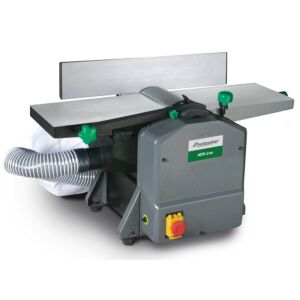
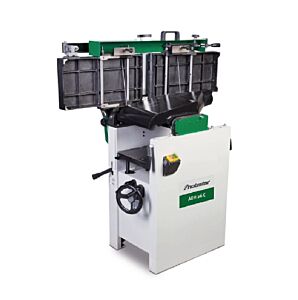
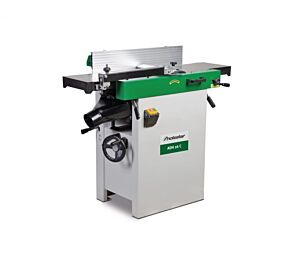
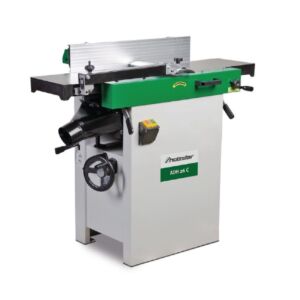
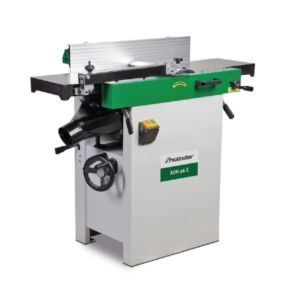
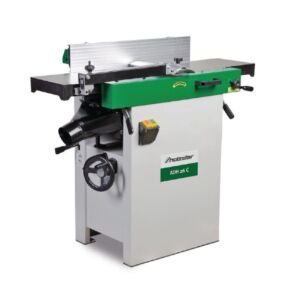
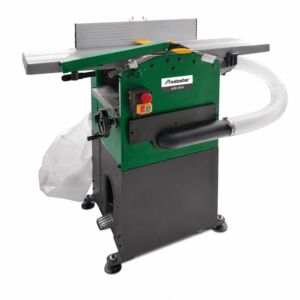
Holzstar woodworking planers are combined surface-planing and thicknessing machines designed to prepare boards, strips, beams and components for joinery, furniture production and general woodworking. Holzstar models share the same basic operating principle but differ in dimensions, working width, table length, thicknessing capacity, construction, adjustment systems and bench-mounted or floor-standing configuration. This variety allows users to select a Holzstar planer proportioned to the workpieces, available workshop space and frequency of use.
Combining surface planing and thicknessing allows the main preparation stages required for straight, flat, parallel and dimensionally consistent timber to be performed on the same Holzstar machine. Surface planing creates the first flat reference face and a straight, square edge. Thicknessing then uses the prepared surface as a datum to machine the opposite face parallel and bring the component to the required thickness.
The correct sequence is essential. A bowed or twisted board should not be placed directly through the thicknessing function because the feed rollers may temporarily flatten it without removing the underlying deformation. Once roller pressure is released, the component can return towards its original shape. One face should first be flattened on the Holzstar surface planer, followed by a reference edge, before thickness calibration begins.
During surface planing, timber travels over the infeed table, across the cutterblock and onto the outfeed table. The Holzstar infeed table is set below the outfeed table according to the required stock removal. This difference establishes cutting depth. The outfeed table supports the newly machined surface and must be aligned correctly with the cutting path of the knives.
The Holzstar cutterblock rotates across the feed direction. Every knife must project equally, operate at the same height and remain parallel to the cutterblock axis and outfeed table. Unequal knife projection can produce ridges, vibration or variations across the board. Knives positioned too low in relation to the outfeed table can allow the workpiece to strike the table edge, while excessive projection may lift the component and create an irregular cut.
Holzstar knife inspection and adjustment must be carried out only with the machine disconnected and in accordance with the manufacturer’s procedure. After replacement, knife position should be checked at several locations along each edge because correct adjustment at one end does not automatically guarantee parallelism. Clamping screws, wedges and seating surfaces must remain clean and be tightened evenly.
When surface planing on a Holzstar machine, the component is moved from the infeed table towards the outfeed table in the specified direction. Initial downward pressure is applied mainly over the infeed table to keep the workpiece stable. Once enough of the newly machined surface has reached the outfeed table, the main pressure should transfer to that side. Continuing to press only on the infeed section may cause the operator to follow the original deformation instead of producing a straight reference.
Stock removal per pass must suit workpiece width, hardness, deformation and length. Light cuts improve control, reduce motor load and limit fibre tearing. An aggressive setting does not compensate for blunt knives and can produce vibration, a rippled surface or difficult feeding.
Grain direction should be inspected before placing the board on the Holzstar tables. Wherever possible, the component is oriented so that the knives cut with the grain instead of lifting the fibres. Knots, reversing grain and irregular figure may require the board to be turned, cutting depth to be reduced or several lighter passes to be made. Highly figured timber requires sharp knives and a consistent feed.
The fence on a Holzstar planer maintains the workpiece edge at the required position relative to the cutterblock. To produce an edge square to the prepared face, the fence is set and checked perpendicular to the tables. Where the machine permits, the Holzstar fence can also be inclined to prepare bevelled edges and specialised joints. The selected angle must be locked securely before machining.
When edge-jointing on a Holzstar planer, the previously machined face must remain firmly against the fence. Pressure is distributed downwards and sideways without tilting the component. Tall, narrow boards require particular care because hand pressure can act as a lever and move the reference face away from the fence. Suitable push blocks improve control and maintain a safer distance from the cutterblock.
The bridge guard on a Holzstar planer must cover the part of the cutterblock not occupied by the workpiece. When planing a wide face, the guard is adjusted in height to leave only the necessary clearance beneath it. When machining an edge, it is moved towards the fence so that only the required cutterblock section remains accessible. The guard should not be removed to speed up production.
After one flat face and one reference edge have been produced, the component can be thicknessed on the Holzstar planer. The prepared face is placed on the lower thicknessing table and the feed rollers carry the workpiece beneath the cutterblock, which machines the upper surface. The distance between the thicknessing table and knife path establishes the resulting thickness.
The Holzstar thicknessing table must remain parallel to the cutterblock and be locked at the required position. The final dimension should be approached progressively, with the workpiece checked between passes. The machine scale supports setup, but precision work should be verified with a suitable measuring instrument at several positions along and across the component.
When several components are intended for the same piece of furniture, they should be taken to final thickness without changing the Holzstar table setting. Repeatedly moving the table and attempting to return to a previous position may introduce small dimensional differences. The components should also be prepared with a reasonably consistent allowance so that one part does not require substantially heavier cuts than the others.
Feed rollers on a Holzstar planer must provide sufficient pressure to move the workpiece without slipping. The thicknessing table should remain clean and smooth because resin, dust and corrosion increase friction and can cause irregular feeding. If the workpiece stops, it should not be forced through the machine. The planer should be stopped and the cause identified by checking setup, table condition, cutting depth and knife sharpness.
A thicknessing pass can leave a shallow depression near the beginning or end of a board if the component tilts while entering or leaving the feed rollers. Supporting the board level with the table, without lifting it, helps reduce this effect. When permitted by the Holzstar operating instructions, consecutive feeding of prepared components may also assist continuity, provided that the required spacing is maintained.
Combined Holzstar planers must be converted between surface-planing and thicknessing configurations. Depending on the model, changeover may involve moving or lifting the tables, repositioning the extraction hood and adjusting the lower table. Before starting, every component must be correctly positioned and locked. Ease of conversion is an important purchasing consideration when the two functions are alternated frequently.
Compact bench-mounted Holzstar planers suit small workshops, mobile installations, occasional use and smaller components. They must be installed on a rigid, stable support with adequate space in front of and behind the machine. Floor-standing Holzstar planers provide a dedicated working height and a more substantial structure for regular use and larger boards.
Table length influences the ability of a Holzstar surface planer to support and straighten long workpieces. Longer tables provide a better reference before and after the cutterblock. Working width alone therefore does not describe total machine capability. Furniture parts, frames, doors and elongated components also require consideration of table support, fence rigidity and available workshop space.
Knife quantity, arrangement and retention system affect surface quality, cutting continuity and maintenance. Before purchasing a Holzstar planer, buyers should check replacement-knife availability, adjustment procedure and compatible accessories. Sharp, correctly installed knives reduce feed effort and leave a more uniform surface.
Effective extraction is essential because Holzstar planers generate a substantial volume of chips. Inadequate collection can obstruct chip discharge, reduce finish quality and interfere with feeding. The extraction hood must be placed in the correct position for the selected configuration and connected to equipment designed for woodworking chips. Excessively long hoses, sharp bends and restrictive reductions may reduce airflow.
Timber must be inspected before machining to exclude nails, screws, staples, stones and other foreign objects capable of damaging the Holzstar knives. Unstable knots, deep cracks and decayed areas also require assessment. The material should be sufficiently dry and clean; heavy resin and contaminated surfaces can soil tables, rollers and the cutterblock.
Very short, thin or narrow pieces should be processed only when they remain within the limits specified by Holzstar and can be guided safely. Push blocks and suitable hold-down devices help maintain contact with the tables while keeping hands away from the cutterblock. Hands must not pass directly above the cutting area, and the operator should avoid standing in the possible kickback path.
Maintenance of Holzstar planers includes cleaning the tables, inspecting the knives, removing resin deposits, checking fence alignment, examining feed rollers and verifying adjustment and locking systems. Tables must remain clean, coplanar and smooth. Any work on the cutterblock, knives or transmission must be performed with the Holzstar planer disconnected from its power supply.
Before purchasing, users should compare working width and capacity, table length, bench-mounted or floor-standing construction, fence rigidity and inclination, depth adjustment, cutterblock configuration, feed system, conversion between surface planing and thicknessing, extraction, power-supply requirements and spare-part availability. A Holzstar planer should be selected according to actual component dimensions, workload and required accuracy.
Holzstar combined surface planers and thicknessers provide a flexible solution for joiners, cabinetmakers, furniture manufacturers, professional woodworkers and advanced hobbyists who need to prepare solid timber on one machine. Correct table, fence and knife adjustment, combined with a logical working sequence, produces flat faces, straight edges, parallel surfaces and consistent thicknesses ready for cutting, gluing, assembly and finishing.