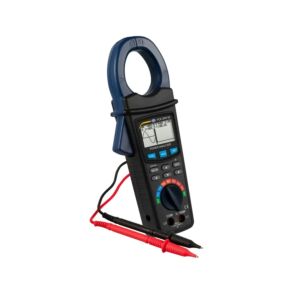
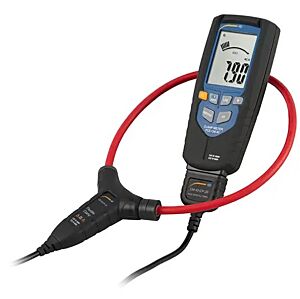
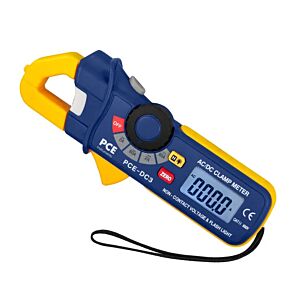
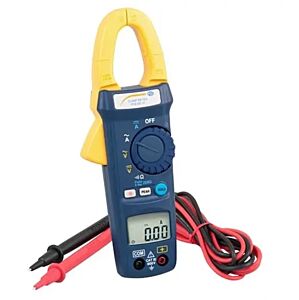
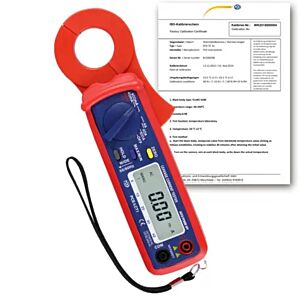
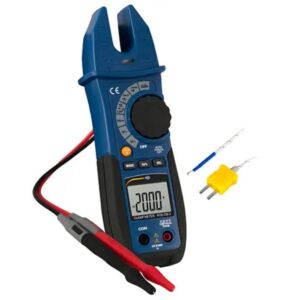
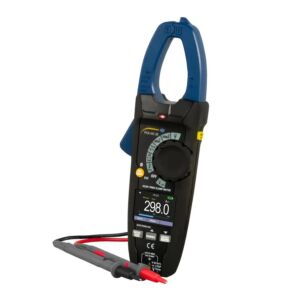
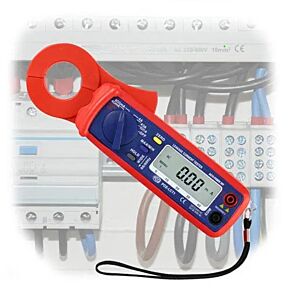
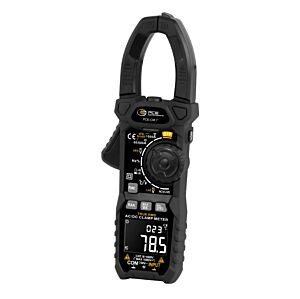
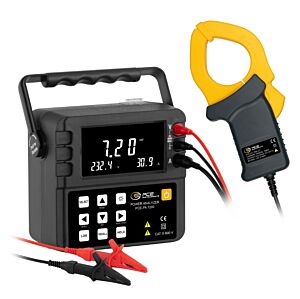
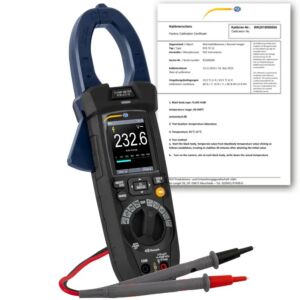
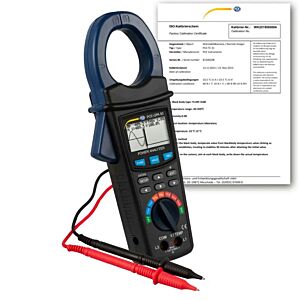
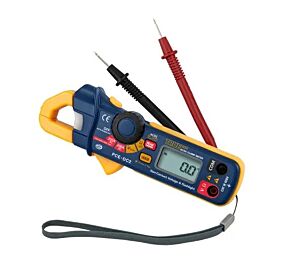
The Clamp Meters category includes professional instruments designed to measure electrical current quickly, practically and safely without interrupting the circuit or disconnecting the conductor. A clamp meter uses an opening jaw that is placed around a single cable, detecting the magnetic field generated by current flow and converting it into a readable value on the display. This measuring principle makes the instrument particularly useful in electrical panels, industrial systems, power lines, automatic machines, motors, inverters, HVAC systems, compressors, pumps, civil installations and maintenance applications where current must be checked without stopping the system.
Modern clamp meters are not limited to current measurement only. Many models integrate multimeter functions for measuring AC/DC voltage, AC/DC current, resistance, continuity, frequency, capacitance, temperature, power, diode testing and other electrical parameters useful for diagnosis. True RMS models are particularly suitable for modern industrial systems, where waveforms can be distorted by inverters, switching power supplies, electronic regulators, controlled motors and non-linear loads. In these cases, a non-True RMS instrument may provide incorrect values, while a True RMS clamp meter gives a more reliable reading of the real effective value.
A clamp meter is used by opening the jaw and enclosing one conductor at a time. It is important not to enclose phase and neutral together, because opposite magnetic fields can cancel each other and generate a zero or incorrect reading. The measurement must be performed on a single cable, selecting the correct range and verifying that the clamp meter is suitable for the expected current, system voltage and required safety category. Models with AC/DC measurement allow checks on both alternating and direct current circuits, useful in industry, photovoltaic systems, batteries, technical automotive applications and power electronics.
In preventive maintenance, clamp meters allow periodic checks of current absorption on motors, pumps, fans, compressors, heaters, power lines and electrical loads. A progressive increase in current may indicate mechanical friction, worn bearings, overload, misalignment, insufficient ventilation, clogged filter, excessive load or motor degradation. A lower-than-expected current may indicate no load, missing phase, disconnected component, control problem or partial operation. Recording and comparing values over time helps detect drift and schedule maintenance before machine downtime occurs.
In corrective maintenance, the clamp meter is a fast tool for diagnosing existing faults. If a machine does not start, if a motor trips protection, if an electrical panel overheats, if an inverter reports an error, if a line draws more current than expected or if a system shows imbalance, current measurement helps determine whether the problem is related to load, wiring, motor, protection device, control or electrical distribution. On three-phase systems, checking all three phases helps identify imbalance, missing phase, uneven load distribution or anomalies that can cause overheating and reduced component life.
In quality control and laboratories, clamp meters are used to test electrical equipment, verify current consumption, check device behaviour during operation and compare values between products or batches. On a test bench, current measurement can confirm that a motor, power supply, machine or component operates within expected limits. In production departments, current absorption can become a functional indicator: a product consuming too much or too little may have an assembly defect, incorrect adjustment or non-conforming internal component.
The choice of a clamp meter must be based on measuring range, accuracy, resolution, AC or DC current, True RMS function, maximum jaw diameter, safety category, maximum allowed voltage, integrated multimeter functions, display, backlighting, HOLD function, memory, overload protection, robustness and test lead quality. Accuracy indicates how close the measured value is to the real value, while resolution indicates the smallest variation readable by the instrument. Good resolution is important for small current measurements, while adequate measuring range, safety and robustness are essential for power lines and motors.
Jaw diameter is an important practical parameter because it determines which cables can be enclosed by the instrument. In compact panels, a clamp meter with a slim and manageable jaw may be useful; on power lines or large-section cables, a wider jaw may be required. The position of the conductor inside the jaw can influence measurement stability, so it is advisable to centre the cable when possible and keep the instrument stable during reading. In environments with vibration or limited space, the HOLD function allows the value to be frozen and read more conveniently.
Safety category is essential. Clamp meters used on industrial panels, distribution systems or power lines must be suitable for the voltage and CAT category of the working environment. Before measuring, the integrity of the instrument, condition of the test leads, cable insulation, correct function selection and absence of visible damage must be checked. Operator safety depends not only on the instrument, but also on the working method, use of PPE and knowledge of the circuit being tested.
The connection with heights, transmission backlash, form errors and geometry is indirect but very relevant in industrial machines. A clamp meter does not directly measure dimensions, play or geometric errors, but it can reveal the electrical effects of a mechanical problem. An axis with abnormal friction, an unlubricated guideway, worn bearing, transmission with excessive play, belt tensioned too much, misaligned rotating part or blocked pump can increase motor current. In this way, current measurement becomes a useful technical indicator for connecting electrical behaviour to the mechanical behaviour of the machine.
In a machine tool, a motor drawing more current during travel may indicate friction, interference, insufficient lubrication, incorrect preload or mechanical deformation. In a transmission system, repeated current peaks may be related to play, shocks, eccentricity, form errors or uneven loads. In a system with pumps or fans, current variations may indicate blockages, dirty filters, damaged impellers or adjustment problems. For this reason, the clamp meter is useful not only for electricians, but also for mechanical maintenance specialists and technicians who must interpret the overall behaviour of a machine.
To obtain reliable measurements, some practical rules must be followed. The clamp must enclose only one conductor, the measuring range must be suitable, the instrument must be zeroed when required, especially in DC measurements, and the value must be interpreted in relation to the real load. Measuring a motor with no load does not provide the same information as measuring under load. A power supply may absorb different values during start-up and steady operation. An inverter may generate complex waveforms that require True RMS instruments. It is therefore important to understand the working cycle and choose the correct time for measurement.
A practical maintenance recommendation is always to compare phases and not consider a single isolated value. In three-phase systems, a significant difference between phase currents may indicate imbalance, power supply problem, uneven load, faulty winding or incorrect connection. When checking several identical machines, comparing current absorption quickly identifies the unit working under abnormal conditions. When possible, it is useful to record measured values and create a history to identify progressive variations over time.
Tadaah presents the Clamp Meters category as a technical reference for companies, technicians, engineers, maintenance specialists, installers, laboratories and quality departments that need to measure current and electrical parameters professionally, safely and reliably. Choosing the correct instrument improves preventive maintenance, fault diagnosis, testing, quality control, system verification, load analysis and operational safety. To select the most suitable product, it is advisable to evaluate current type, measuring range, True RMS capability, accuracy, resolution, safety category, jaw diameter, multimeter functions, robustness, display and real operating conditions.