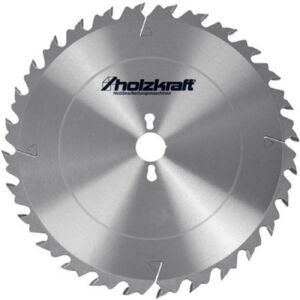
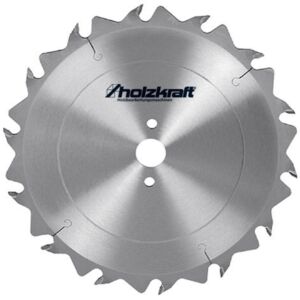
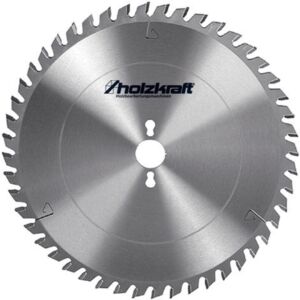
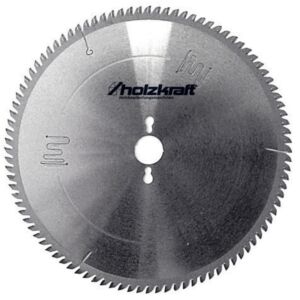
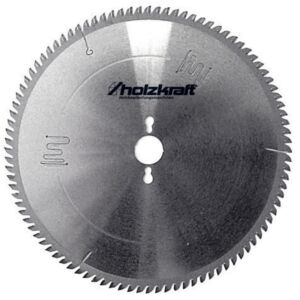
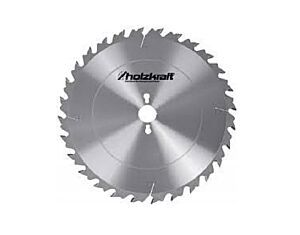
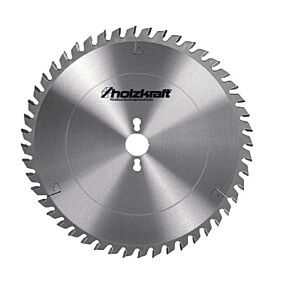
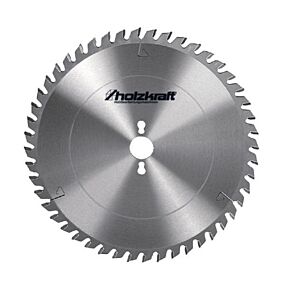
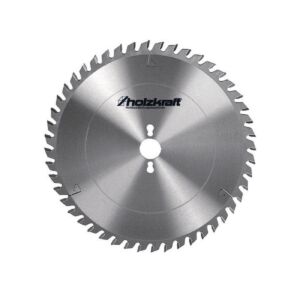
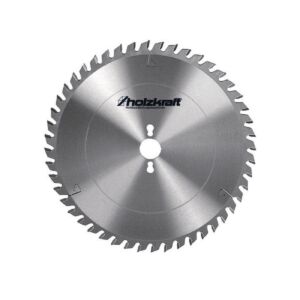
Circular saw blades for wood are cutting tools designed for ripping, crosscutting, bevel cutting, profiling and finishing solid timber, boards, strips and wood-based panels used in joinery, carpentry and furniture manufacturing. Different combinations of blade diameter and tooth count allow the cutting process to be adapted to the machine, workpiece thickness, grain direction and required surface quality. The category includes blades with diameters of 250 and 315 mm and configurations with 18, 24, 28, 40, 48 and 80 teeth, covering applications ranging from fast cutting with high chip-removal capacity to accurate profiling and fine finishing.
Tooth count is one of the most important selection criteria. A blade with fewer teeth normally has larger gullets capable of receiving and removing more material during each revolution. Blades with 18 or 24 teeth are therefore particularly suitable for ripping solid wood, rapidly preparing boards and strips and performing operations where productivity is more important than the final edge finish. The larger distance between the teeth facilitates the evacuation of the long fibres generated when cutting with the grain and helps prevent the gullets from becoming overloaded at higher feed rates.
Blades with 28 or 40 teeth provide a versatile solution for general woodworking. They can be used for rip and cross cuts, for preparing furniture components and for operations requiring a balanced combination of cutting speed and edge quality. A 40-tooth blade can be a practical choice when different materials, workpiece thicknesses and cutting directions are frequently handled on the same machine and changing the blade before every operation would reduce productivity.
Configurations with 48 or 80 teeth are more closely associated with profiling and finishing. The higher number of cutting edges reduces the amount of material removed by each tooth and produces more frequent contact between the blade and the workpiece. This can provide cleaner edges and reduce splintering, which is important in furniture construction, the production of frames and mouldings, panel processing and the preparation of parts that will be painted, coated or assembled without extensive additional finishing. When working with laminated, coated or delicate panels, the result also depends on tooth geometry, machine rigidity, the possible use of a scoring blade and correct feed adjustment.
Blade diameter determines potential cutting capacity but must always be compatible with the machine. A 250 mm blade offers a practical balance between handling, rigidity and cutting depth and can be used on many compatible table saws, mitre saws and woodworking machines. A 315 mm blade generally provides greater cutting depth, provided that the spindle, enclosure and machine structure are designed for this size. Blade selection must not be based on cutting depth alone. The arbor-hole diameter, blade-body thickness, kerf, drive-hole arrangement and maximum permitted speed must also be checked.
The arbor hole must fit the machine spindle precisely. Reducing rings should only be used when permitted by the manufacturer and when they are appropriate for the intended rotational speed. Inaccurate centring can cause vibration, variations in kerf width and irregular tooth wear. Clamping flanges must also be clean, parallel and free from resin or sawdust. Even small particles trapped between a flange and the blade body can cause lateral runout that becomes visible on the cut surface.
Before installation, the teeth must be inspected for damage and the blade body checked for impacts, cracks or deformation. The direction arrow marked on the blade must correspond to the direction of spindle rotation. The maximum speed stated on the blade must never be exceeded. An incorrect rotational speed can reduce cutting quality, increase heat generation and present a serious safety risk.
The vertical position of the blade in relation to the table changes the angle at which the teeth enter the material. The blade should project above the workpiece only as far as required to complete the cut and in accordance with the machine manufacturer’s instructions. Excessive projection unnecessarily exposes more of the blade and produces a more aggressive tooth-entry angle. Insufficient projection can restrict chip evacuation and increase friction and temperature. The blade guard, riving knife and all other protective devices must remain installed and correctly adjusted.
When the blade is perpendicular to the table, it produces straight cuts at 90 degrees. Tilting the saw unit makes it possible to create bevels, chamfers and angled joints. Tilting increases the effective section of material through which the blade must travel and reduces the available vertical cutting capacity. Before starting the cut, the operator should check the clearance in the table insert, the distance from the fence, the position of the guard and possible interference with extraction components. During inclined cuts, the workpiece requires stable support because lateral cutting forces can encourage it to move away from its intended position.
The rip fence is primarily used for cuts along the grain, while a sliding table, crosscut fence or mitre guide is used for transverse and angled cutting. The rip fence must be correctly aligned. If it converges towards the rear of the blade, the workpiece may become trapped, develop burn marks or be exposed to kickback. Long boards and large panels require suitable support at both the infeed and outfeed sides so that their weight cannot alter the cutting path or close the kerf behind the blade.
Grain direction is a key factor in choosing the tooth configuration. During ripping, the blade separates fibres in their longitudinal direction and produces longer, bulkier chips. A more open tooth configuration supports higher feed speeds and efficient chip evacuation. During crosscutting, the teeth cut directly across the fibres and must limit splintering on the entry and exit surfaces. A higher tooth count normally provides a finer finish under these conditions, although the feed must remain sufficient to prevent excessive rubbing and heat.
Feed rate must be steady and appropriate for the material, tooth count and available machine power. Feeding too quickly can overload the motor, deflect the blade and produce torn edges. Feeding too slowly increases rubbing between the teeth and the wood and can cause burn marks or resin accumulation. The cutting sound, chip shape and condition of the edge provide useful information about the process. A correctly operating blade should not require excessive pushing force. If resistance increases, blade sharpness, fence alignment, internal timber stress and the suitability of the blade for the material should be checked.
Workpiece stability also affects cutting quality. Curved, stressed or poorly supported components can move during the cut and press against the blade. The workpiece must rest securely on the table and against the guide intended for the operation. Push sticks, hold-down devices and power-feed systems help maintain controlled pressure while keeping hands away from the cutting area. When processing panels with a decorative face, the most delicate surface should be oriented according to tooth movement and machine type. A test cut on an offcut can help determine the best orientation and feed setting.
Regular cleaning of the teeth and blade body prevents the accumulation of resin and compacted dust. These deposits increase friction, encourage heat build-up and can make an otherwise serviceable blade appear blunt. Once the blade has been cleaned, the cutting edges can be inspected more accurately and the need for professional sharpening can be assessed. Blades should be stored individually or on dedicated supports so that their teeth cannot strike one another and so that the blade bodies are protected against impact, moisture and deformation.
The availability of different diameters and tooth counts makes circular saw blades flexible tools for use on compatible woodworking machines. Technical selection should consider diameter, arbor size, tooth number and geometry, workpiece thickness, grain direction, material type, machine power and required finish as a complete system. A correctly selected, installed and adjusted blade improves productivity, dimensional accuracy, tool life and the overall quality of the finished component.