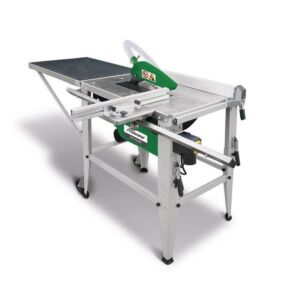
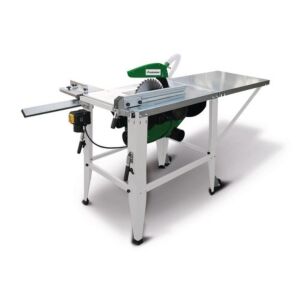
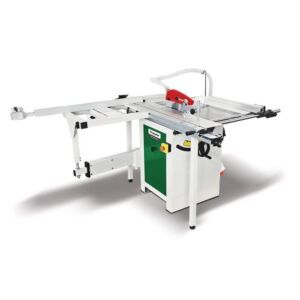
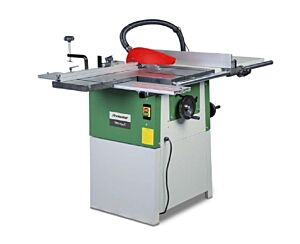
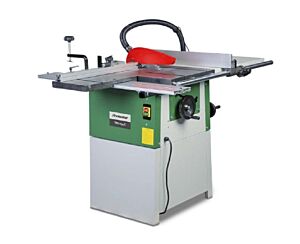
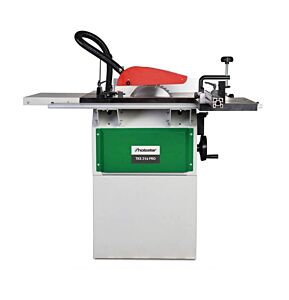
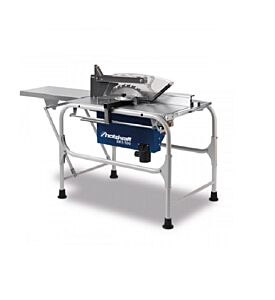
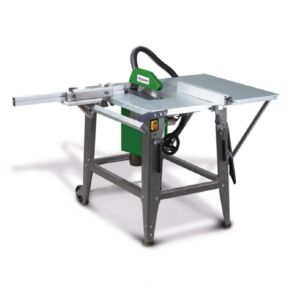
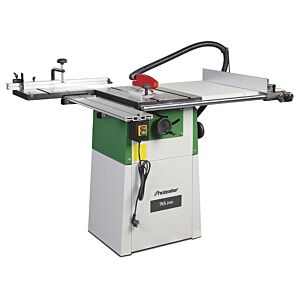
Holzstar circular saws for woodworking are designed for ripping, crosscutting, angled cutting and bevel cutting of solid timber, boards, panels, strips and furniture components. The category covers machines with different footprints, structural rigidity, workpiece capacities and operating equipment, ranging from compact table saws for smaller workshops to sliding-table machines intended for larger panels, repetitive production and work requiring extended reference surfaces.
A Holzstar circular saw removes material with a rotating blade projecting through the worktable. The workpiece must remain fully supported and must be guided by the rip fence, mitre guide, sliding table or a dedicated jig. Cutting quality depends not only on the saw’s power but also on table flatness, machine rigidity, fence alignment, blade condition and the consistency of the feed movement.
For ripping, the rip fence keeps the material at a constant distance from the blade. This arrangement is used to produce boards, strips and components whose edges run parallel to the grain. The fence must lock securely and must not converge towards the rear teeth. Incorrect alignment can force the timber against the rising section of the blade, causing friction marks, burning, loss of accuracy or kickback. Narrow components require a push stick or an appropriate feeding device so that hands remain outside the cutting zone.
Crosscutting is carried out with the mitre guide or the sliding table fitted to compatible Holzstar machines. The blade cuts mainly across the grain, so blade selection and workpiece support are particularly important for limiting breakout. The component must remain firmly against the crosscut fence throughout the movement. The rip fence should not act as a continuous length stop where this could trap the offcut between the fence and blade. Repetitive operations are safer and more controllable with a spaced stop that releases the component before it reaches the cutting area.
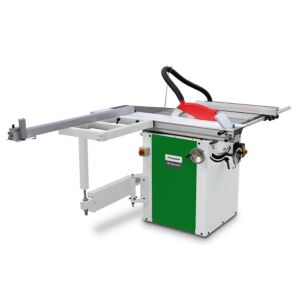
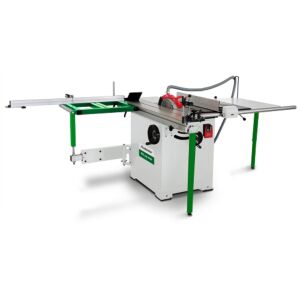
The sliding table is a key feature on Holzstar saws intended for dimensioning panels. It carries the material through the cut and reduces the need to slide a large surface directly across the fixed table. Accuracy depends on smooth travel, minimal play, correct crosscut-fence calibration and adequate support for the overhanging section of the panel. Extension tables, side supports and outfeed supports must be level with the machine table to prevent the workpiece from tilting as its centre of gravity moves.
Blade inclination allows compatible Holzstar circular saws to produce bevels, chamfers and inclined joints. The blade assembly is tilted relative to the table while the workpiece continues to travel on a stable reference surface. The effective angle should be verified with a suitable measuring instrument before precision work begins. Graduated scales are useful for initial positioning but may require calibration when accurately matched components are being produced.
Tilting the blade changes the projected cutting line and normally reduces the available cutting capacity. The positions of the guard, riving knife, table insert and fences must therefore be checked after every angular adjustment. The workpiece should be arranged so that it cannot become trapped between the inclined blade and the fence. Narrow bevelled parts may require a purpose-made jig that increases support and prevents the component from rolling or rotating during the cut.
Blade-height adjustment determines both cutting depth and the way the teeth enter the material. The blade should project sufficiently to complete the cut while allowing the guard and riving knife to function correctly. Excessive projection exposes more of the tool and changes tooth engagement; insufficient projection may increase friction and impair chip clearance. Height adjustments must be made with the machine stopped and must be checked before the saw is restarted.
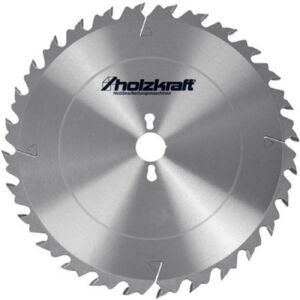
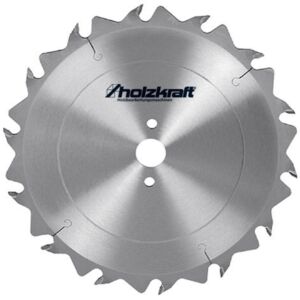
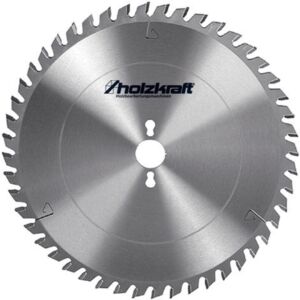
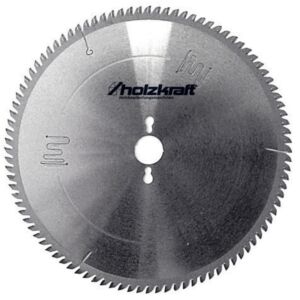
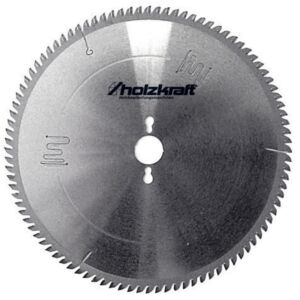
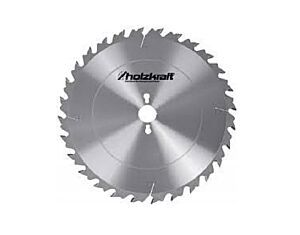
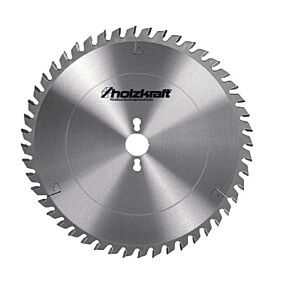
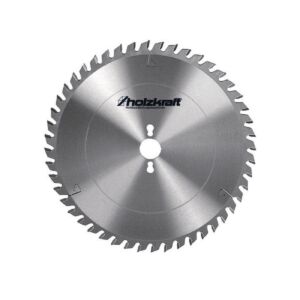
Holzkraft circular saw blades extend the flexibility of Holzstar machines by allowing the cutting tool to be matched to material, grain direction and required edge quality. A blade developed for ripping prioritises efficient chip clearance during cutting along the grain. A blade with a finer tooth arrangement is generally better suited to crosscutting and surfaces on which fibre breakout must be limited. Combination blades offer a useful compromise for mixed work, while a dedicated blade normally provides a better result when one process dominates production.
Holzkraft blades for boards and coated panels must be selected according to the sensitivity of the surface layer. Decorative coatings, laminates and veneers require suitable tooth geometry, consistent feeding and an accurately adjusted machine. Where a Holzstar saw is equipped with a scoring unit, the scoring blade makes a shallow preliminary cut on the underside before the main blade passes through the panel. The scorer and main blade must be aligned so that the preliminary groove covers the main cutting width without leaving an unnecessarily wide step.
Blade outside diameter, bore, plate thickness, cutting width, tooth form and permitted rotational speed must all be compatible with the Holzstar machine. Physical fit on the arbor alone is not sufficient. Compatibility with the flanges, guard, table insert and riving knife must also be verified. The riving knife should be matched to the blade plate and kerf so that it keeps the cut open without rubbing against the workpiece.
The riving knife follows the blade and helps prevent the kerf from closing around the rear teeth. This is particularly important when internal stress, moisture variation or timber distortion causes the material to move during cutting. The riving knife must be aligned with the blade and positioned at the distance specified for the machine. Removing it should not become a routine method of carrying out special cuts; non-through operations require only configurations and protective measures expressly permitted for the saw.
The upper guard covers the exposed section of the blade and may also help collect dust and chips close to their point of generation. It must adapt to the workpiece thickness without obstructing feed. Guards must never be fixed in the raised position. After changing blade diameter, height or inclination, clearance between the blade, guard, riving knife and table insert must be checked by hand with the machine isolated.
The rip fence on a Holzstar saw should move freely and lock without changing position. A long fence face provides an extended reference for straight boards and panels. A shorter auxiliary face can be advantageous where the component needs to be released immediately after passing the cutting point. Fence-face height should suit the operation: a taller reference supports upright work, while an approved low position may provide better clearance near the guard during narrow or bevel cuts.
The mitre guide positions the component at an angle to the blade for crosscuts and mitres. Repeatability requires a close fit in the table slot and positive locking at the selected angle. The actual setting should be tested on scrap material before finished components are cut. In frames and paired joints, the relationship between complementary cuts is often more important than the nominal number shown on the scale.
Stable support is essential. Twisted, bowed or irregular timber without a reliable reference face should not be forced directly against the fence because it can rock, rotate or close around the blade. The component should first be straightened or held in an appropriate jig. Large sheet material also needs support at the infeed, side and outfeed positions. The operator should not lift the trailing edge to compensate for overhang, since this changes the workpiece path relative to the blade.
Feed pressure must be smooth and appropriate for timber species, thickness, tooth geometry and the available drive. Feeding too slowly increases rubbing and may burn the surface. Excessive feed overloads the motor and teeth, reduces finish quality and may deflect the blade. If unusual force is required, the machine should be stopped and the blade sharpness, resin contamination, fence alignment, material stability and tooth selection should be investigated.
Resinous timber can leave deposits on Holzkraft blade teeth, increasing friction and reducing cutting performance. Blades should be cleaned with compatible products and without tools that could damage the tooth tips. Cracks, distorted plates, damaged teeth or unusual vibration require immediate withdrawal from service. Sharpening should be carried out by competent personnel so that the tooth geometry remains uniform around the blade.
Dust extraction contributes to cutting quality, visibility and workshop cleanliness. Holzstar circular saws should be connected to an extraction system suited to the available lower and upper ports. Clear airflow paths must be maintained around the blade enclosure and guard. Extraction does not replace internal cleaning: compacted sawdust can interfere with height and tilt mechanisms, retain heat and reduce adjustment accuracy.
When selecting a Holzstar circular saw, buyers should compare machine structure, table size, sliding-table quality, panel-support capacity, fence accuracy, blade-height and tilt adjustment, control accessibility, guarding, extraction and available accessories. A compact machine favours reduced footprint and easier installation in a small workshop. A larger, heavier machine generally provides greater stability, longer reference surfaces and more controlled handling of large panels.
The intended production is equally important. Ripping solid timber places emphasis on the rip fence, chip clearance and controlled feeding. Furniture and cabinet production requires particular attention to the sliding table, repeatable stops, sheet support and clean edges on coated materials. A mixed workshop benefits from rapid changeover between ripping, crosscutting and bevel work, together with access to compatible Holzkraft blades for each material and cutting direction.
Before each work period, the blade mounting, free rotation, fence alignment, riving-knife position, guard operation and extraction system should be checked. Blade replacement, cleaning and adjustment must only be performed while the Holzstar saw is isolated from the power supply and fully stationary. Careful setup and correct Holzkraft blade selection allow Holzstar circular saws to produce accurate, repeatable cuts for professional joinery, furniture production and demanding craft applications.