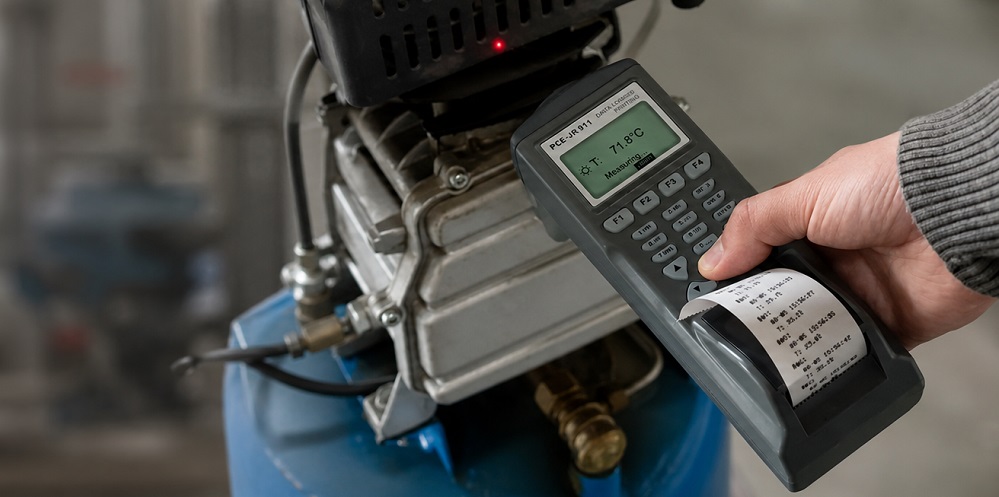
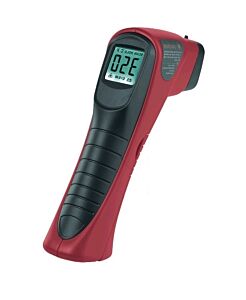
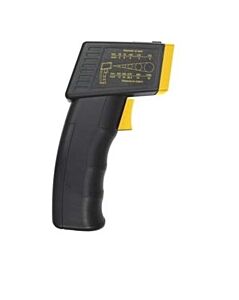
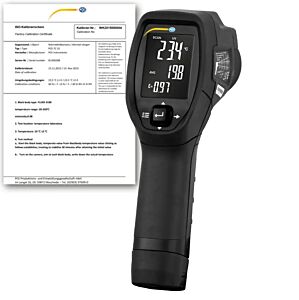
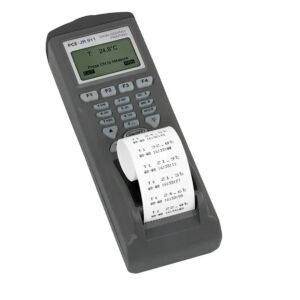
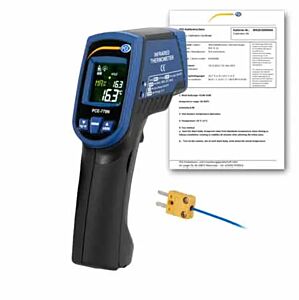
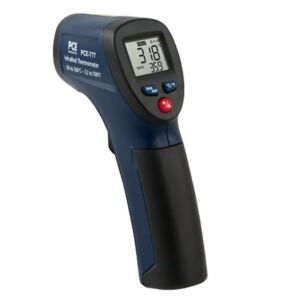
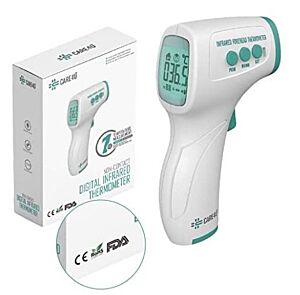
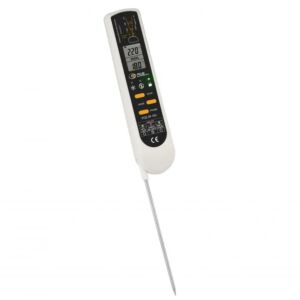
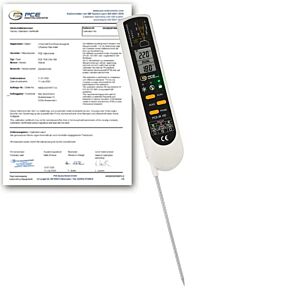
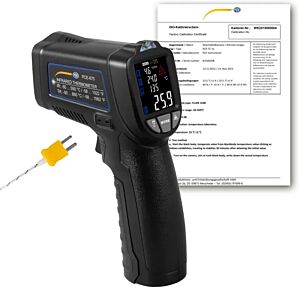
Infrared thermometers are professional instruments designed to measure surface temperature without direct contact with the component. Their operating principle is based on detecting infrared radiation emitted by a surface: the instrument captures this thermal energy, processes it through the internal sensor and shows a temperature value on the display. This technology is particularly useful when the point to be checked is hot, moving, difficult to access, electrically live, sensitive to contamination or when contact with a traditional probe would be unsafe, slow or not representative. For this reason, IR thermometers are widely used in industrial maintenance, quality control, HVAC, building inspection, laboratories, electrical systems, automatic machines, production processes and rapid technical checks.
Unlike contact probes, which measure temperature at the point where the sensor physically touches the material, an infrared thermometer measures radiation from a defined area of the surface. This allows fast and safe checks, but requires correct interpretation of the data. The displayed value depends not only on the real temperature of the object, but also on material emissivity, measuring distance, spot size, aiming angle, reflections and environmental conditions. To obtain reliable results, technicians must understand the behavior of the material and set the instrument consistently with the application.
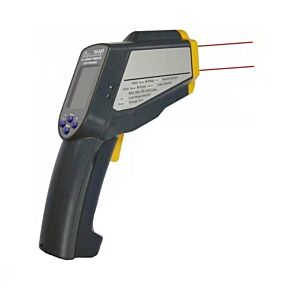
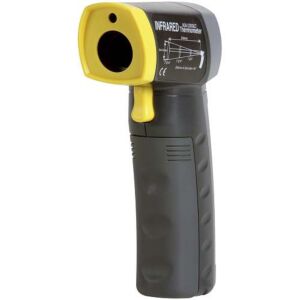
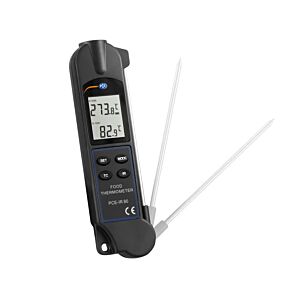
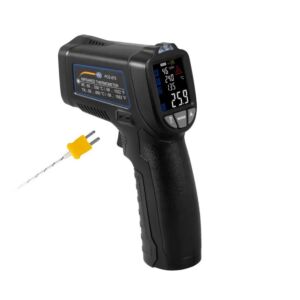
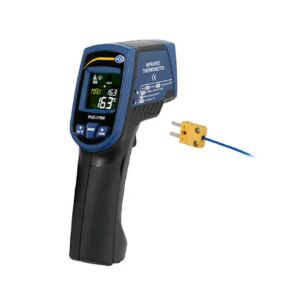
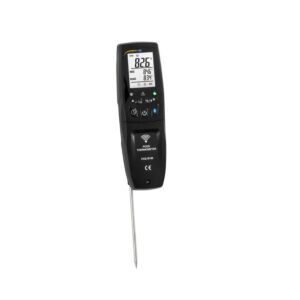
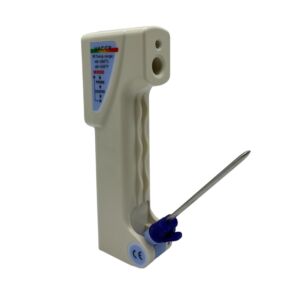
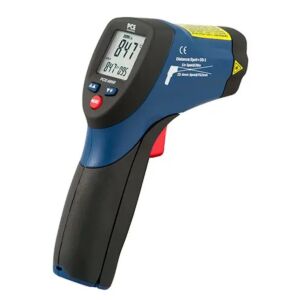
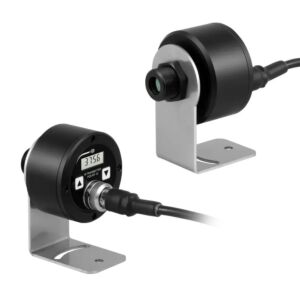
This category includes portable infrared thermometers with laser pointer, professional pyrometers with adjustable emissivity, models with dual laser to better identify the measured area, instruments with penetration probe or integrated thermocouple, Bluetooth thermometers, fixed pyrometers for permanent installation and instruments with extended measuring ranges for high-temperature applications. Portable models are ideal for mobile checks and maintenance because they allow many points of a system to be verified quickly. Fixed models are used when temperature must be monitored continuously on a machine, line or process. Combined models with contact probes allow comparison between IR and direct measurement, increasing operational flexibility.
Measuring range is one of the main parameters when selecting an instrument. For HVAC, building inspection, cold rooms, environments, materials or general maintenance, medium temperature ranges may be sufficient. For industrial processes, ovens, hot parts, molds, metals, motors, thermal systems and components subject to high heating, pyrometers with extended range and suitable sensors are required. Some models can measure very high temperatures, allowing checks on surfaces where traditional probes cannot be used. It is important to choose a thermometer with a range consistent with the process, avoiding instruments that are either oversized or insufficiently sensitive for the real operating interval.
Accuracy and resolution are essential. Accuracy indicates how close the measured value is to the real surface temperature, while resolution indicates the smallest increment displayed. Good resolution makes it possible to observe minimal variations between different points, but measurement quality also depends on emissivity, distance, optical ratio, instrument stability and correct procedure. In professional checks, reading an isolated value is often not enough: it is more useful to compare several similar points, check relative differences, observe changes over time and document the operating context of the measurement.
The distance-to-spot ratio, often indicated as D:S ratio, is a decisive technical aspect. This ratio indicates how the diameter of the measured area increases as distance increases. If the component is small and the thermometer is used from too far away, the instrument measures not only the component but also the surrounding area, producing a non-representative average value. To correctly measure an electrical terminal, pulley, bearing, small pipe or machine detail, the measuring spot must be smaller than the target. The laser pointer helps the operator align the instrument, but it does not always represent the entire area actually measured, so the optical ratio must always be considered.
Emissivity is another essential parameter. Each material emits infrared radiation differently. Opaque, painted, oxidized or non-reflective surfaces are generally easier to measure, while shiny metals, aluminum, stainless steel, chrome surfaces, glass and reflective materials can generate unreliable readings. A shiny surface may reflect radiation from nearby objects or from the operator, causing the displayed temperature to differ from the real one. In professional thermometers, adjustable emissivity allows the instrument to be adapted to the measured material, improving result reliability. When emissivity cannot be set correctly, it is advisable to use known references or practical methods such as applying a compatible matte surface when the process allows it.
Infrared thermometers are widely used in industrial maintenance. They allow checks on motors, bearings, gearboxes, pumps, compressors, pipes, valves, electrical panels, terminals, transformers, inverters, batteries, ovens, molds, rollers and mechanical parts. Abnormal temperature rise may indicate friction, overload, insufficient lubrication, misalignment, defective electrical contact, loss of efficiency, obstruction, cooling defect or wear. The instrument does not directly measure mechanical backlash, but it can highlight thermal effects caused by transmission backlash, slipping, vibration, loose belts, incorrect couplings or parts working with abnormal friction.
In quality control, IR thermometers allow rapid checks on heating, cooling, welding, bonding, painting, molding, packaging, drying, heat treatment and assembly processes. They can be used to check the temperature of moving products, hot materials, freshly processed surfaces or components before a subsequent phase. In laboratories and R&D departments, they are useful for comparative testing, validation, prototype monitoring and sample control when contact is not possible or might alter the temperature of the measured point.
In building inspection and HVAC, infrared thermometers are used to identify temperature differences on walls, windows, ducts, vents, radiators, floors, radiant systems, evaporators, pipes and air-conditioning equipment. They help verify heating and cooling system operation, air distribution, cold points, heat losses and localized thermal anomalies. Although they do not provide a complete thermal map like a thermal camera, IR thermometers are fast, practical and useful for point checks and comparative measurements.
The main adjustments include emissivity, measurement unit, temperature alarms, minimum and maximum values, memory, Data-Hold function, laser, backlight, data connection, Bluetooth and, in combined models, selection between infrared and probe measurement. Some instruments can record values, compare measurements and transfer data for reports or later analysis. In professional contexts, this function is useful when maintenance checks, quality inspections or operating conditions must be documented.
Height and positioning also influence measurement. A measurement taken from a point that is too high, too low or at a very inclined angle may read a surface different from the intended one or increase reflection effects. On curved surfaces, pipes, rollers or small components, the aiming angle should be kept as stable and perpendicular as possible. In repeated measurements, it is advisable to maintain the same distance, position and control point so that results can be compared over time. This is particularly important in preventive maintenance, where progressive variations are often more meaningful than a single absolute value.
Shape and geometry errors can strongly affect measurement. A curved, shiny, irregular, inclined or partially hidden surface may return a non-representative value. A small pipe measured from too far away, a pulley with reflective surface, an inclined sheet metal panel or a component behind a grille may generate altered readings. The IR thermometer measures only the visible surface and not the internal temperature of the material; therefore, for thick products, food, fluids or components with thermal gradients, it may be necessary to integrate the measurement with a contact or penetration probe.
To obtain reliable results, it is advisable to clean the measuring point if dirty, avoid uncontrolled reflective surfaces, set correct emissivity, respect the distance-to-spot ratio, wait for instrument stabilization and repeat the measurement several times. When checking electrical or mechanical components, it is useful to compare similar elements: three phases, several bearings, several rollers, several motors or several pipes in the same system. Relative differences help identify anomalies even when the absolute value may be influenced by environmental conditions or different materials.
Infrared thermometers are therefore essential professional instruments for companies, technicians, engineers, maintenance teams and laboratories that need to perform fast, safe and non-destructive surface temperature measurements. The availability of portable, laser, dual-pointer, adjustable-emissivity, Bluetooth, memory, integrated-probe and fixed process models makes it possible to choose the correct instrument according to the application. For Tadaah, a category dedicated to infrared thermometers provides a complete technical reference to support professionals and companies in selecting the most suitable device, improving maintenance, quality control, safety, diagnostics and process reliability.