Abrasive wheels for sharpening HSS and carbide tools (HM) and for blade sharpening When people think about sharpening, it is common to assume that choosing a “harder” wheel automatically leads to a better cutting edge. In practice, sharpening is a balance between the tool material, the abrasive type, the bond, the grit size, the peripheral speed, the cooling strategy and, above all, dressing. A grinding wheel is not just a consumable: it is a real cutting tool, and like any tool it must work under the right conditions to remove material consistently, keep heat under control and maintain the required geometry. As soon as that balance is lost, the symptoms are very recognizable: the wheel becomes shiny, it tends to slide on the part, heat rises quickly, surface finish deteriorates, and the edge shows burning, micro-chipping or dimensional errors. The most effective way to select the correct wheel is to start from abrasive-to-material compatibility. HSS tools are best sharpened with Whi…
Abrasive wheels for sharpening HSS and carbide tools (HM) and for blade sharpening
When people think about sharpening, it is common to assume that choosing a “harder” wheel automatically leads to a better cutting edge. In practice, sharpening is a balance between the tool material, the abrasive type, the bond, the grit size, the peripheral speed, the cooling strategy and, above all, dressing. A grinding wheel is not just a consumable: it is a real cutting tool, and like any tool it must work under the right conditions to remove material consistently, keep heat under control and maintain the required geometry. As soon as that balance is lost, the symptoms are very recognizable: the wheel becomes shiny, it tends to slide on the part, heat rises quickly, surface finish deteriorates, and the edge shows burning, micro-chipping or dimensional errors.
The most effective way to select the correct wheel is to start from abrasive-to-material compatibility. HSS tools are best sharpened with White Aluminum Oxide (WA), a high-purity aluminum oxide that performs well on steels and provides good thermal control. Its key feature is friability: grains break down in a controlled way and keep the wheel cutting, provided the wheel is dressed regularly. In sharpening operations, especially when clean finishes and accurate geometries are required, WA supports small and controlled stock removal, typically in the range of 0.01–0.05 mm per pass. Grit size directly affects the result: coarser grits remove more material but leave a heavier scratch pattern, while finer grits reduce scratches and improve edge quality. For this reason, sharpening drills and end mills in HSS often combines an intermediate grit for profile restoration and a finer grit for final finishing, always paying attention to heat, because thermal burns are one of the main risks on steel. Peripheral speed must also match the bond: vitrified wheels usually run at moderate speed, while resinoid wheels can run faster, but higher speed and pressure increase the need for correct cooling and for a wheel that remains “open” and sharp.
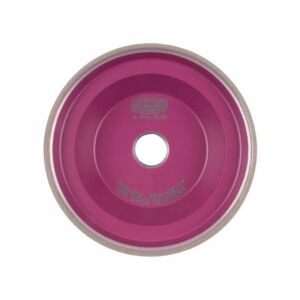
When moving to carbide tools (HM), the rules change. Carbide cannot be sharpened efficiently with conventional aluminum oxides, because its hardness and structure require a superabrasive. In this case, Diamond wheels are the correct solution, enabling micrometric stock removal and the geometric stability needed to grind cutting edges and relief angles accurately. Carbide sharpening typically uses very small passes, roughly 0.005–0.02 mm, and coolant is not optional but essential. Diamond can degrade if the contact zone reaches excessive temperatures, a phenomenon often described as graphitization, which causes loss of cutting ability and poorer finishes. This is why stable carbide sharpening depends on the wheel, the bond and the cooling working together: metal bond offers rigidity and long life, while resinoid bond can feel “softer” and more forgiving, but in both cases you need a well-directed emulsion at the grinding zone and continuous control of wheel condition.
Alongside diamond, the other essential superabrasive is CBN, cubic boron nitride. A point that often causes confusion must be made clear: CBN is not a universal solution for “anything hard”; it is the reference choice for hardened steels above 50 HRC and, more generally, for ferrous materials where diamond is not recommended. In grinding and sharpening of very hard steel components, CBN works at very high peripheral speeds and offers an excellent compromise between hardness and toughness, but it requires strict thermal management, often with oil mist, because extremely high temperatures can lead to oxidation and performance loss. For beginners, the simplified rule is reliable: steels and HSS are managed with aluminum oxides, or with CBN when steels are extremely hard, while carbide requires diamond.
However, selecting the correct abrasive is not enough. The step that separates an average result from a professional one is dressing. Dressing is the operation that restores wheel geometry, flatness and cutting ability when the wheel is worn, dull or loaded. Over time, exposed grains lose their sharp edges, wheel pores fill with debris, and the wheel face becomes shiny. A shiny wheel does not cut: it generates heat. That leads to lower removal rates, worse surface finish, burns on steels and, in severe cases, vibrations and imbalance that compromise both safety and accuracy. Dressing therefore becomes decisive, because it restores sharp grains, removes loading and reopens the wheel structure so chips can be evacuated correctly.
The dressing method depends on the wheel type and the required precision. On vitrified precision wheels, diamond dressers are used to maintain an accurate profile and high repeatability. When dresser life becomes critical, polycrystalline diamond is a common choice, while star dressers are used on rough wheels where cost and robustness matter more than micrometric accuracy. Rotary carbide systems are suitable for heavy work on cast iron or non-ferrous alloys, but they are not ideal for very fine grits. Dressing parameters are equally important: precision wheels are dressed with very small infeed values, often only a few microns per pass, while coarse wheels can use larger infeed. Dresser orientation also matters: vitrified wheels are often dressed with an angled approach, while resinoid wheels benefit from a more perpendicular contact to reduce chipping and instability. Dressing frequency is not a fixed number but a process criterion: you dress whenever cutting drops, heat increases or finish degrades. In production, it is common to program dressing at regular intervals, for example every 10–15 parts in repetitive cycles, because prevention is more efficient than correction.
Blade sharpening deserves its own explanation, because edge geometry and heat sensitivity are even more critical. Steel blades, including HSS and alloy steels, can be sharpened with White Aluminum Oxide when a clean edge and controlled finish are required. In these applications, avoiding localized overheating at the edge is essential, because even slight thermal damage can alter hardness and drastically reduce edge life. That is why grit choice, frequent dressing and effective cooling become central. When fast material removal is needed, for example to restore a damaged blade or for pre-sharpening in production, Zirconia (ZA) in abrasive belts or flap discs is often used because its self-sharpening behavior supports aggressive removal. Productivity is high, but pressure must be controlled: excessive force can cause grain pull-out and reduce belt or wheel life. For blades with carbide tips or carbide teeth, diamond is again the correct solution, with very small passes and careful coolant control, because the goal is not to force removal but to maintain correct profiles and relief angles without micro-chipping.
Ultimately, effective sharpening follows a simple but strict logic. From a material perspective, HSS and steel benefit from White Aluminum Oxide when precision and thermal control matter, while carbide requires diamond and a controlled, “cool” process. CBN is the reference solution for very hard, hardened steels where superabrasive stability is critical. From a process perspective, dressing is not an accessory step but the core of stability: a dressed wheel cuts, a dull wheel heats. Professional sharpening is not about pushing the wheel beyond its limits, but about keeping the wheel in its best cutting condition through correct parameters, correct cooling and a dressing strategy that maintains geometry and cutting performance over time.
| Tool / workpiece material | HSS (high speed steel) • Carbide (HM) • Steel/HSS blades • Carbide-tipped/toothed blades |
| Suitable abrasive | HSS: White Aluminum Oxide (WA) Carbide: Diamond (D) Very hard steels > 50 HRC: CBN |
| Typical bond | WA: Vitrified (V) for precision / Resinoid (B) for more “forgiving” behavior D: Metal (M) or Resinoid (B) depending on finish & durability CBN: often V or M depending on process |
| Indicative grit range | WA: G80–G220 (depending on roughing/finishing) CBN: G180–G320 for stable finishes on hard steels D: fine/medium selection depending on geometry & required finish |
| Indicative stock removal per pass | WA (HSS): 0.01–0.05 mm D (carbide): 0.005–0.02 mm |
| Recommended cooling | WA: emulsion recommended, air only for light controlled operations D/CBN: coolant mandatory and well-directed (thermal stability & finish) |
| Typical risks to control | HSS: surface burning if wheel is dull or pressure is excessive Carbide: performance loss if thermal management is insufficient General: pore loading and loss of cutting regularity |
| Blade sharpening note | Steel/HSS: WA for clean cutting edge and controlled finish Fast restoration: ZA (belts/flap) with controlled pressure Carbide blades: Diamond with very small passes and accurate cooling |
| Purpose of dressing | Restore cutting ability • Remove dull grains • Remove loading • Reopen porosity |
| Recommended tools | Single-point diamond for precision PCD for longer life Star dresser for rough wheels and quick restoration (less precise) |
| When to perform | When cutting drops, temperature rises, finish degrades, sound/vibration changes |
| Indicative frequency | In repetitive cycles: can be scheduled (e.g., every 10–15 parts) to stabilize quality and productivity |
| Common mistakes to avoid | Insufficient dressing (wheel glossy and not cutting) Excessive pressure (grain chipping & instability) Asymmetric dressing (uneven wear & vibration) |
| Expected benefits | More stable process • Less overheating • Better finish • Longer average wheel life |
- Brand
-
- Typology
-
- Diameter "d1" mm
-