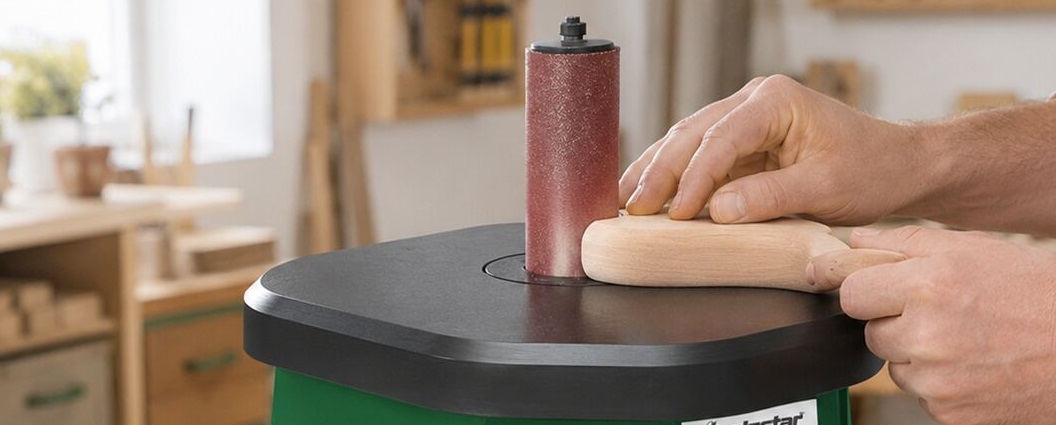
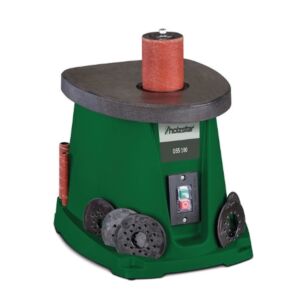
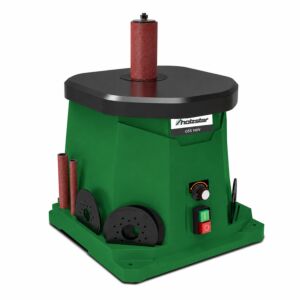
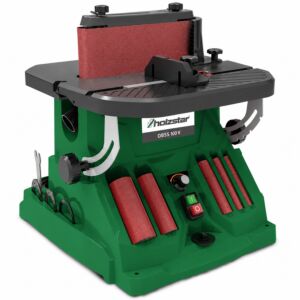
Holzstar oscillating spindle sanders are stationary machines designed for finishing internal curves, concave transitions, openings, templates, edges and wooden components that are difficult to process with a conventional belt sander. The abrasive tool consists of a sanding sleeve fitted over a cylindrical drum or spindle that combines rotation with vertical oscillation. Rotation removes material, while oscillation distributes contact over a larger abrasive area, reduces groove formation and helps control heat.
Holzstar oscillating spindle sanders are used for furniture parts, frames, seating components, decorative elements, wooden toys, joinery templates, routed parts and panels with internal openings. They are particularly useful after cutting with a bandsaw, scroll saw or router, when machining marks must be removed and the profile prepared for painting, oiling or bonding.
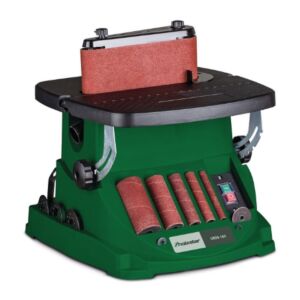
The Holzstar category includes dedicated oscillating spindle sanders and combination configurations with an oscillating sanding belt. Dedicated machines prioritise compactness and access around the vertical spindle. Combination models use the spindle for internal curves and concave radii and the belt for straight edges, longer surfaces, external curves and more extensive sanding work.
The spindle normally operates vertically and perpendicular to the worktable. This position provides a stable reference and helps keep the workpiece edge consistent through its thickness. The spindle must not be tilted arbitrarily. Angled sanding requires a tilting table, jig or support specifically intended for the Holzstar machine. If the model does not provide such adjustment, the component should be prepared with more appropriate equipment rather than held at an unstable angle by hand.
Vertical oscillation is an important technical feature. Without oscillation, the workpiece would continuously contact the same narrow area of the sleeve, wearing it quickly and making horizontal grooves more likely. The reciprocating movement distributes wear over a greater height, helps keep the abrasive clear and produces more evenly crossed sanding marks. This action is particularly useful with resinous timber and during extended operation.
Holzstar machines can use spindles and sleeves of different diameters. Selection should be based on the internal radius of the workpiece. The largest diameter that fits the curve without forcing is normally preferable because it provides a more stable contact area, reduces the tendency to create hollows and makes it easier to maintain a uniform profile. Smaller spindles are intended for tight radii, narrow openings and intricate details but require gentler movement.
The sanding sleeve must fit evenly over the drum. Folds, looseness or incomplete installation can cause vibration, repeated marks and abrasive movement. Where an expanding rubber drum is used, it should be tightened sufficiently to secure the sleeve without excessive deformation. After replacement, the Holzstar sander should be run briefly without a workpiece to verify centring and stability.
Table inserts must be selected to match the spindle diameter. The opening should provide enough clearance for rotation and oscillation while keeping the gap around the sleeve as small as practical. An excessively large opening may allow small components, chips or thin ends to become trapped. The insert must sit correctly in the table without creating a step that could tilt the workpiece.
The workpiece should rest fully on the table and be guided against the abrasive with both hands at a safe distance. Feed should oppose the direction of rotation as specified by Holzstar, avoiding a climb-sanding action that might pull the component. Before starting, the operator should confirm spindle rotation and test the movement on scrap material.
To process an internal curve, the workpiece is introduced gradually and kept moving continuously along the profile. It should not be pressed against a single point of the sleeve because this would create a local hollow. Movement should follow the shape smoothly, distribute contact and allow frequent inspection. Leaving a small machining allowance during initial cutting and approaching the final line progressively during sanding provides better control.
The oscillating spindle should not be used to create an entirely new curve from a large amount of excess material. This would require high pressure and make the geometry difficult to maintain. The main shape should be produced with a bandsaw, scroll saw or router, leaving the Holzstar spindle sander to remove machining marks and refine the profile.
Ends and thin workpiece areas require particularly light pressure. Their reduced contact area produces rapid removal and can round edges unintentionally. To preserve an accurate line, more robust sections should be processed first and details completed with short passes, checking the shape frequently against a template.
Small components should not be sanded directly if they cannot be held securely. They can be attached to a larger carrier or controlled with jigs and holding devices. This improves stability and keeps fingers away from the spindle. Wide components must also remain properly supported, using aligned extensions where required.
On combination Holzstar machines, changing between the spindle and belt broadens the available operations. The spindle handles concave curves and shaped openings, while the belt processes straight sections, convex curves and larger surfaces. Depending on the configuration, the belt unit may be positioned horizontally or vertically so that the most stable working arrangement can be selected.
With the belt in a horizontal position, the workpiece can be supported over a broader surface. In the vertical position, the front table provides a reference for edges and profiles. The belt unit must be locked securely before starting and the abrasive should run without interference. The workpiece must remain in motion on an oscillating belt to distribute wear and prevent hollows.
Holzstar configurations with variable speed allow abrasive action to be adapted to the material, grit and component geometry. A lower speed can improve control on small pieces, delicate surfaces and timbers susceptible to burning. A higher speed supports productivity on more robust surfaces but requires consistent feeding. Speed adjustment does not replace correct abrasive selection and should not compensate for a worn sleeve.
Grit should match the processing stage. Coarse abrasive rapidly removes bandsaw and routing marks but may alter the profile and leave deep scratches. Medium grit evens the shape, while fine grit prepares the edge for finishing. A progressive sequence produces a more regular surface than moving directly from rough sanding to a very fine grit.
Grain direction changes continuously along a curve. Pressure should therefore remain moderate and the component should not stop moving. Where the abrasive works against the grain, splintering or more visible scratches may occur. In these areas, pressure should be reduced, workpiece orientation adjusted slightly and a less aggressive grit used.
Soft and resinous timbers may clog sanding sleeves rapidly. If cutting performance decreases, additional pressure should not be applied because it generates heat and burn marks. The abrasive should be inspected, cleaned with a compatible product or replaced. Adhesive residue must also be fully cured and major excess removed before sanding.
Dust extraction is essential because fine particles are generated around the spindle and, on combination machines, along the belt unit. The Holzstar sander should be connected to an extractor providing suitable airflow and filtration for wood dust. Correct inserts and clear extraction ports help collect dust close to the contact area. Poor collection reduces visibility, clogs the abrasive and releases more dust into the workshop.
Maintenance includes cleaning the table, inserts, spindle, drums, sanding sleeves and extraction system. Oscillating movement should remain smooth, with no abnormal play, and all abrasives should be inspected for damage. Torn, distorted or loose sleeves must be replaced. Maintenance must always be performed with the Holzstar machine disconnected and completely stationary.
Before purchasing, compare the available spindle diameters, sleeve and insert availability, table size and stability, oscillating action, variable-speed control, the presence and positioning of a belt unit, motor power, dust extraction and accessory storage. A correctly selected Holzstar oscillating spindle sander accurately finishes internal radii, curves, openings and templates, while combination versions also process straight edges, elongated surfaces and external curves