METALLKRAFT, NEBES Elettromeccanica and OPTIMUM band saw stands and roller conveyors are accessories designed to improve stability, ergonomics, safety and cutting accuracy when processing metal bars, tubes, profiles and components. The category includes machine columns and dedicated bases, adjustable single-roller or shaped supports, mobile stands, modular infeed and outfeed roller conveyors and, depending on the configuration, conveyor systems with length stops and measuring devices. Although all these products support or move material, their construction, load capacity, adjustment range and compatibility differ.
A machine stand directly supports the band saw and contributes to a stable, correctly positioned workstation. It is more than a simple means of raising the machine: rigidity, supporting surface and connection to the saw influence vibration, vice alignment, loading convenience and cutting quality. A stand intended for a specific METALLKRAFT, NEBES Elettromeccanica or OPTIMUM saw uses the appropriate mounting points, keeps the controls accessible and distributes machine weight correctly.
A fixed column is suitable where the band saw occupies a permanent workstation. Before installation, floor flatness and strength must be checked, together with the location of the feet or anchoring points. The machine must not rock after assembly. Fasteners between the stand and saw should be tightened evenly without distorting the structure. Saw-table, vice, blade, roller-conveyor height and material-feed direction must then be aligned.
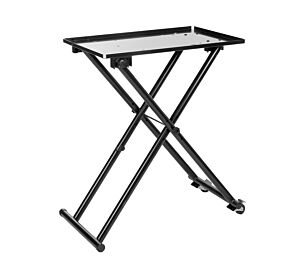
Mobile or wheeled stands provide greater flexibility when the machine needs to be moved between work areas. During cutting, however, all wheels and stabilising devices must be locked. The machine must not be moved while material rests on the vice or conveyor. Before transport, moving assemblies should be lowered or secured, the power supply safely disconnected and the route checked for obstacles.
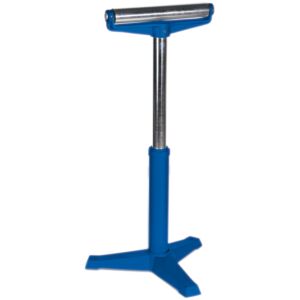
Single-roller stands support a specific point on a long bar, tube or profile. Height adjustment allows the roller to be aligned with the saw’s material-support surface. A stand positioned too low leaves the component inclined away from the machine, while one set too high may lift the workpiece from the vice and impair clamping. Adjustment should be made at the actual position occupied by the material, with alignment checked over its length using a straight reference or suitable measuring method.
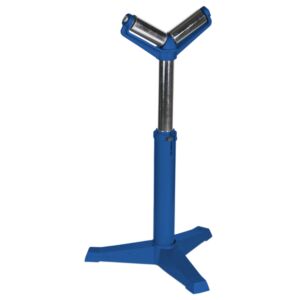
Flat rollers suit rectangular bars, profiles, flats and components with a stable supporting face. V-shaped or shaped supports assist with centring round tubes and cylindrical bars that might otherwise move sideways. The support shape does not replace the saw vice: the roller carries the weight, while the vice immobilises the component during cutting. For finished or delicate material, rollers must also be clean and free from burrs that could scratch the surface.
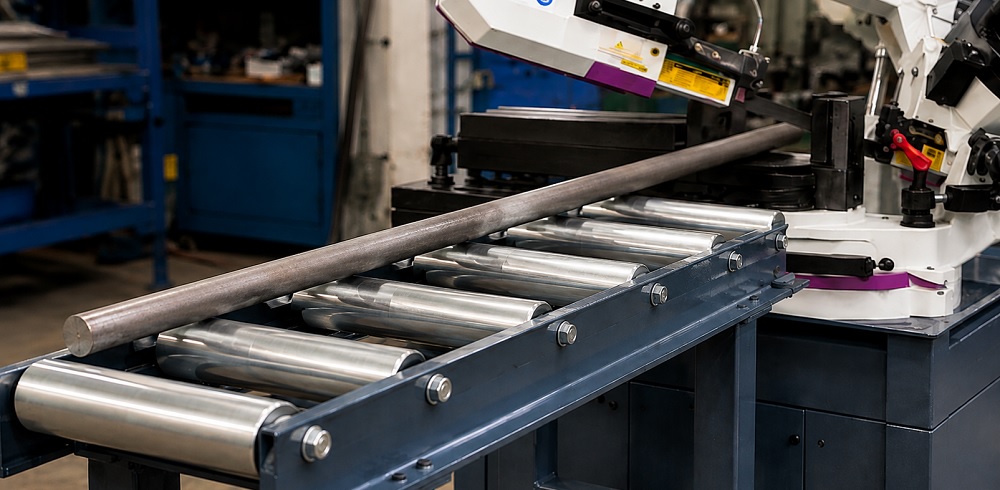
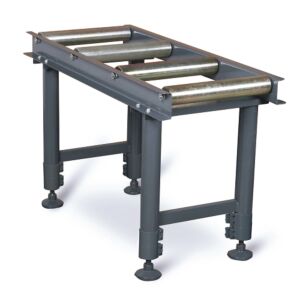
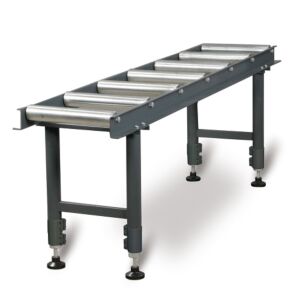
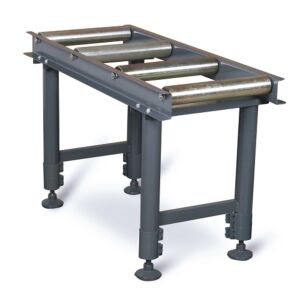
Multi-roller conveyors distribute weight over a wider area and make long or heavy material easier to load. They may be installed on the infeed side, outfeed side or both sides of the saw. An infeed conveyor helps position stock in the vice, while an outfeed unit supports the cut length and prevents it from falling at the end of the cycle. Correct arrangement reduces operator effort and limits lateral loads on the vice, blade and machine structure.
The choice between a single support and a complete roller conveyor depends on material length, weight and flexibility. One stand may be adequate for a relatively rigid profile during occasional work, whereas long bars, thin tubes and heavy components require several supporting points. Excessive distance between supports allows material to deflect, altering its position in the vice, changing the cutting angle or closing the kerf on the blade as the component separates.
Roller-conveyor selection requires consideration of total capacity and load distribution. Material weight is not always distributed equally over every roller, particularly during initial loading and final discharge. Rated capacity should therefore be evaluated against possible concentrated load as well as total workpiece weight. Usable width, roller diameter, roller spacing, height adjustment and frame stability are also important.
Roller spacing is especially important for thin tubes, short cut pieces and flexible profiles. Excessive spacing can allow the component to fall between rollers, strike the frame or lose its reference. Closer roller spacing supports short components and reduces deflection. Long, rigid materials may be handled with different spacing, provided they remain securely supported throughout movement.
Modular roller conveyors allow the handling line to be extended according to stock length. Modules must be connected and aligned without creating steps between adjacent sections. Adjustable feet compensate for minor floor irregularities but should not be used to correct a severely inclined or unstable installation. Every foot must carry its intended load, and the adjustment mechanisms must be locked after levelling.
Conveyors with length stops improve repeatability when producing identical components. Material is advanced against the stop, clamped in the vice and cut. Before starting a batch, the stop must be referenced to the actual blade position and a trial cut performed. The operator must consider the real blade line, measuring-system play, condition of the reference end and any burr remaining from the previous cut.
A stop should locate the material longitudinally without pushing it sideways or lifting it from the rollers. On some systems, the stop may need to retract or be moved away after clamping so that the workpiece is not compressed between the stop and blade during cutting. A length stop improves repeatability but cannot compensate for an out-of-square reference end, blade deviation or incorrect material support.
The most stable workpiece surface should rest on the rollers. Round tubes must be guided so that they cannot roll sideways and may require side rails or shaped supports. Angle, channel, T-section and box profiles should be oriented for both conveyor stability and suitable blade engagement. The most stable transport position must still allow correct clamping within the saw vice.
Before cutting, material must be supported, aligned and clamped without remaining suspended between the vice and conveyor. After clamping, the supports should be checked to ensure they are not lifting or twisting the component. No operator should manually carry the workpiece weight during cutting as a substitute for a correctly sized conveyor. The section being separated must remain supported until the cycle finishes so that it cannot fall, rotate or close against the blade.
Finished pieces should be moved to a stable unloading area rather than accumulated randomly across the rollers. A component left transversely can block the next workpiece or fall during handling. For repetitive production, containers, tables or collection systems should be positioned separately from the cutting line. Hot, sharp or coolant-covered parts require suitable handling tools and protective equipment.
During mitre cutting, the material occupies a different position relative to the blade and may require additional lateral clearance. Depending on the saw, the frame, vice or table rotates, while the roller conveyor must continue to support the component without interfering with moving assemblies. The full movement should be simulated before starting, checking for collisions and ensuring that the support does not twist or bend the profile. Repeat mitre work may benefit from dedicated stops and a consistent loading procedure.
Material type affects accessory selection primarily through weight, shape and surface sensitivity. Solid steel bars need rigid structures and appropriate load distribution. Thin tubes and light profiles need several supports to prevent deflection. Stainless steel, aluminium and finished components require clean rollers free from contaminants that could scratch surfaces or transfer ferrous particles. Conveyors should be cleaned when moving from dirty or scaled stock to material with a more delicate finish.
Safety depends on the stability of the complete system formed by saw, stand, conveyor and workpiece. Supports must not be overloaded, used as walkways or employed for purposes other than their intended material-handling function. Hands, clothing and loose items must remain clear of crushing points between rollers and material. Height adjustments must be locked and should not be made while the material is moving or supported precariously.
Maintenance includes cleaning rollers, frames, stops and measuring systems. Rollers should rotate freely without abnormal play, seizure or noise indicating bearing wear. Long chips can wrap around roller shafts and must be removed with the system stopped and suitable tools. Fasteners, connections, adjustable feet, wheels, brakes and locking devices require periodic inspection. Deformed surfaces, damaged rollers and unstable frames must be repaired or replaced before further use.
Before purchasing, buyers should verify stand compatibility with the specific METALLKRAFT, NEBES Elettromeccanica or OPTIMUM model, its ability to support the machine, working height and mounting system. Roller conveyors must be selected according to workpiece length, weight, section, usable width, height adjustment, modularity, length-stop requirement and installation on the infeed or outfeed side. Available floor space and the route required to bring bars into the workshop must also be considered.
Dedicated stands improve ergonomics and place the saw at its intended operating height. Single supports offer a flexible, easily repositioned solution for variable work. Short conveyors suit compact stations, while modular systems create longer material-handling lines. Length stops improve repeatability and reduce manual marking. The correct workstation may therefore combine several coordinated accessories rather than rely on one product.
METALLKRAFT, NEBES Elettromeccanica and OPTIMUM stands and roller conveyors are used in metal fabrication shops, machine shops, toolrooms, machine-tool repair departments, construction sites and structural-steel companies. Applications include the manufacture of frames, doors, windows, railings, supports, pipework, plant components, welded structures and parts intended for subsequent CNC machining. They are useful wherever bars and profiles must be loaded, measured, cut and unloaded in a controlled manner.
Tadaah supports the selection of METALLKRAFT, NEBES Elettromeccanica and OPTIMUM stands, supports and roller conveyors by evaluating the saw model, vice height, material weight, length and shape, operating frequency, available space and need for repetitive cuts. Correct integration between the saw and its accessories reduces operator effort, improves workpiece alignment, protects the blade from lateral loads and creates a safer, more efficient cutting station.