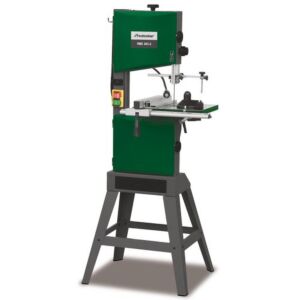
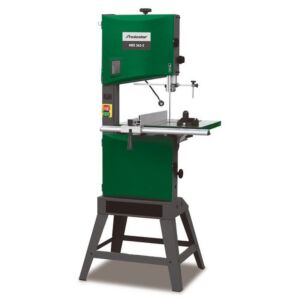
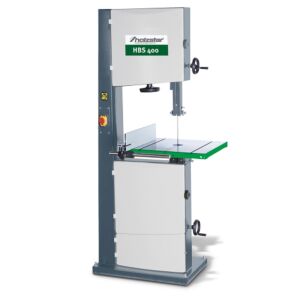
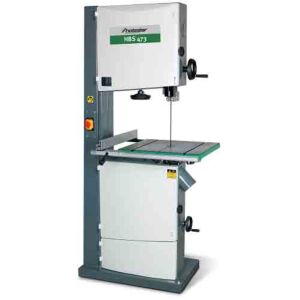
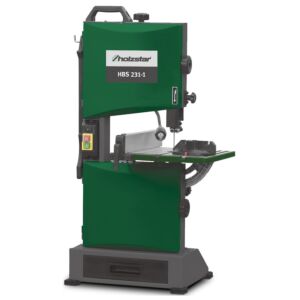
Vertical bandsaws for wood are versatile machines designed for straight, curved and bevel cutting, trimming and resawing solid timber, boards, strips, panels and semi-finished components used in joinery and furniture manufacturing. Their operating principle is based on a continuous loop blade travelling vertically through the worktable and running around two wheels enclosed within the machine structure. The continuous blade movement produces a regular cut with a generally narrow kerf and allows workpieces of very different shapes and dimensions to be processed.
The category covers machines with cutting heights ranging approximately from 152 to 305 mm and worktables ranging from compact dimensions of about 360 × 320 mm to larger supporting surfaces of approximately 530 × 480 and 545 × 515 mm. Compact bandsaws are suitable for craft workshops, maintenance work, model making, small components and advanced hobby woodworking. Machines with a taller frame, larger table and greater cutting capacity are intended for thick boards, furniture components, solid-wood trimming and more demanding professional use.
Cutting height indicates the maximum theoretical workpiece thickness that can be processed with the blade in its vertical position. This specification must be considered together with the distance between the blade and the machine column, commonly known as throat capacity. Cutting height determines the thickness of the workpiece, while throat capacity affects the width that can be introduced onto the table before reaching the frame. A high cutting capacity is useful for dividing thick boards, producing thin sections from substantial timber and preparing solid components. A larger throat provides more room for turning templates, panels and irregular shapes.
The worktable supports the workpiece and establishes the geometric reference for the cut. A large surface improves the support of boards, panels and wide templates and reduces their tendency to tilt or rotate. A compact table is more practical where space is limited and small components are mainly processed. In either case, the result depends on stable support. Long workpieces should also be supported outside the machine with roller stands, trestles or extensions accurately aligned with the table.
With the table perpendicular to the blade, the machine produces 90-degree cuts, straight trimming operations and cuts parallel to the workpiece surface. Tilting the table makes bevel cuts, chamfers and angled edges possible. When the table is inclined, the workpiece tends to slide towards the lower side and the effective distance travelled by the blade through the material increases. Feed should therefore be reduced, the workpiece must be supported securely and possible interference between the blade, fence and guides must be checked. The setting can be read on the machine scale, but precision work should be verified with an angle gauge or adjustable square.
The blade normally remains vertical while the table changes its angle. This arrangement keeps the blade path between the wheels stable and allows bevel cuts without altering blade tracking. Before tilting the table, the area of movement should be cleared, blade clearance in the table insert checked and the mechanism firmly locked at the required angle. After adjustment, manually rotating the wheels with the machine disconnected confirms that the blade cannot contact the insert, guide or other components.
A rip fence is used for straight cuts and maintains a consistent distance between the blade and the edge of the workpiece. It is suitable for trimming boards, sizing strips and panels and dividing thick components into thinner sections. The fence should be aligned with the blade’s actual cutting direction. A bandsaw blade may show a slight tendency to travel laterally, commonly called blade drift. A test cut on scrap material helps identify the natural cutting direction so that the fence can be adjusted before the finished component is processed.
During curved cutting, the workpiece is guided manually along a marked line. Blade width determines the minimum achievable radius. A narrow blade can follow tighter curves, whereas a wide blade provides greater stability during straight cutting and work on thick material. A wide blade should not be forced around a radius that is too tight, because twisting may damage the teeth, deform the band or cause it to leave the wheels. Relief cuts made in waste areas can make tight profiles easier to produce by reducing the volume of material that must move around the blade.
Tooth pitch must be selected according to the thickness and type of wood. A coarse pitch with fewer teeth per unit of length provides larger gullets and supports chip evacuation during thick and longitudinal cuts. A fine pitch normally produces a smoother surface on thin components, plywood and panels, but can become clogged when used on excessive material thickness. Several teeth should generally be engaged in the material at the same time without an excessive number being trapped in the cut. Correct selection helps reduce vibration, heat, blade wandering and tooth damage.
Tooth form and set also influence cutting behaviour. Tooth set produces a kerf slightly wider than the band body, reducing friction between the blade and the walls of the cut. A more pronounced set can support cutting in soft or damp timber, while a finer configuration favours a smoother surface on dry and prepared materials. Blade selection must account for the exact length required by the machine, the widths permitted by the wheels and guides, band thickness, tooth pitch and tooth geometry.
Correct blade tension is essential for accuracy. Insufficient tension encourages wandering, vibration and blade loss from the wheels. Excessive tension places unnecessary stress on the blade, bearings and machine frame. Tension should be adjusted according to the manufacturer’s specifications and the width of the installed blade. After tensioning, the operator should check blade tracking on the wheel tyres and rotate the wheels manually to confirm that the path remains stable.
Upper and lower guides limit lateral blade movement and support the rear edge during feeding. The height-adjustable upper guide should be positioned as close as practical to the top of the workpiece, leaving only the clearance required for passage. An unnecessarily long unsupported blade section reduces rigidity and encourages deflection. Side blocks or bearings should guide the band without continuously clamping it, while the rear thrust support should engage when feed pressure pushes the blade backwards.
When a thick board is divided into thinner sections, a process known as resawing, a relatively wide blade, open tooth pitch and a rigid machine with sufficient power are generally preferable. The workpiece should have at least one flat face and one stable reference edge. Irregular timber should be secured to a suitable carrier or prepared before cutting so that it cannot rock on the table. A steady feed allows the teeth to evacuate chips without overheating the blade.
Motor power becomes particularly important for high workpieces and ripping operations. Professional models may provide power in the region of 1,500 W and are designed for more demanding cutting than compact machines. Power alone, however, does not determine cutting quality. Blade tension, sharpness, tooth pitch, blade speed and feed rate must operate together. If the motor slows noticeably, additional pressure should not be applied; feed should be reduced and the suitability of the blade checked.
Versions with different electrical supplies allow the machine to be selected according to the available installation and working environment. Supply voltage, absorbed power, circuit protection and socket compatibility must be checked before purchase. For continuous professional operation it is also useful to assess frame rigidity, guide quality, ease of blade tensioning, replacement-blade availability and dust-extraction connection sizes.
A bandsaw should not be operated by forcing the workpiece sideways against the blade. Feed must follow the direction of the cut and allow the teeth enough time to remove material. Curved cuts should be approached gradually. Reversing the workpiece should only be done when the blade can be released without pulling it out of the guides. If the cut begins to wander, feed should be stopped and the path corrected without twisting the band.
Dust extraction is important because sawdust can collect around the lower wheel, blade guides and inside the cabinet. Deposits on the wheel tyres can alter blade tracking and generate vibration. Connection to a suitable extractor and periodic cleaning keep the machine efficient and improve visibility of the cutting line. The power supply must be disconnected and the blade completely stationary before opening the wheel covers or adjusting the guides.
Stops and reference systems are useful for repetitive cuts, with the first component checked using suitable measuring tools. For precision work, a small machining allowance can be left for subsequent planing, routing or sanding. A bandsaw is particularly effective for initial sizing and shape preparation, while final dimensional finishing may be performed by another process when tight tolerances or glue-ready surfaces are required.
Machine selection should consider maximum cutting height, throat capacity, table dimensions and tilt, motor power, electrical supply, blade speed, permitted blade widths and overall footprint. Compact versions are suitable for small parts and limited spaces. Models with cutting heights from approximately 225 to 305 mm, larger tables and more robust frames are better suited to professional joinery, bespoke furniture and large solid-wood components. A correctly configured vertical bandsaw provides high flexibility for straight, shaped and inclined cutting while keeping material loss relatively low.