PCE Instruments PCE-191 CB Detector for live cables and lines in walls and cable ducts, voltage range from 200 to 240 V AC
(Incl. Tax: €121.88)
The PCE-191 CB cable locator is a pocket-size instrument with transmitter and receiver for locating live cables and electrical lines in walls, cable ducts and distribution boards. It operates on 220 - 240 V AC using an acoustic signal and allows the user to trace cable routes, detect interruptions, identify fuses and check walls before drilling, fixing or maintenance work.


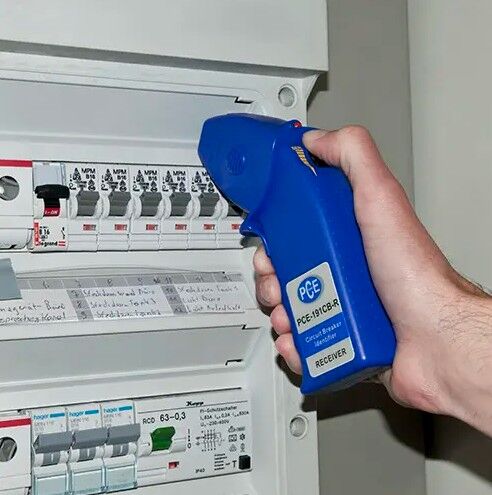
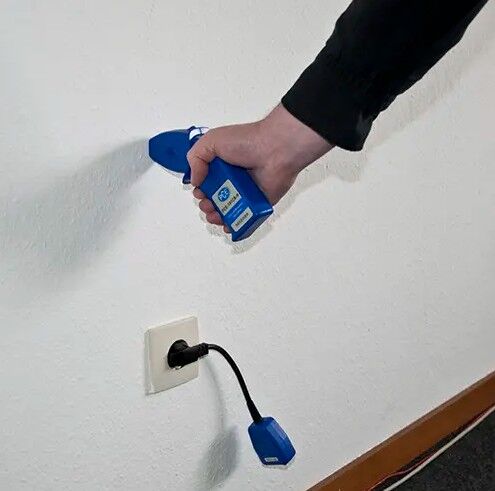
The PCE-191 CB cable locator is a compact professional instrument for locating live cables and electrical lines inside walls, cable ducts, electrical panels and distribution circuits. It consists of a transmitter and a receiver: the transmitter is connected to a standard socket of the circuit to be checked and sends an acoustic signal along the line, while the receiver allows the user to follow the cable route up to the required point or to a possible interruption.
The device is suitable for lines with 220 - 240 V AC voltage and 50 / 60 Hz frequency. Unlike other systems that require the circuit to be disconnected or fuses to be removed, the PCE-191 CB allows tracing while the cable remains live, making checks faster during normal inspection, maintenance and line identification tasks. This makes it particularly useful in building installations, technical rooms, service areas and distribution boards where circuits are not always clearly marked.
One of the main applications of the cable locator is checking walls before drilling, fixing anchors, installing shelves, electrical boxes, cable ducts, brackets or other components. When the path of cables under plaster is unknown, the instrument helps identify the presence of the line and reduces the risk of damaging conductors. The same principle is useful for finding cables inside ducts, technical passages, existing installations and undocumented cable routes.
The PCE-191 CB can also detect interruptions along an electrical line. If a cable is interrupted, the signal followed by the receiver stops or changes near the critical point, providing an acoustic indication that helps locate the fault area. This function is important for electricians and maintenance technicians working on existing installations, broken conductors, continuity problems or incorrect connections without immediately carrying out extensive dismantling work.
Another practical application is the identification of fuses or circuit breakers that are not correctly labelled in distribution boards. By connecting the transmitter to the socket of the circuit concerned, the technician can use the receiver in the distribution board to identify the corresponding fuse or line. This is especially useful in buildings where electrical documentation is outdated, in shared technical rooms, during quick maintenance operations and fault-finding tasks.
The receiver includes sensitivity adjustment, allowing the user to adapt the search to the distance from the cable, the depth of the line, the type of wall or duct and the presence of nearby conductors. By gradually adjusting the sensitivity, the search area can be narrowed and the cable route can be followed with better control. The acoustic signal makes operation simple and practical, even when the user needs to move along walls, ducts or electrical panels.
The compact structure and pocket-size format make the PCE-191 CB suitable for daily use by electricians, installers and maintenance technicians. Its low weight of approximately 300 g and the supplied carrying bag make it easy to keep in a work kit, service vehicle or toolbox. The transmitter is powered through the mains supply, while the receiver operates with a 9 V battery.
For correct use, it is advisable to connect the transmitter to the socket belonging to the circuit to be identified, move the receiver close to the search area and adjust the sensitivity gradually. During tracing, the operator should proceed slowly, check the signal from different directions and pay attention to acoustic variations, especially when several lines are close together, ducts are crowded or wall materials may attenuate the signal.
The delivery includes one PCE-191 CB cable locator consisting of transmitter and receiver, one battery, one carrying bag and operating instructions. The instrument complies with CE, IEC / EN 61010-1:01 safety requirements and is suitable for professional checking, tracing and maintenance tasks on civil and technical electrical installations.
Delivery scope:
1 x PCE-191 CB cable detector - includes signal transmitter and receiver
1 x 9 V battery
1 x carrying case
1 x user manual
Cable detector - Technical specifications
| Cable detection | By acoustic signal |
| Voltage range | 220 ... 240 V AC |
| Frequency range | 50 / 60 Hz |
| Connections | Standard socket |
| Transmitter power supply | Via mains power |
| Receiver power supply | 9 V battery |
| Weight | 300 g |
| Format | Pocket-size |
| Cable search | In walls or cable ducts |
| Interruption detection | Yes |
| Acoustic alarm | At the interruption point |
| Live cable operation | Yes |
| Cutting accessories or fuses required | No |
| Sensitivity adjustment | Yes |
| Structure | Compact |
| Supplied with | Batteries, carrying bag and instructions |
| Safety | CE, IEC / EN 61010-1:01 |
- EAN Code:
- 4250348702401
- Typology:
- Multifunctional
- Brand:
- PCE INSTRUMENTS