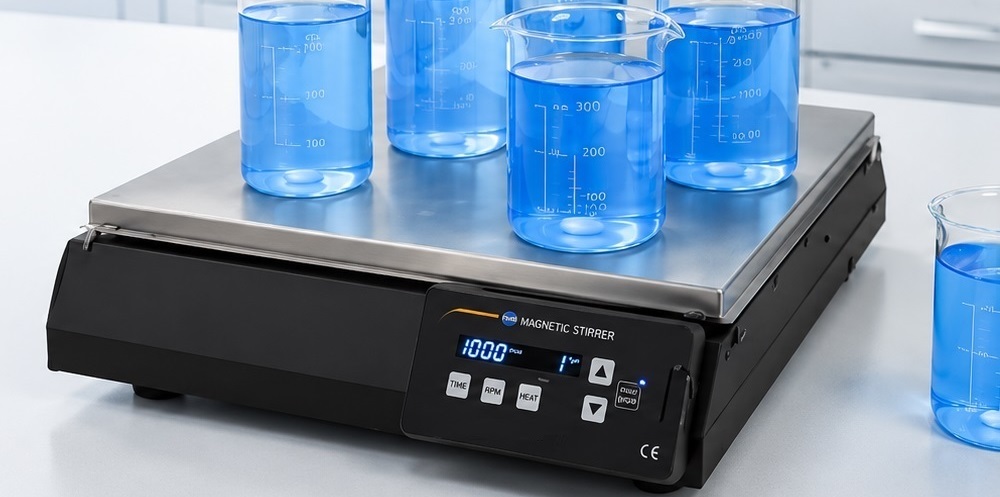
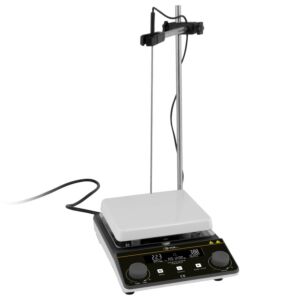
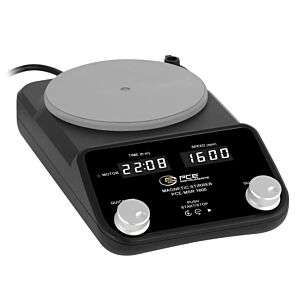
Stirrers are professional instruments designed for the controlled mixing of liquids, solutions, reagents, laboratory samples, technical fluids and materials used in industrial processes. A complete stirrer category includes magnetic stirrers, hotplate magnetic stirrers, laboratory stirrers with ceramic or metal plates, digital models with speed control, instruments with temperature regulation, stirrers with vertical supports for probes and sensors, and multi-position systems that allow several samples to be processed at the same time. Their main function is to keep the liquid in regular, uniform and repeatable motion, improving dissolution, particle dispersion, mixture homogeneity and process control.
A magnetic stirrer normally works with a magnetic stir bar placed inside the vessel and a magnetic field generated by the base of the instrument. The controlled rotation of the stir bar moves the liquid without external mechanical shafts immersed in the sample. This solution is highly practical in laboratories because it reduces direct contact with the sample, simplifies cleaning, allows the use of beakers, flasks and vessels of different sizes, and provides stable mixing during long test cycles. In hotplate models, in addition to speed adjustment, the instrument can also control the temperature of the sample or of the support surface, making it suitable for preparations that require progressive heating, thermal holding or solution stabilization.
Hotplate magnetic stirrers are especially useful when the process requires both movement and temperature control. In these instruments, temperature accuracy, display resolution, plate capacity, PID control stability and the possibility of using an external probe are essential factors. PID control allows the heating process to be managed more steadily, reducing deviation from the set value and improving process repeatability. This is important in quality control laboratories, comparative testing, preparation of standard solutions, chemical analysis, technical formulations and applications where excessive temperature variation may alter the behavior of the sample.
Multi-position magnetic stirrers are designed to handle several vessels simultaneously. This configuration is useful when a laboratory needs to compare different samples under the same operating conditions or increase productivity without using several separate instruments. Each stirring position must provide a regular magnetic field, stable rotation and uniform operation. In professional models, the speed range is usually broad and accurate, allowing the instrument to work with low-viscosity liquids, aqueous solutions, chemical samples, technical fluids and preparations requiring either gentle or intensive stirring. The use of several positions also requires attention to vessel geometry, spacing between containers and load distribution on the working surface.
In professional applications, the choice of a stirrer should not be based only on maximum speed, but also on effective mixing capacity, stability at low speed, adjustment accuracy, control resolution, mechanical robustness and compatibility with the work environment. A stirrer used in a chemical laboratory may require materials resistant to corrosive agents and an easy-to-clean plate. A stirrer used in industrial quality control may require repeatability, simple setup and clear digital readings. A stirrer used for maintenance or technical preparation may require strength, fast adjustment and stable operation even with vessels of different sizes.
Correct use of a stirrer requires several practical precautions. The vessel should be placed correctly in the center of the plate or stirring position, the magnetic stir bar should be selected according to the vessel diameter and liquid volume, and the speed should be increased gradually to avoid excessive turbulence, splashing or loss of magnetic coupling. In hotplate models, it is important to check that the set temperature is compatible with the sample, the vessel and any immersed probes. When a temperature probe is used, its height must be adjusted so that the sensor works correctly inside the liquid without interfering with the stir bar and without touching the bottom of the vessel. The vertical support allows the probe height to be adjusted and kept stable throughout the process.
Accuracy and resolution are key aspects of professional stirrers. The stirring speed must be adjustable according to the type of fluid and the objective of the test. A speed that is too low may not provide sufficient mixing, while excessive speed may generate vortices, air entrainment, foam or sample instability. In thermal processes, inaccurate temperature regulation may cause measurement errors, differences between samples, non-uniform preparation times or results that cannot be compared reliably. For this reason, digital displays, precise set values, long-term stability and controlled heating response are important features in professional instruments.
Stirrers are used in many industrial and technical applications. They are common in chemical laboratories, quality control departments, pharmaceutical companies, environmental laboratories, food industry laboratories, paint and coating laboratories, solution treatment, sample preparation, additive mixing, powder dissolution, fluid stability testing and process trials. They can also be used in maintenance activities when technical solutions, cleaning liquids, test fluids or controlled mixtures need to be prepared before being applied to systems, machines or components. In all these cases, the instrument helps reduce operational variability and improve preparation quality.
When technically evaluating a stirrer, it is important to consider plate size, recommended maximum volume, maximum temperature, speed adjustment range, programmable functions, display type, support quality, working surface stability and electronic protection. The height of the support and the possibility of adjusting accessories, clamps and probes directly affect ease of use. Although stirrers do not have transmission backlash in the same way as conventional machine tools, the regularity of magnetic motion, absence of abnormal vibration and stability of the coupling between base and stir bar are equivalent aspects to be checked, because any irregularity may cause loss of rotation, discontinuous stirring or errors in sample preparation.
Shape and geometry errors in this context mainly concern vessel positioning, flatness of the support surface, probe alignment, incorrect stir bar selection and unsuitable vessels. A vessel with an uneven bottom or excessive distance from the magnetic field can reduce stirring efficiency. A probe positioned too low may interfere with rotation, while a probe positioned too high may not read the real liquid temperature correctly. The sample volume must also be consistent with the capacity of the instrument: excessive loads, high viscosity or oversized vessels may reduce motion stability.
Professional stirrers are therefore essential instruments for companies, technicians and laboratories requiring control, repeatability and safety in sample preparation. The availability of models with heating, digital control, probe support, programmable functions and multi-position configurations makes it possible to choose the most suitable instrument according to the process. For Tadaah, a category dedicated to stirrers provides a technical reference for professionals, engineers and laboratory operators, helping them select the correct instrument according to volume, temperature, speed, liquid type and required level of accuracy.