PCE Instruments PCE-T 260 Stroboscope and tachometer with optical and contact measuring function, infrared temperature measurement, PT-1000 or thermocouple type K and memory of last measured value and MIN/MAX values
In stock
SKU
PCE-T-260
€387.90
(Incl. Tax: €473.24)
(Incl. Tax: €473.24)
The PCE-T 260 combined stroboscope and tachometer is ideal for maintenance and production. It measures rotations and temperature by contact, controlling the speed of centrifuges, motors and fans. With a range of 0.5-99,999 rpm and low power consumption, it is suitable for research and development. Non-contact measurement up to 99,999 rpm and contact measurement with rotary display. Includes infrared and contact temperature measurement (PT-1000, thermocouple type K). RS-232 interface for data logging.

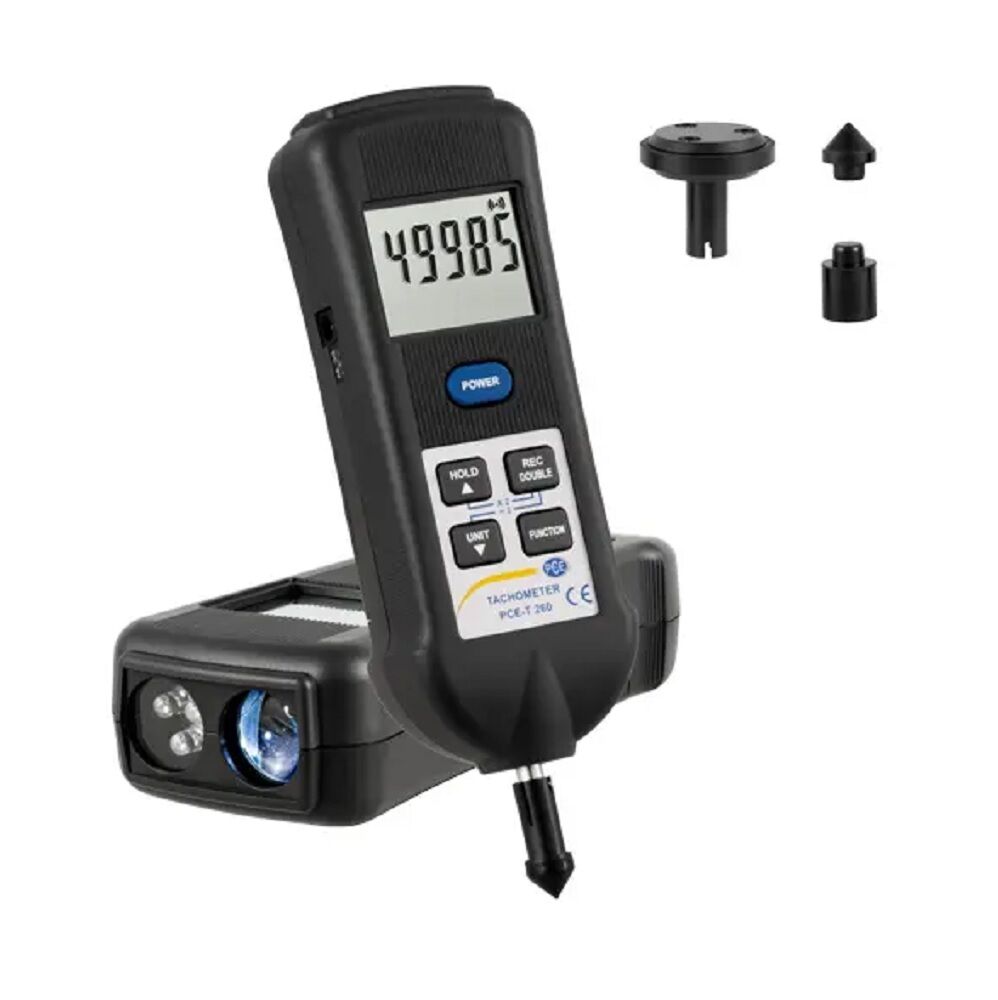
Features:
- Simple operation
- Powerful LEDs
- Non-contact temperature measurement
- Temperature measurement with PT-1000 or type K
- Robust ABS structure
- 5-digit LCD display with 10 mm height
- Last value and MIN/MAX memory
- Red stroboscopic light
- Simple operation
- Powerful LEDs
- Non-contact temperature measurement
- Temperature measurement with PT-1000 or type K
- Robust ABS structure
- 5-digit LCD display with 10 mm height
- Last value and MIN/MAX memory
- Red stroboscopic light
| Technical Specifications for Optical Tachometer | |
| Measurement Range | 5 ... 99,999 rpm |
| Resolution | 0.5 rpm (< 1,000 rpm) 1 rpm (> 1,000 rpm) |
| Accuracy | ±0.05% + 1 digit |
| Measurement Distance | 50 ... 150 mm max. 300 mm (depending on ambient light) |
| Technical Specifications for Contact Tachometer | |
| Measurement Range | 0.5 ... 19,999 rpm |
| Resolution | 0.5 rpm (< 1,000 rpm) 1 rpm (> 1,000 rpm) 0.05 m/min (< 100 m/min) 0.1 m/min (> 100 m/min) |
| Accuracy | ±0.05% + 1 digit |
| Technical Specifications for Stroboscope Mode | |
| Measurement Range | 100 ... 99,990 rpm |
| Resolution | 0.1 rpm (< 1,000 rpm) 1 rpm (1,000 ... 30,000 rpm) 5 rpm (30,000 ... 50,000 rpm) 1 rpm (50,000 ... 99,990 rpm) |
| Accuracy | ±0.1% + 2 digits |
| Flash Light | 3 x LED (red) |
| Technical Specifications for Type K Temperature | |
| Measurement Range | -100 ... +1,300 °C |
| Resolution | 0.1 °C |
| Accuracy (instrument only) | ±0.4% + 1 °C (-100 ... -50 °C) ±0.4% + 0.5 °C (-50 ... 1,300 °C) |
| Technical Specifications for PT-1000 Temperature | |
| Measurement Range | -10 ... 70 °C |
| Resolution | 0.1 °C |
| Accuracy (instrument only) | ±1.2 °C |
| Technical Specifications for Infrared Temperature | |
| Measurement Range | -30 ... 305 °C |
| Resolution | 0.5 °C |
| Accuracy | ±3% or ±3 °C |
| Emission Degrees | 0.95 fixed |
| Spectral Range | 6 ... 14 µm |
| Distance / Measurement Point Ratio | 3:1 |
| General Technical Specifications | |
| Display | 5-digit LCD |
| Interface | RS-232 |
| Power Supply | 4 x 1.5V AA batteries (UM-3) / 9V DC adapter |
| Power Consumption | Approx. 52 mA |
| Operating Conditions | 0 ... +50 °C / < 80% RH |
| Memory | Last measured value, MIN/MAX values |
| Dimensions | 207 x 67 x 39 mm |
| Weight | 255g (without batteries) |
The PCE-T 260 combined meter, consisting of a stroboscope and a tachometer, is ideal for maintenance and use in the production sector. This multifunctional device allows for contact measurements of rotations and temperature, making it perfect for monitoring the rotational speed and temperature of centrifuges, motors, fans, and other machinery in research and development.
The instrument can operate within a range of 0.5 to 99,999 rpm. Its distinctive feature is the ability to perform various types of measurements, both optical and contact. The integrated red LED circuit ensures very low power consumption and virtually no maintenance. The device is set up using buttons that allow for both coarse and fine adjustments, ensuring ease of use and accuracy.
The PCE-T 260 can measure non-contact up to 99,999 rpm with a resolution of 0.5 rpm for values below 1,000 rpm. During contact measurements, the display rotates 180 degrees to facilitate data reading. In addition to rotational speed, the device also measures temperature both in infrared and contact modes, using PT-1000 probes or type K thermocouples.
The integrated RS-232 interface allows for viewing and recording values directly on a computer using the appropriate software. This feature is particularly useful for documentation and data analysis, making it an essential tool for professionals who need precise and reliable monitoring.
With its combination of stroboscope and tachometer, it provides a comprehensive solution for monitoring and inspecting machinery in various industrial contexts. The ability to perform accurate and non-contact measurements, along with the capability to record and analyze data, makes this tool indispensable for ensuring the efficiency and reliability of production processes. Additionally, the robust ABS structure ensures a long lifespan and resistance to the environmental stresses typical of industrial settings.
In summary, the combined meter, with its advanced stroboscope and tachometer features, represents a valuable resource for controlling the rotational speed and temperature of various machines. The ease of use, low maintenance, and versatile and precise measurement capabilities make it an ideal tool for many industrial applications, significantly improving the quality and efficiency of production processes.
The instrument can operate within a range of 0.5 to 99,999 rpm. Its distinctive feature is the ability to perform various types of measurements, both optical and contact. The integrated red LED circuit ensures very low power consumption and virtually no maintenance. The device is set up using buttons that allow for both coarse and fine adjustments, ensuring ease of use and accuracy.
The PCE-T 260 can measure non-contact up to 99,999 rpm with a resolution of 0.5 rpm for values below 1,000 rpm. During contact measurements, the display rotates 180 degrees to facilitate data reading. In addition to rotational speed, the device also measures temperature both in infrared and contact modes, using PT-1000 probes or type K thermocouples.
The integrated RS-232 interface allows for viewing and recording values directly on a computer using the appropriate software. This feature is particularly useful for documentation and data analysis, making it an essential tool for professionals who need precise and reliable monitoring.
With its combination of stroboscope and tachometer, it provides a comprehensive solution for monitoring and inspecting machinery in various industrial contexts. The ability to perform accurate and non-contact measurements, along with the capability to record and analyze data, makes this tool indispensable for ensuring the efficiency and reliability of production processes. Additionally, the robust ABS structure ensures a long lifespan and resistance to the environmental stresses typical of industrial settings.
In summary, the combined meter, with its advanced stroboscope and tachometer features, represents a valuable resource for controlling the rotational speed and temperature of various machines. The ease of use, low maintenance, and versatile and precise measurement capabilities make it an ideal tool for many industrial applications, significantly improving the quality and efficiency of production processes.
Shipment Contents:
1 x Stroboscope and Tachometer PCE-T 260
1 x Adapter
2 x Measurement tips (internal and external cone)
1 x Measuring wheel
1 x Reflective tape (600 mm)
1 x Carrying case
Operating instructions (available for download)
1 x Stroboscope and Tachometer PCE-T 260
1 x Adapter
2 x Measurement tips (internal and external cone)
1 x Measuring wheel
1 x Reflective tape (600 mm)
1 x Carrying case
Operating instructions (available for download)
The stroboscope is an essential tool in measurement technology, used to obtain fixed images of moving parts. For example, in printing it is used to check printing rollers, while in industry it is employed to determine the speed of rotating parts.
Defining the application before purchase is crucial. One key aspect is the flash frequency, with some industrial models reaching thousands of hertz, allowing optical inspection of fast sequences.
The type of light source is another important factor. Modern LED flashes provide powerful LED arrays that fully illuminate an object, rivaling traditional xenon bulbs. Some stroboscopes can enlarge the LED matrix to properly inspect wide and moving parts, such as paper strips. Additionally, there are models with UV LED light sources used for non-destructive testing in maintenance.
Another selection criterion is the triggering of the light source. A simple flash has an internal regulator, while a more sophisticated stroboscope is equipped with a trigger input for external speed sensors, ensuring that the flashes are always synchronized with the speed of the object. This is useful when rollers rotate at different speeds, such as in paper production or in tests on printed products.
Modern stroboscopes also offer adjustable flash frequency and the ability to adjust the phasing, briefly delaying the flash pulse to achieve an "optically rotating" image. This moves the marks on moving parts into the correct position.
For portable stroboscopes, power is a key factor. If usage is occasional, a battery model is sufficient, but for frequent use, a model with rechargeable batteries is recommended. Fixed models are generally powered by an adapter or directly from the mains.
The IP protection rating of the stroboscope is another important factor, indicating the level of protection against dust and water. For harsh environments, a model with an IP67 protection rating is ideal, as it offers optimal protection from external environmental influences.
Defining the application before purchase is crucial. One key aspect is the flash frequency, with some industrial models reaching thousands of hertz, allowing optical inspection of fast sequences.
The type of light source is another important factor. Modern LED flashes provide powerful LED arrays that fully illuminate an object, rivaling traditional xenon bulbs. Some stroboscopes can enlarge the LED matrix to properly inspect wide and moving parts, such as paper strips. Additionally, there are models with UV LED light sources used for non-destructive testing in maintenance.
Another selection criterion is the triggering of the light source. A simple flash has an internal regulator, while a more sophisticated stroboscope is equipped with a trigger input for external speed sensors, ensuring that the flashes are always synchronized with the speed of the object. This is useful when rollers rotate at different speeds, such as in paper production or in tests on printed products.
Modern stroboscopes also offer adjustable flash frequency and the ability to adjust the phasing, briefly delaying the flash pulse to achieve an "optically rotating" image. This moves the marks on moving parts into the correct position.
For portable stroboscopes, power is a key factor. If usage is occasional, a battery model is sufficient, but for frequent use, a model with rechargeable batteries is recommended. Fixed models are generally powered by an adapter or directly from the mains.
The IP protection rating of the stroboscope is another important factor, indicating the level of protection against dust and water. For harsh environments, a model with an IP67 protection rating is ideal, as it offers optimal protection from external environmental influences.
- EAN Code:
- 4250348716835
- Typology:
- Multifunctional
- Brand:
- PCE INSTRUMENTS