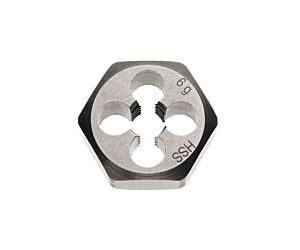
Dies for metric, gas, American and Whitworth threads
Dies for metric, gas and inch threads are cutting tools designed to produce external threads by chip removal. They are used for threading bars, pins, tie rods, fittings, pipes, turned parts and mechanical components that require a precise, repeatable threaded profile compatible with industrial assembly standards. In a professional range, HSS dies and HSS-G dies are essential tools for both production and maintenance, because they allow operators to create new threads, restore damaged threads, finish machined ends and ensure correct coupling between screw, nut, fitting or assembled component.
This category includes M ISO metric dies, MF ISO fine metric dies, GAS dies, BSP dies, BSW dies, UNC dies, UNF dies and Whitworth dies, covering the main threading requirements used in workshops, maintenance departments, mechanical production, plant engineering and industrial component manufacturing. M ISO threads are among the most common in general mechanics and are used for screws, pins, tie rods, fastening elements, adjustment parts and components intended for assembly. MF ISO threads, or fine metric threads, are suitable when a finer pitch than the standard metric thread is required, for example in applications requiring higher adjustment accuracy, better coupling stability, reduced thread depth or greater resistance to loosening.
GAS threads and BSP threads are mainly used in fittings, piping, pneumatic systems, hydraulic systems and oil-hydraulic applications. In these fields, thread quality directly affects the correct connection between components, the continuity of the coupling and the safety of the system. Dies for GAS threads and BSP dies are therefore particularly important for machining technical fittings, manifolds, pipes, sleeves, adapters and components intended for the passage of air, oil, fluids or technical gases.
UNC threads and UNF threads belong to the American Unified Thread Standard and are widely used on inch-based components, machines of American origin, industrial equipment, spare parts, fastening elements and mechanical parts intended for international markets. UNC dies are suitable for producing coarse-pitch American threads, used when a strong and practical coupling is required on general mechanical materials and components. UNF dies, on the other hand, produce fine-pitch American threads, suitable when higher tightening precision, finer adjustment and better vibration resistance are required.
BSW threads and Whitworth threads belong to the family of inch threads of British origin and are still found on machines, equipment, historical components, industrial spare parts, plants and specific technical applications. BSW dies are used for coarse Whitworth threads, while Whitworth dies allow operators to work on inch-threaded profiles where non-metric geometries and couplings must be respected. For maintenance workshops, technical departments and companies managing older machines or imported components, having Whitworth dies, BSW dies, UNC dies and UNF dies available in different sizes helps reduce machine downtime and quickly restore worn, damaged or non-conforming threads.
HSS dies and HSS-G dies are designed to offer a good balance between cutting performance, mechanical strength and service life. HSS, high-speed steel with high resistance, is suitable for general machining on metallic and non-ferrous materials, while HSS-G, normally ground after heat treatment, provides higher profile precision, better thread finish and smoother feed regularity. This feature is particularly important when the thread must maintain constant tolerances over multiple parts, as in the production of turned small parts, automotive components, technical fittings, fastening pins and parts intended for mechanical assembly.
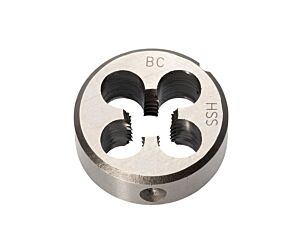
Dies may be available in round or hexagonal versions, depending on the type of use and operating environment. Round dies are generally used with manual die stocks, guided holders or machine threading systems, where good centering with respect to the workpiece axis is required to obtain progressive and controlled threading. Hexagonal dies, on the other hand, are particularly practical for maintenance and repair operations, because they can also be operated with standard wrenches and allow quick intervention on damaged, dirty, oxidized or partially deformed threads.
The field of use of professional workshop dies includes light alloys, free-cutting steels, carbon steels, alloy steels, construction steels, non-ferrous materials, aluminium, brass, bronze, copper and materials commonly used in the production of turned parts. On light alloys and aluminium, it is important to use a sharp and well-lubricated tool to avoid material build-up and deposits on the cutting edge. On free-cutting steels, widely used in turned small parts and automatic lathe production, the die must ensure regular chip evacuation and continuity of the thread profile. On tougher or alloyed steels, it is essential to control lubrication, alignment and cutting progression to avoid overloads, chipping or out-of-tolerance threads.
From an operational point of view, thread precision depends on the quality of the die, the correct choice of the pre-machining diameter, the material being machined, lubrication/cooling and the maintenance of the working axis. Before threading, the workpiece should be correctly prepared with an entry chamfer, a clean surface and a diameter consistent with the required thread. A misaligned start can generate inclined threads, damaged crests and difficult couplings. For this reason, in technical machining and quality control, it is important to check the thread with suitable gauges, threaded rings, plug gauges or measuring instruments compatible with the thread produced.
In industrial applications, dies for external threads are used both in production and throughout the component life cycle. In production, they allow turned parts, threaded pins, fittings and mechanical components to be completed with a simple, reliable tool that can be easily integrated into the process. In maintenance, they make it possible to recover components with damaged threads, remove burrs, restore the functionality of mechanical couplings and reduce machine downtime. For maintenance technicians and workshop operators, having M ISO, MF ISO, GAS, BSP, BSW, UNC, UNF and Whitworth dies in different sizes means being able to intervene quickly on plants, equipment, machine tools, clamping systems, fittings and fastening elements.
Dies for metric, gas and inch threads are therefore indispensable tools for mechanical workshops, maintenance departments, turned-parts manufacturers, automotive industries, machine tool builders and companies working with threaded components requiring precision and reliability. The correct combination of tool material, geometry, round or hexagonal shape and thread type helps improve thread quality, reduce scrap, simplify technical interventions and maintain high production continuity. Tadaah offers this category with a technical consulting-oriented approach, helping operators, maintenance technicians, engineers and professionals identify the most suitable die according to the material being machined, the threading standard, the required precision level and the application environment.