Grinders Grinders are stationary machines used for grinding, deburring, correcting edges and surfaces, sharpening tools and preparing metal components for subsequent satin finishing, brushing or polishing. This category includes bench grinders, machines with tool-sharpening systems, models with dust extraction, combination grinders, abrasive wheels and the accessories or replacement components required to configure and maintain a professional workstation. Although the machines share the same basic operating principle, based on a rotating abrasive wheel or finishing accessory, they can differ considerably in construction, size, power, electrical supply, duty, wheel arrangement, work-rest configuration, protective systems and intended application. Selection should therefore not be based solely on machine size or appearance. It must begin with the material, component dimensions and weight, amount of stock to remove, operating frequency and required surface quality. Bench grinders are t…
Grinders
Grinders are stationary machines used for grinding, deburring, correcting edges and surfaces, sharpening tools and preparing metal components for subsequent satin finishing, brushing or polishing. This category includes bench grinders, machines with tool-sharpening systems, models with dust extraction, combination grinders, abrasive wheels and the accessories or replacement components required to configure and maintain a professional workstation.
Although the machines share the same basic operating principle, based on a rotating abrasive wheel or finishing accessory, they can differ considerably in construction, size, power, electrical supply, duty, wheel arrangement, work-rest configuration, protective systems and intended application. Selection should therefore not be based solely on machine size or appearance. It must begin with the material, component dimensions and weight, amount of stock to remove, operating frequency and required surface quality.
Bench grinders are the traditional solution for engineering workshops, maintenance departments, toolrooms and craft production. Opposed wheels allow the machine to be prepared with different abrasives, dedicating one station to rough grinding and the other to controlled finishing. Compact machines suit small tools and light components, while heavier and more rigid models provide greater stability when processing castings, larger parts and repetitive batches.
A stable structure reduces vibration, improves workpiece control and helps maintain the wheel profile. The grinder should be fixed to a rigid bench or installed on a suitable, securely anchored pedestal. Sufficient space is required around the machine to manoeuvre long or irregular parts without striking walls, equipment or other operators. Working height should permit a natural posture through the back, shoulders and wrists.
Grinders with tool-sharpening systems incorporate orientable tables, supports, articulated guides or devices that improve stability and repeatability when restoring cutting geometry. Depending on the accessories fitted, they may be used for twist drills, chisels, lathe tools, blades, engraving tools and other compatible cutting edges. Sharpening is not primarily about rapid stock removal; its purpose is to restore the functional profile while preserving as much of the original geometry as possible.
Before sharpening, the operator should identify the surface requiring restoration and distinguish normal wear from chipping or heat damage. The support and guide are then set to reproduce the required geometry. Wheel contact should be short and evenly distributed. Unequal pressure can produce an asymmetrical cutting edge, while uncontrolled rocking can round a surface that should remain flat. Drill sharpening requires balanced cutting lips and correct use of the guide, as poor symmetry can cause wandering, vibration and inaccurate holes.
Grinders with extraction incorporate a system for capturing abrasive dust, metal particles and residue close to the working area. Wheel guards direct debris into ducts connected to bags, containers, separators or filtration equipment. Extraction helps keep the workstation clean and improves visibility, but must be selected according to the work material and dust characteristics.
An extraction fan does not automatically make a grinder suitable for every metal. Dust from cast iron, steel, abrasives, aluminium, light alloys, brass and bronze has different properties. Fine dust from some metals can be combustible and must not be collected indiscriminately together with sparks and ferrous residue. The complete system formed by the guard, capture opening, ducting, extractor, filtration and collector must be compatible with the intended process.
Combination grinders pair a rigid wheel with a wire brush, flexible abrasive wheel or polishing mop. This arrangement allows the operator to move from burr removal to cleaning, blending and cosmetic finishing at the same workstation. Each accessory has a different purpose: the rigid wheel corrects geometry and removes stock; the brush removes oxidation and surface residue; a non-woven wheel blends and satin-finishes; a cloth or felt mop with compatible compound produces a brighter finish.
Flexible wheels and brushes exert a pulling action that differs from rigid grinding. The component should be oriented so the accessory runs away from edges rather than into holes, recesses or projections. Ring-shaped parts, frames, handles and hollow components must not be wrapped around the wheel because they can jam and rotate violently. Brushes and polishing wheels must be compatible with the grinder, correctly mounted and free from missing wires, tears, distortion and uneven wear.
During manual grinding, the workpiece should be supported on the adjustable rest and guided towards the front peripheral surface of the wheel. Contact must occur within the area specified by the manufacturer so that wheel rotation keeps the component against the support rather than lifting or pulling it away. The side face of a straight wheel must not be used unless expressly designed for side loading.
Whenever component size, shape and temperature permit, it should be controlled with both hands. The grip must be secure while allowing small corrective movements. Very small, thin, hot or awkward parts require suitable pliers, holders or fixtures. Excessive pressure should never be used to compensate for an unstable grip.
When removing a burr, the projection should meet the abrasive progressively. Pointing an edge directly into the direction of rotation can cause catching or irregular removal. A constant angle must be maintained when producing a chamfer. Extended edges should be moved laterally across the wheel face to distribute wear and prevent groove formation.
Holding a component against one point creates localised wear and concentrates heat. Slow, regular lateral movement uses the abrasive surface more effectively and preserves wheel geometry. Pressure should allow the wheel to cut without significantly slowing the machine. If considerable force is required, the wheel may be worn, loaded, glazed or unsuitable for the material.
The work rest must be rigid, undamaged and capable of being locked without play. Clearance from the wheel should be kept as small as practicable while complying with the manufacturer’s instructions and applicable safety requirements. Excessive clearance can allow the component to become trapped; insufficient clearance can cause contact between the wheel and rest. As the wheel becomes smaller through use and dressing, the rest must be readjusted with the machine stopped.
Rest height and inclination must match the component geometry. A rest positioned too low makes angle control difficult, while an unsuitable setup can encourage catching. For repetitive work, a stable reference should be established, the table locked securely and every component presented with the same sequence of movements. Rest, guards and working clearance must be checked whenever the wheel, part or operation changes.
Wheel selection is one of the most important technical decisions. Aluminium oxide abrasives are commonly used for carbon steels, tool steels and other ferrous materials. Cast iron, aluminium, brass, bronze and non-ferrous materials may be better served by silicon carbide or another abrasive explicitly approved by its manufacturer. Ceramic abrasives, diamond and cubic boron nitride are used for specialised applications and must be selected according to the work material and machine.
Grit influences both removal rate and finish. A coarse grit removes substantial flash, casting remnants and excess material rapidly but leaves deeper marks. An intermediate grit suits general deburring. A fine grit provides greater control for finishing and sharpening but may generate heat if used with excessive pressure or if the wheel surface does not remain open.
Wheel grade describes how strongly the bond retains the abrasive grains and must not be confused with grain hardness. A comparatively soft-grade wheel releases dull grains readily and maintains cutting action on hard materials. A harder-grade wheel holds its form and may suit softer materials, provided it does not load. Wheel structure controls the space available for chips and affects cooling and clogging.
Before mounting, wheel shape, dimensions, bore, bushing, spindle, flanges, guard and machine speed must be checked for compatibility. The wheel should fit freely on the spindle and must not be forced into place. Flanges, blotters and contact surfaces must be clean and correctly matched. A wheel showing cracks, chips, distortion or impact damage must not be used.
After installation, the grinder should be run without load while the operator remains outside the plane of rotation. Vibration, wobbling or unusual noise requires immediate shutdown. Dressing restores wheel concentricity, flatness and cutting ability by removing loaded or glazed abrasive. It cannot make a damaged wheel safe.
When fettling foundry castings, unwanted material must be distinguished from functional surfaces. Parting lines, gates, feed-system remnants, flash, oxides and irregularities should be removed through short, progressive passes. Forcing the casting heavily into the wheel increases heat, overloads the machine and may alter radii, edges, mating faces or areas intended for later machining.
Cast iron may have hard scale, moulding residue and substantial flash. Dust and graphite-rich debris can reduce wheel efficiency, making regular dressing important. Aluminium and light-alloy components can load an unsuitable wheel and require abrasives expressly approved for those materials. Brass and bronze should be processed with moderate pressure to prevent grabbing, tearing and excessive edge rounding.
In cookware, tableware, cutlery, handle, tap and household-accessory production, grinders remove casting or stamping burrs, blend gate areas, soften edges and prepare components for satin finishing, brushing or polishing. A rigid wheel is primarily intended for stock removal and geometry correction. Final cosmetic appearance is normally produced with flexible finishing accessories.
Temperature should be managed through short contacts, moderate pressure and frequent pauses. Where the material and process permit, the workpiece may be cooled in a separate container, ensuring that water or coolant cannot reach a dry-running wheel, guards, motor or electrical parts. Hardened tools, thin components and materials with specific metallurgical requirements may suffer thermal shock, distortion, cracking or loss of hardness.
Discolouration around a cutting edge can indicate overheating. A correctly selected and dressed wheel cuts more coolly and requires less pressure. Interrupting contact frequently is generally more controlled than overheating the component and then cooling it abruptly.
Accessories and spare parts complete the grinder configuration. Pedestals provide stable workstations; control units manage starting, stopping, emergency functions and, where provided, braking; guards enclose the non-working portion of the wheel; rests and guides support the component; extraction ducts and collectors manage dust and debris.
Every replacement part must be selected by accurately identifying the machine, series, position and configuration. A guard or control unit that looks similar can have different mountings, geometry or functions. Guards must not be modified by unauthorised cutting or drilling, and electrical devices should be installed by qualified personnel. Following maintenance, fixings, free rotation, guards, controls, stopping and extraction should be verified.
Before purchase, the main function should be defined. A compact grinder may be sufficient for maintenance and small tools. Daily fettling of production castings benefits from a heavier, stable machine capable of regular operation under load. Sharpening requires repeatable guides and tables. Finishing benefits from combination configurations. Dust-producing departments require careful evaluation of extraction.
Wheel and spare-part availability, rest adjustment, control accessibility, guard quality, extraction options, maintenance access and working space should also be considered. An oversized machine can be inconvenient for very small parts, while an overly light structure may not provide sufficient stability for demanding castings.
Grinders are used in engineering workshops, foundries, fabrication, toolrooms, mould making, valve and tap production, industrial and agricultural maintenance, automotive manufacturing, window and door fabrication and the production of cutlery, cookware, tableware, handles, hinges, furniture fittings and decorative products.
Professional selection treats the workstation as a complete system formed by the structure, motor, controls, wheel, flanges, guards, rests, guides and extraction. Tadaah technical support assists with selection by evaluating material, component shape, amount of flash, operating frequency, required finish and workshop organisation, with the aim of identifying a productive, safe and application-appropriate solution.
Items 97-100 of 100
- Page Previous
- Page 1
- Page 2
- You're currently reading page 3
-

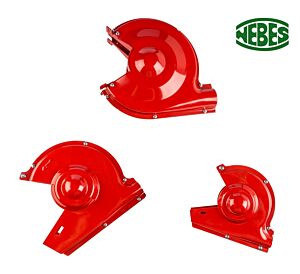
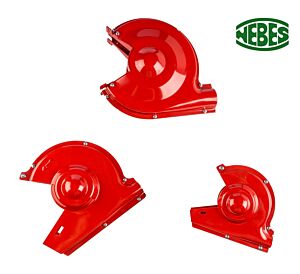
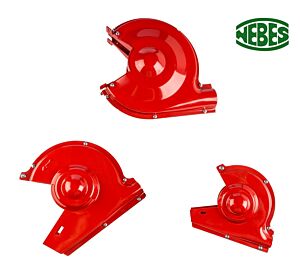
115 NEBES Wheel protector cover for Grinders and Combined Machines - Diameter 150mm, Thickness 2.5mm
Special Price €54.40 Regular Price €64.00
(Incl. Tax: €66.37) -
116 NEBES Wheel protector cover for Grinders and Combined Machines - Diameter 200mm, Thickness 3.0mm
Special Price €79.05 Regular Price €93.00
(Incl. Tax: €96.44) -
504 NEBES Wheel protector cover-guard for Grinders and Combined Machines - Diameter 250mm, Thickness 3.0mm
Special Price €104.00 Regular Price €130.00
(Incl. Tax: €126.88) -
704 NEBES Wheel protector cover-guard for Grinders and Combined Machines - Diameter 400mm, Thickness 8.0mm
Special Price €482.25 Regular Price €643.00
(Incl. Tax: €588.34)

Items 97-100 of 100
- Page Previous
- Page 1
- Page 2
- You're currently reading page 3
- Category
-
- Power
-
- Brand
-
- Application
-
- Machine Type
-
- Typology
-
- Size
-
- Price
-