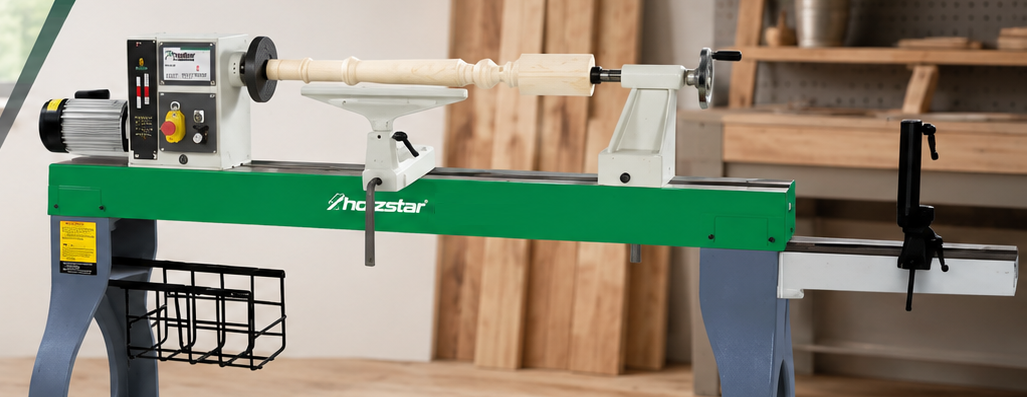
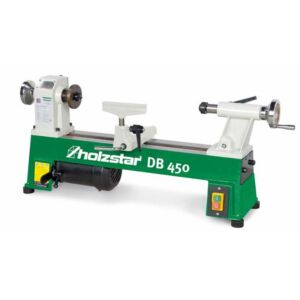
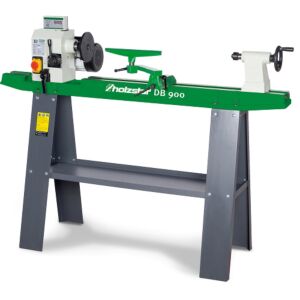
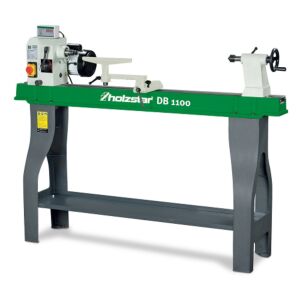
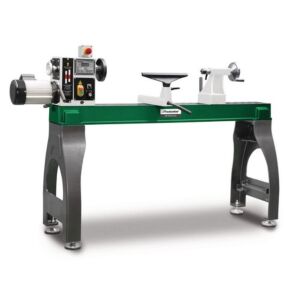
Holzstar wood lathes are designed for machining wooden components held in rotation between the drive headstock and the tailstock. The category includes Holzstar lathes based on the same operating principle but differing in size, working capacity, bed length, swing capacity, support structure, speed-control system and equipment. The range includes compact Holzstar bench lathes for smaller components and restricted work areas, as well as Holzstar floor-standing lathes offering a more substantial and dedicated working station.
Holzstar wood lathes are used to produce cylindrical, tapered, concave and profiled components such as table and chair legs, spindles, handles, knobs, rollers, decorative details and furniture parts. The workpiece is aligned between the headstock drive centre and the tailstock centre and then set in rotation. Material is progressively removed with gouges, chisels, scrapers and parting tools supported on the adjustable tool rest.
Stock removal on a Holzstar wood lathe is not performed by a blade as it would be on a sawing machine. It is carried out with hand-guided turning tools whose position and inclination change according to the operation. The tool rest can be moved along the bed, positioned close to the component and oriented relative to its surface. This provides support during roughing, cylindrical turning, profiling, tapering, cutting coves, producing transitions and forming shoulders.
When a square blank is being rounded, the Holzstar tool rest is normally arranged parallel to the axis and positioned as close to the workpiece as possible without interfering with rotation. This gives the roughing gouge stable support and allows the blank to be converted gradually into a cylinder. As the diameter decreases, the rest should be repositioned closer to the surface to prevent excessive unsupported tool overhang.
During profiling, the tool rest on a Holzstar lathe can be moved and slightly angled to follow the area being shaped. For tapered work, the tool travels along an oblique path relative to the workpiece axis. When cutting coves and transitions, the gouge is progressively rolled as it advances, changing the cutting-edge orientation while remaining supported by the rest. Tool inclination must change smoothly because an abrupt presentation can tear the fibres or cause the cutting edge to catch.
The height of the Holzstar tool rest must suit the cutter and turning method. The cutting edge generally operates close to the centreline, but its effective position varies according to the geometry of the gouge, skew chisel or scraper. A cutter positioned too low may take an excessively aggressive angle, while one positioned too high may cut inefficiently or become difficult to control. Height, distance and orientation should therefore be adjusted while the Holzstar lathe is completely stationary.
The movable tailstock on a Holzstar wood lathe slides along the bed to suit different component lengths. Once positioned, it is locked securely and the quill provides precise final movement of the centre towards the workpiece. Pressure must support the timber without compressing it excessively. Insufficient support may allow instability, while excessive pressure can deform slender parts, mark the ends or increase friction unnecessarily.
Accurate centring is essential for effective use of a Holzstar lathe. The centre of each end should be identified before mounting. An off-centre blank produces greater vibration and requires more stock removal before a regular surface can be obtained. Long or slender components should be machined through light, progressive passes because excessive tool pressure can flex the workpiece and produce inconsistent diameters.
Different Holzstar lathe sizes allow the machine to be selected according to the work normally performed. A compact Holzstar bench lathe requires less room and is suitable for small components, decorative parts, handles, knobs and occasional or precision work. A Holzstar lathe with a longer bed accommodates more extended components such as furniture legs, uprights and spindles. A Holzstar floor-standing lathe provides a dedicated station, a more substantial support structure and improved management of demanding workpieces.
The rigidity of the Holzstar bed directly affects surface quality and profile accuracy. A stable construction limits vibration and maintains alignment between the headstock, tool rest and tailstock. Holzstar bench lathes should be secured to a strong, level and appropriately sized support. A lightweight or unstable bench can amplify movement caused by a blank that is not yet fully balanced.
Rotational speed is another important factor when comparing Holzstar wood lathes. Different models may use different speed-selection or speed-adjustment systems. A lower speed improves control during the initial roughing of irregular, heavy or larger-diameter blanks. Once the component has become cylindrical and balanced, the speed can be adapted for profiling and finishing. Holzstar variable-speed lathes allow the rotation to be adjusted more quickly according to material, geometry and processing stage.
Workpiece diameter and length are not the only selection criteria. Choosing a Holzstar lathe also requires consideration of timber hardness, initial blank shape, required stock removal and frequency of use. Hard species and substantial sections benefit from a stable machine and correctly sharpened tools. Soft or fibrous timber requires efficient cutting edges and controlled passes to limit tearing and fibre compression.
A good finish on Holzstar wood lathes is obtained through progressive processing. Roughing regularises the blank, cylindrical turning establishes the reference diameter, profiling creates tapers, coves, beads and transitions, and finishing removes marks left by earlier operations. When several matching components are required, templates, dividers and measuring tools help reproduce the same positions, profiles and diameters.
Tool travel should follow the grain structure wherever possible. On profiles with changes in diameter, it is generally preferable to cut from larger sections towards smaller ones so that the fibres remain better supported. Cutting depth should be reduced near direction changes, coves and shoulders. Forcing the tool against the timber does not improve productivity and may cause vibration, tearing or profile distortion.
A sharp tool allows a Holzstar lathe to remove material with less pressure and greater control. A roughing gouge is suitable for initially rounding the blank, while profiling tools form transitions and decorative shapes. A skew chisel can produce clean surfaces and defined details but requires accurate presentation. A scraper uses a different cutting action and must remain firmly supported. A parting tool produces narrow grooves, establishes shoulders and separates the completed component.
Before starting a Holzstar lathe, the workpiece should always be rotated manually to confirm that it does not touch the tool rest, bed or other machine components. Every adjustment to the tool rest or tailstock must be made with the machine stationary. The locking of movable components should also be checked after every repositioning along the bed.
Dust extraction should collect chips and fine dust without restricting the operator’s movements. Turning waste is projected in several directions, so a fixed extraction point may not capture it completely. An adjustable extraction arrangement compatible with the Holzstar workstation is particularly useful during final sanding, when finer airborne dust is produced.
Before purchasing, it is advisable to compare working capacity, bed length and rigidity, bench-mounted or floor-standing construction, speed adjustment, tailstock movement, tool-rest dimensions and adjustability, overall stability and accessory compatibility. Selecting the Holzstar lathe with the largest capacity is not always the best solution. The machine should match the components actually produced, available workshop space and expected frequency of use.
The Holzstar wood-lathe category provides suitable solutions for advanced hobbyists, joiners, cabinetmakers, furniture manufacturers and professional woodworkers. Although all Holzstar lathes share the same operating principle, the models offer different technical characteristics and working capacities. Correct selection provides a flexible station for roughing, cylindrical turning, shaping and finishing wooden components with direct control over the profile and stock-removal process