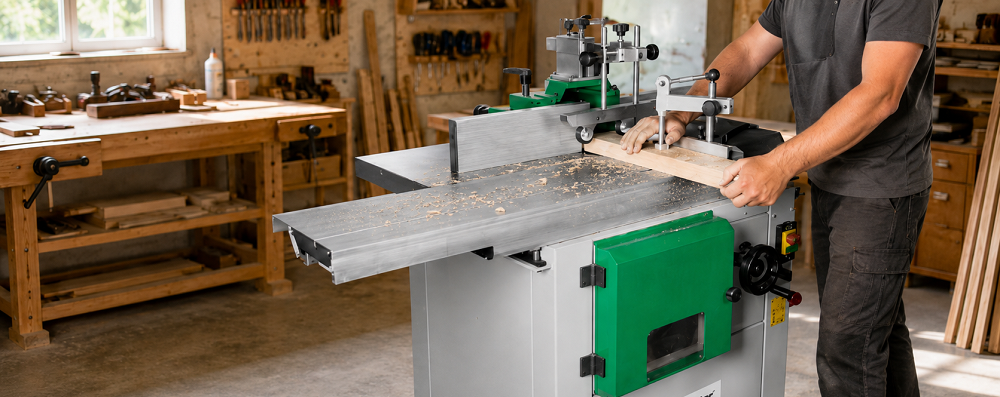
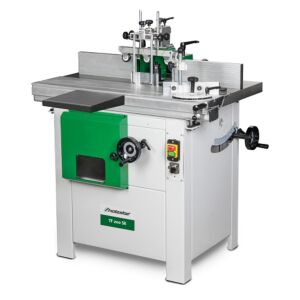
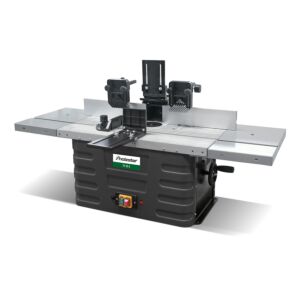
Holzstar spindle moulders and wood shapers are stationary machines designed for profiling edges, cutting rebates and grooves, producing joints and creating decorative mouldings on boards, panels, strips, frames and furniture components. Holzstar machines share the same basic operating principle but differ in size, bench-mounted or floor-standing construction, table area, spindle design, tilting capability, sliding table, adjustment systems and tool capacity.
The central working element of a Holzstar spindle moulder is the vertical spindle carrying the cutting tool. Depending on the operation, compatible cutters, cutterheads and profile tools can be installed. The cutter must match spindle diameter, direction of rotation, operating speed and machine capacity. The workpiece is guided across the table while the rotating tool progressively removes material from its face or edge.
Spindle height determines which part of the Holzstar cutter profile engages the workpiece. Vertical adjustment moves the cut towards the upper face, lower face or an intermediate position. The same profile cutter can therefore produce different results by changing the relative height between tool and component, provided that the cutting section remains correctly engaged and the clamping system retains the required grip.
Height adjustment must be completed with the Holzstar machine stationary, allowing for workpiece thickness, fence position and table opening. A test cut on scrap material of the same section is recommended. A small height error can misplace a groove, make a moulding asymmetrical or prevent a joint from fitting correctly.
Holzstar spindle moulders with a rigid spindle maintain the cutter axis perpendicular to the worktable. This configuration offers straightforward adjustment and a stable reference for straight profiles, rebates, grooves and repeated operations. The resulting shape is controlled by cutter geometry, spindle height and fence depth.
Holzstar machines with a tilting spindle allow the cutter axis to be inclined relative to the table. Inclination enables bevels, angled profiles, transitions and compound shapes that might otherwise require special cutters or several operations. Combining height, tilt and fence position allows different portions of the cutting profile to be used and considerably increases flexibility.
Tilting a Holzstar spindle changes the space occupied by the cutter relative to the table, fence and guard. Before starting, the spindle should be rotated manually to verify clearance from table rings, inserts, fence elements and protective components. The cutter’s projected diameter across the table may increase and require a different opening.
Spindle inclination must not be used to compensate for an unsuitable tool. Every cutter must be designed for the material, profile and speed of the Holzstar machine. Excessive tool overhang or operation outside the intended cutting area can generate vibration and an irregular finish. The spindle must be locked accurately after every angular adjustment.
The fence on a Holzstar spindle moulder consists of reference surfaces positioned before and after the cutter. The infeed fence determines how deeply the workpiece reaches the cutting circle, while the outfeed fence supports it after stock removal. When a profile does not remove the complete edge, both fence sections can remain aligned. When the cutter removes material across the full edge height, the outfeed section may need to correspond to the newly machined surface.
Fence halves should be moved close to the cutter while leaving sufficient clearance for rotation and chip discharge. Excessive opening reduces workpiece support near the cutting area, while insufficient clearance risks interference. Vertical and horizontal pressure devices should keep the component against the table and fence without preventing smooth feeding.
Feed direction on a Holzstar spindle moulder must follow the manufacturer’s instructions and is normally against cutter rotation. This opposing action makes workpiece movement more controllable. Feeding in the same direction as rotation can allow the cutter to pull and accelerate the component unexpectedly and must not be attempted unless a specific professional configuration expressly permits it.
When profiling a straight edge, the workpiece remains flat on the Holzstar table and firmly against the fence throughout the cut. Pressure is applied ahead of the cutter and transferred progressively to the machined section. Loss of fence contact changes profile depth. Long boards require infeed and outfeed supports aligned accurately with the machine table.
Holzstar spindle moulders with a sliding table improve support during cross-grain and end machining. The workpiece is located on the moving table and guided past the cutter with a controlled movement. This arrangement is useful for tenons, coping cuts, frame ends and operations in which it would be difficult to hold the component square to the fence manually.
On a Holzstar sliding table, the workpiece must remain against its reference and be secured against rotation during cutting. End-grain machining needs particular care because fibres may break away at the exit. A sacrificial backing piece placed behind the component supports the final fibres, reduces breakout and prevents direct cutter contact with the reference fence.
Rebates and grooves are produced by setting Holzstar spindle height and fence depth to the required section. Substantial stock removal should be divided across several passes. The first pass removes part of the material and subsequent passes progressively reach the final geometry. This reduces tool load and improves finish quality.
Mouldings are generated by Holzstar cutter geometry and its position relative to the workpiece. For repeatable production, the fence must remain locked, pressure devices must maintain consistent contact and every component in the batch should be machined without changing the setting. Test samples and reference pieces provide a practical record of a successful configuration.
Deep or complex profiles should not be attempted in one pass. Progressive operations reduce vibration, tearing and cutter heating. Hard timber requires controlled stock removal and steady feeding. Soft or fibrous timber must be oriented carefully so that the cutting edge does not lift the grain.
Holzstar table rings and inserts reduce the opening surrounding the spindle. The insert providing the smallest safe clearance for cutter diameter and inclination should be installed. A more continuous table surface supports smaller components and reduces the possibility of an edge tipping into the opening. Clearance must be checked before the machine is started.
For shaped or curved work, when the Holzstar machine and cutter are designed for it, the component may be guided against a suitable curved-work reference. Cutting must begin from a controlled starting position and the workpiece must remain supported throughout. Unsupported freehand routing should not be improvised. Templates and holding jigs improve both repeatability and control.
Tools installed on a Holzstar spindle moulder must fit the spindle and be secured with the specified spacers, rings and locking system. Seating surfaces must be clean, and the cutter must not show cracks, deformation, missing edges or impact damage. Every mounting key must be removed before starting.
Rotational speed must be selected according to cutter diameter, material, number of cutting edges and the maximum speed marked on the tool. Larger-diameter tools require particular attention because peripheral speed rises rapidly. Multiple speed settings increase the flexibility of a Holzstar machine but never replace checking the tool’s permitted operating range.
A sharp cutting edge produces a cleaner surface, requires less feed pressure and reduces burn marks. When a Holzstar cutter becomes blunt, the operator should not compensate by feeding excessively slowly or applying greater force. Slow feed increases contact time and may darken the timber. The tool should be cleaned, inspected, sharpened or replaced as appropriate.
Dust extraction must be connected to the Holzstar guard and positioned close to the cutting area. Chips trapped between the fence and workpiece can alter the reference and create depth errors. Insufficient airflow also reduces visibility and allows residue to accumulate inside the protective enclosure.
Compact bench-mounted Holzstar spindle moulders suit restricted workshops, lighter operations, small profiles and non-continuous use. They require a rigid and stable supporting bench. Floor-standing Holzstar machines with larger tables provide better support for panels and long components. Holzstar models with sliding tables are especially useful for frequent cross-grain machining, tenoning and end profiling.
Before purchasing, users should evaluate table size and rigidity, bench-mounted or floor-standing construction, spindle type and diameter, tilting capability, vertical travel, sliding table, fence accuracy, fence-half adjustment, table inserts, guarding, extraction, speed range, electrical supply and cutter compatibility. The Holzstar machine should be selected according to actual workpiece dimensions, required profiles and frequency of setup changes.
Maintenance of Holzstar spindle moulders includes cleaning the table, removing resin, inspecting the spindle, checking every lock, verifying fence alignment and cleaning the extraction path. The sliding table must move smoothly without abnormal play while maintaining its reference. Adjustments, tool changes and maintenance must be carried out with the Holzstar machine disconnected and the cutter completely stationary.
Holzstar spindle moulders provide joiners, cabinetmakers, furniture manufacturers, professional woodworkers and advanced hobbyists with a flexible station for profiling edges, producing joints, cutting mouldings and machining straight or cross-grain components. Correct coordination of cutter, height, tilt, fence position and feed method enables repeatable work and surfaces ready for assembly and finishing.