PCE Instruments PCE-P15 Pressure Gauge with RS232 interface and software, for overpressure, underpressure, differential pressure, suitable for air and gases
In stock
SKU
PCE-P15
€242.40
(Incl. Tax: €295.73)
(Incl. Tax: €295.73)
The PCE-P15 digital differential pressure gauge is a high-precision professional instrument, ideal for industrial, maintenance, control and laboratory applications. It measures non-corrosive fluids and transmits values via RS-232 to a PC. It offers 9 measuring units and twice the range overload protection. For data transmission to the PC, optional Windows-compatible software and RS-232 cable are required.

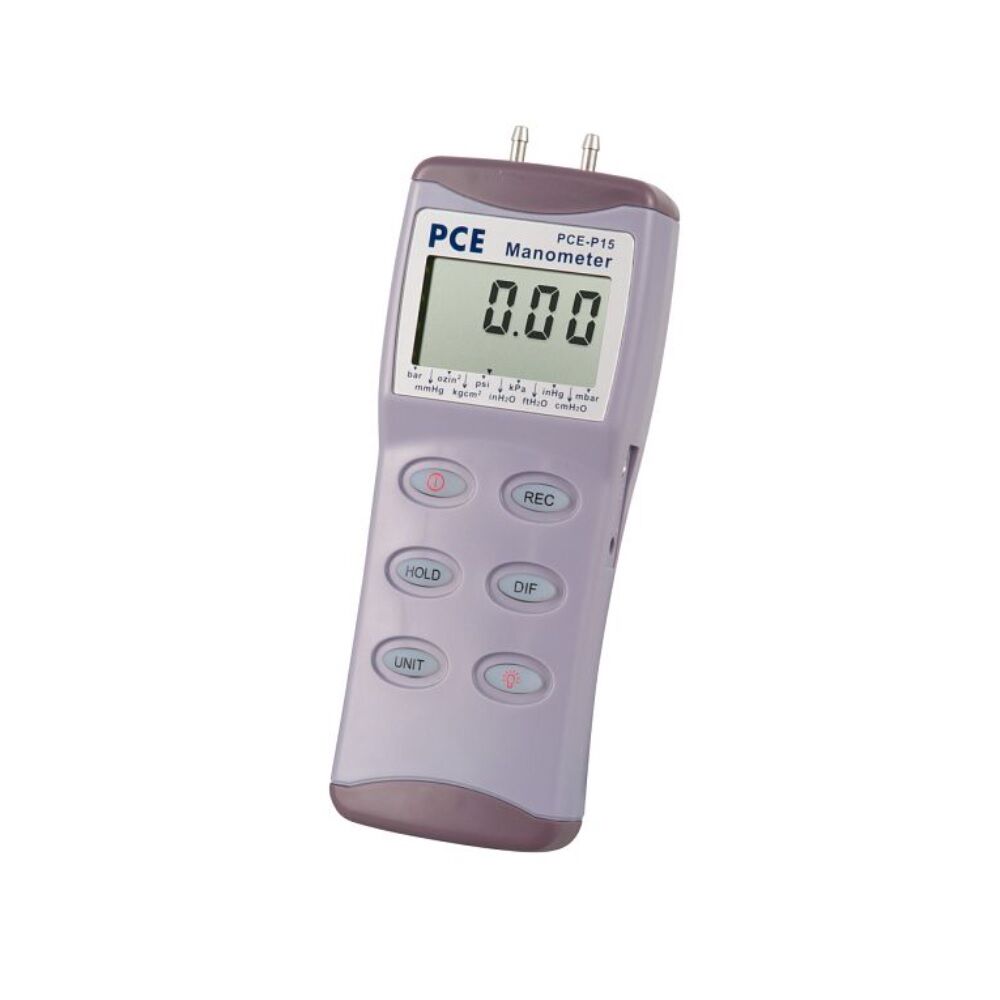
Features:
- 9 units of measurement to choose from
- Digital display: positive pressure, negative pressure (vacuum) or differential pressure
- MIN / MAX value memory
- Data Hold function - Backlit LCD display
- Impact-proof ABS plastic housing
- Auto power-off function
- The digital differential pressure gauge is basically used in heating systems air conditioning, pneumatic and hydraulic systems, medical instruments
- 9 units of measurement to choose from
- Digital display: positive pressure, negative pressure (vacuum) or differential pressure
- MIN / MAX value memory
- Data Hold function - Backlit LCD display
- Impact-proof ABS plastic housing
- Auto power-off function
- The digital differential pressure gauge is basically used in heating systems air conditioning, pneumatic and hydraulic systems, medical instruments
| Max. Pressure | positive/ negative or overpressure / vacuum | 30 psi |
| PSI | Measuring range | 0 ... ±15 |
| Resolution | 0,003 | |
| mbar | Measuring range | 0 ... ±1.000 |
| Resolution | 0,2 | |
| inH2O | Measuring range | 0 ... ±415 |
| Resolution | 0,1 | |
| inHg | Measuring range | 0 ... ±30,5 |
| Resolution | 0,001 | |
| mmHg | Measuring range | 0 ... ±750 |
| Resolution | 0,2 | |
| Torr | Measuring range | 0 ... ±750 |
| Resolution | 0,01 | |
| kPa | Measuring range | 0 ... ±100 |
| Resolution | 0,02 | |
| cmH2O | Measuring range | 0 ... ±1.050 |
| Resolution | 1 | |
| Kg/cm² | Measuring range | 0 ... ±1,05 |
| Resolution | 0,001 |
| Data format | Baud rate: 2400 baud,1 stop bit, 8 data bits |
| Accuracy | ±0,3% (full range a + 25°C) |
| Repeatability | ±0,2% (max. ±0,5% of full scale) |
| Duration | 0,3 ms |
| Operating temperature max | + 50 °C |
| Battery | 1 x 9V - block battery PP3 |
| Dimensions | 182 x 72 x 30 mm / 7.1 x 2.8 x 1.1" |
| Weight | 150g / 5.3oz |
The digital differential pressure gauge is a highly accurate professional instrument with excellent performance. This device not only takes measurements, but is also capable of transmitting the measured data to a PC via the RS-232 interface. It is particularly suitable for industrial applications, maintenance services, control and laboratories.
The PCE-P15 is designed to measure non-corrosive fluids and offers overload protection up to twice its measuring range. With 9 different measuring units, this digital pressure gauge is extremely versatile and saves time by avoiding manual conversion of results.
To transfer data from the PCE-P15 to a PC, the optional software and RS-232 interface cable are required. The software is Windows compatible.
Dlivery scope:
1 x Digital differential pressure gauge PCE-P15
1 x carrying case
1 x battery
1 x 1 m PVC pipe
Operating instructions (available as download)
Introduction to manometers
Manometers are fundamental instruments for measuring the pressure of gases and liquids within a system. Their primary function is to monitor pressure to ensure the safe and efficient operation of equipment across various industries. Thanks to their ability to provide accurate readings, manometers are essential for preventing malfunctions, optimizing performance, and maintaining safety.
Types of Manometers
There are different types of manometers, each designed to meet specific needs:
- Analog manometers: These use a dial and needle to display pressure. They are simple, robust, and widely used due to their reliability and ease of use.
- Digital manometers: These offer more precise readings compared to analog models and may include advanced features such as data recording and the transmission of measured values to a PC via interfaces like RS-232. These instruments are ideal for applications requiring precision and the ability to monitor and analyze data over time.
- Differential manometers: These measure the pressure differential between two points and are crucial in situations where monitoring pressure variations within a system is important. They are particularly useful in ventilation systems and for detecting obstructions or leaks.
Who uses manometers?
Manometers are used by a wide range of professionals in various industries. Some of the main users include:
- Technicians and engineers: In the industrial sector, these experts use manometers to ensure systems operate within safe pressure limits. This is particularly important in facilities that handle high-pressure fluids or operate under variable conditions.
- Maintenance technicians: These professionals employ manometers to monitor and adjust pressure in heating, ventilation, and air conditioning (HVAC) systems, as well as in hydraulic and pneumatic systems.
- Laboratory operators: In laboratories, manometers are essential for controlling and regulating processes that require precision in pressure measurement, such as chemical analysis and materials testing.
Sectors and environments of use
Manometers are applied in numerous sectors thanks to their versatility and importance in pressure measurement. Some of the key sectors include:
- Industry and manufacturing: In industrial processes, manometers are used to monitor pressure in hydraulic and pneumatic systems, which are essential for the operation of machinery and equipment. In energy production, for example, pressure measurement is crucial for the control of boilers, turbines, and compressors.
- HVAC (Heating, ventilation, and air conditioning): In this field, manometers monitor the pressure of refrigerant gases in air conditioning and ventilation systems. A differential manometer can detect leaks in the system or indicate when maintenance is needed.
- Medical sector: Manometers are crucial tools for monitoring blood pressure, pressure in respiratory devices, and other medical equipment. Accuracy in measurement is essential, as errors can have serious consequences for patients.
- Automotive sector: In the automotive field, manometers are used to measure tire pressure, and to monitor fuel system and boost pressure. Correct tire pressure is vital for vehicle safety and improving fuel efficiency.
- Chemical and pharmaceutical industries: Here, manometers ensure that mixing and reaction processes occur at precise pressures. Safety is a crucial aspect, as pressure variations can lead to dangerous reactions or compromise product quality.
- Agriculture: In irrigation systems, manometers are used to ensure that water is evenly distributed across a field, preventing both over- and under-irrigation.
Conclusion
Manometers are indispensable instruments in a variety of industrial, medical, and everyday applications. Their ability to provide precise pressure readings enables the monitoring and control of complex systems, ensuring safety, efficiency, and reliability. The choice of the appropriate manometer depends on the specific needs of the application, but all types of manometers are fundamental in any sector that requires accurate pressure measurement.
- EAN Code:
- 4250348701121
- Typology:
- Differential pressure gauge
- Brand:
- PCE INSTRUMENTS