PCE Instruments PCE-PDA A100L Pressure gauge up to 200 kPa with data logger, graphic LCD display, USB interface and MAX, MIN, Hold functions
(Incl. Tax: €946.60)
The PCE-DPA A100L pressure gauge measures atmospheric pressure and operates in a range from absolute zero to 200 kPa. It is ideal for industrial and shop floor applications, including vacuum control in containers. It runs on USB rechargeable batteries and has a large, backlit display for easy reading. The internal sensor detects absolute pressure, with a mode that improves resolution. It includes a data logger for documenting data, with customisable frequency and duration.

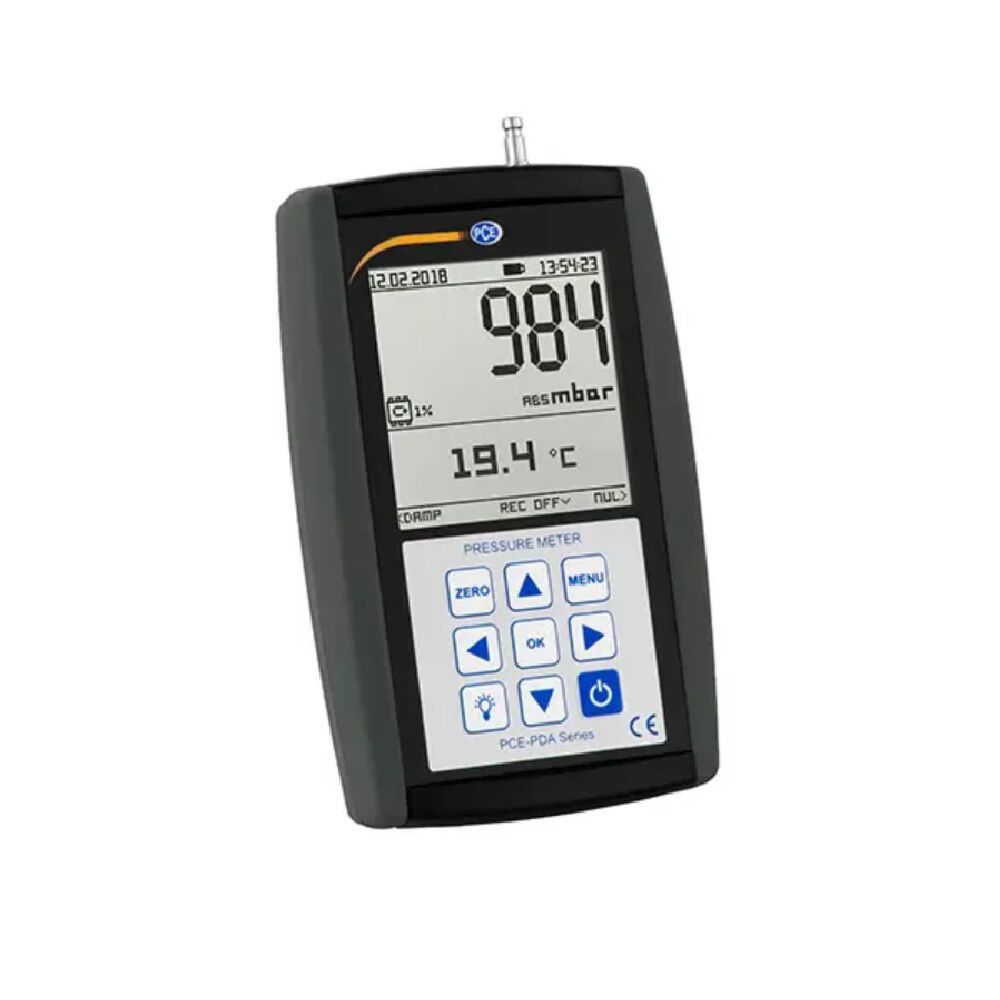
- Graphic LCD display
- USB interface
- Datalogger
- Vacuum measurement
- Various units of measurement
- MIN, MAX, HOLD functions
- Measured value levelling
- Temperature measurement function
| Specification | |
| Measuring range pressure | 0 ... 200 kPa absolute |
| Resolution | 0.01 kPa, 0.1 kPa |
| Accuracy | <± 0.5% of the measuring range |
| Nominal pressure | 200 kPa |
| Overpressure | 200 kPa |
| Burst pressure | 300 kPa |
| Media | Liquids Air Non-aggressive gasses |
| Measuring rate | 10 Hz |
| Measurement units | Pa, hPa, kPa, MPa, mbar, bar, ATM, kg / cm², mmH2O, cmH2O, inH2O, mmHg, inHg, Torr, PSI, PSF |
| Pressure | Absolute pressure |
| Pressure connections | 5 mm nipple for quick connectors |
| Max, Min and Hold function | Yes |
| Data logger | 1024 memory slots 1 s ... 255 h Recording time per memory location 1 s ... 24h recording interval |
| Medium | For air and non-explosive gasses |
| Zero correction | Yes, with a zero key |
| Averaging | Yes, between 0.1 ... 9.9 s |
| Display | Graphic LCD with backlight |
| Protection | IP41 |
| Power supply | 2 x 1.5V AA battery / 1.2V NiMh battery 5V / 500-mA USB power adapter |
| Current consumption | 50-mA (with backlight) 10-mA (without backlight) |
| Operating temperature | 0 ... 50°C / 32 ... 122°F |
| Storage temperature | 10 ... 55°C / 50 ... 131°F |
| Dimensions | 145 x 85 x 35 mm / 5.7 x 3.3 x 1.4 in |
| Weight | About 285 g / < 1 lb |
1 x Pressure gauge PCE-PDA A100L
2 x 1.2V AA NiMh battery
1 x USB power cable
1 x Micro USB cable
1 x Software
Instruction manual (available as download)
-
Spring Manometers: These use a calibrated spring that compresses or extends in response to applied pressure. The deflection of the spring is read on a graduated scale.
-
Capsule Manometers: These use a metallic capsule that deforms under pressure. The deformation is translated into a reading on the manometer scale.
-
Electronic Manometers: These use electronic sensors to measure pressure and provide digital readings. These manometers may include advanced features such as data storage and USB communication.
-
Industrial Sector: In industrial settings, manometers are crucial for monitoring production processes. They are used to measure pressure in compression systems, pumps, boilers, and hydraulic systems. Precision is essential for ensuring the safety and operational efficiency of machinery and systems.
-
Workshops and Maintenance: Operators and technicians use manometers for the maintenance and control of machinery and equipment. Their ability to provide accurate measurements helps prevent malfunctions and keeps equipment in optimal condition.
-
Energy Sector: In the energy sector, manometers monitor pressure in energy production facilities, such as power plants and refining plants. Accurate measurement is vital for energy efficiency and plant safety.
-
Research and Development Laboratories: In laboratories, manometers are used for experiments and scientific research that require precise pressure measurement. These environments often require high-precision instruments with advanced features such as data logging.
-
Food and Pharmaceutical Industry: In these industries, manometers help monitor pressure during production and packaging processes. Cleanliness and accuracy are particularly important to ensure product quality and safety.
-
Automotive Sector: Manometers are used to test and monitor pressure in fuel and cooling systems of vehicles. Their application helps maintain vehicle performance and safety.
-
Analog Manometers: These instruments provide pressure readings via a graduated scale. They are simple and robust, ideal for many industrial and maintenance applications.
-
Digital Manometers: These offer precise readings and may include additional features such as display backlighting, data logging, and USB connectivity. These manometers are useful for applications requiring high precision and advanced analysis.
-
Precision Manometers: Designed for scientific and laboratory applications, these instruments offer extremely high precision and can measure very low or high pressures.
- EAN Code:
- 4250348717672
- Typology:
- Pressure gauge
- Brand:
- PCE INSTRUMENTS
- Resolution (mm):
- 0.01 kPa
- Measurements range:
- 0 - 200 kPa