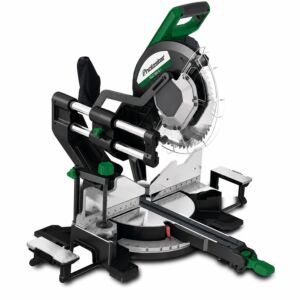
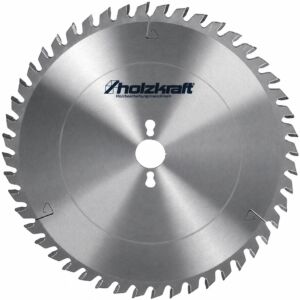
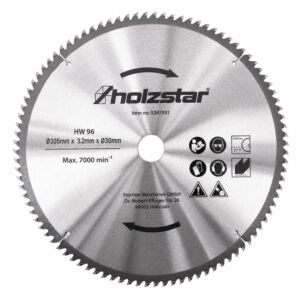
Holzstar and Holzkraft mitre saws for woodworking are designed to produce crosscuts, mitres, bevels and compound cuts in boards, strips, mouldings, skirting boards, narrow panels and components used in joinery, furniture production and interior fitting. The category mainly includes sliding compound mitre saws together with compatible circular saw blades for different materials and finish requirements. The available configurations share the same operating principle but differ in structure, cutting capacity, adjustment range, stability, slide mechanism, equipment and compatible blade types.
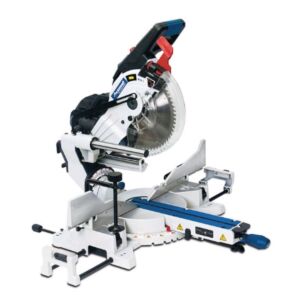
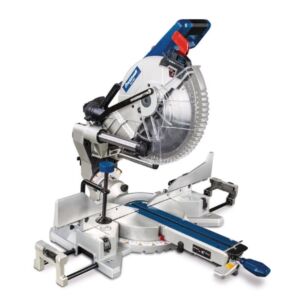
On Holzstar and Holzkraft mitre saws, the component rests on the machine base and against the rear fence while the motor and blade assembly is lowered through the material. Sliding models also allow the cutting head to travel along linear guides, providing a wider cutting range than a fixed-pivot machine. This arrangement is suitable for dimensioning boards, shelves, frame components, furniture parts and finishing profiles.
A square crosscut is made with the turntable in its central position and the cutting head vertical. The workpiece must lie fully on the base and against the rear fence without rocking. The blade assembly is positioned according to the operating procedure, lowered into the material and guided through the radial travel with a smooth movement. Consistent movement helps reduce vibration, fibre breakout and marks on the cut surface.
The sliding head must not be pushed or pulled abruptly. A rotating blade generates forces that can move both the head and the workpiece, particularly as the teeth enter the material. The component should be secured with the clamp provided for the Holzstar or Holzkraft machine and supported over its entire length. Feed pressure should remain controlled, allowing the teeth to cut without overloading the drive.
Mitre cuts are produced by rotating the saw table relative to the rear fence. The blade generally remains vertical but crosses the component at an angle other than a square cut. This setting is used for frames, mouldings, skirting boards, cladding and components that meet at a defined angle. Positive stops simplify adjustment at commonly used positions, while continuous settings accommodate structures and walls that are not perfectly square.
The graduated scale provides a convenient reference, but precision work should be confirmed with a square, bevel gauge or test cut. In a joint made from two components, a small error on each cut becomes more evident after assembly. For frames and decorative profiles, it is useful to cut two complementary samples, bring them together and correct the setting before processing the finished parts.
A bevel cut is obtained by tilting the cutting head sideways relative to the saw base. The turntable may remain central while the blade passes through the workpiece at an angle to its supporting surface. This arrangement is used for chamfers, inclined joints, trim and components that require an edge other than a square one.
Where provided on the selected Holzstar or Holzkraft machine, a dual-bevel mechanism allows mirrored bevels to be produced without turning the component over. This is useful for decorative mouldings, long sections and parts with a finished face that should remain in the same orientation. A single-bevel machine can produce corresponding joints by repositioning the material, but the working sequence requires greater attention.
Rotating the table and tilting the head simultaneously creates a compound cut. The blade works at both a horizontal and vertical angle, allowing complex joints to be prepared for mouldings, frames, furniture and inclined structures. Accuracy is particularly important because changing one setting affects the way the mating surfaces meet. Correct values should be recorded, and stops or jigs used where multiple identical components are required.
The capacity of a Holzstar or Holzkraft sliding mitre saw depends on slide travel, blade position, bevel angle and workpiece geometry. A component that fits the machine during a square cut may exceed its useful capacity during a mitre or compound setting. Purchasing decisions should therefore be based on the actual component sizes and cutting configurations required rather than on a single maximum-capacity figure.
Radial guides must travel smoothly without binding or noticeable lateral play. Irregular movement can alter the blade path and leave steps on the cut face. Arm rigidity, joint quality, base stability and resistance to deflection are especially important when the cutting head is fully extended. Repetitive precision work also benefits from a mechanism that returns accurately to its reference positions.
The rear fence supports the workpiece against the cutting forces. It must be straight, stable and correctly aligned with the cutting plane. Sliding fence sections should provide maximum support without interfering with the blade when the head is tilted or the table rotated. After a major adjustment, the entire blade path should be checked manually with the machine disconnected.
The support surface must carry the component on both sides of the cutting line. Side extensions on Holzstar and Holzkraft saws help handle long mouldings and boards, but particularly long workpieces may require additional stands, roller supports or a mitre-saw bench adjusted level with the base. An unsupported end acts as a lever and may lift or rotate the component before the blade has left the cut.
Clamps prevent the material from moving. They should apply pressure to a stable area without deforming thin mouldings or damaging finished surfaces. Clamping must resist both lifting and lateral displacement, especially during mitre and compound cuts. A clean protective pad may be placed between the clamp and a delicate surface, provided that it does not reduce holding stability.
Short pieces should never be held with fingers close to the blade. If the remaining length does not permit safe support and clamping, a jig or auxiliary fence should be used, or a longer component should be cut before the smaller section is separated. Small offcuts must also have sufficient clearance so that they cannot become trapped between the blade, insert and fence.
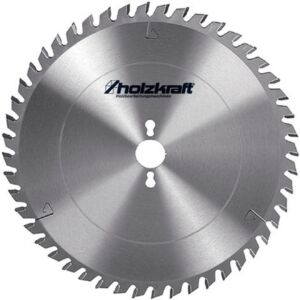
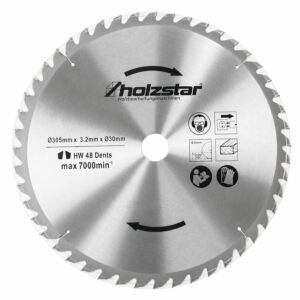
Holzstar and Holzkraft circular saw blades substantially influence cutting speed, edge finish and usable applications. A blade with a finer tooth arrangement is generally selected for clean crosscuts, mouldings and coated boards. A more open tooth pattern improves chip clearance and may be suitable for less delicate work or heavier sections. Selection must nevertheless account for the material, cutting direction, permitted blade size, arbor bore, blade thickness, maximum speed and machine instructions.
Tooth geometry must match the material. Holzstar and Holzkraft blades designed for timber and wood-based panels use geometries intended to cut fibres and composite wood products. Blades intended for profiles or non-ferrous materials must only be used where both blade and machine are expressly approved for that purpose. Dimensional compatibility alone does not make a woodworking blade suitable for a different material.
The direction arrow on a Holzstar or Holzkraft blade must correspond to the machine’s rotation. Teeth must face in the orientation specified by the manufacturer, and the arbor and flange contact surfaces must be clean. Dust, resin or small particles trapped behind the flange can cause runout and vibration. The blade should be tightened correctly without improvised extensions on the tool and without excessive force.
Before installation, the blade should be checked for damaged teeth, cracks, distortion or loose cutting tips. A blade that has suffered an impact or produces unusual vibration must be withdrawn from service. Resharpening should preserve uniform tooth geometry; variations between teeth can cause wandering and poor finish even when the mitre saw is correctly adjusted.
To reduce breakout, use a Holzstar or Holzkraft blade suitable for crosscutting, support the component firmly and maintain a consistent feed movement. A sacrificial auxiliary fence placed behind the material supports the fibres where the blade exits. A reduced-clearance insert may also improve support close to the cut where it is compatible with the saw. Finished surfaces and supporting faces should be kept free of chips, as trapped debris can tilt the component and create angular errors.
Feed rate must allow the blade to cut without rubbing or overloading the motor. Lowering the head too slowly can increase heat and leave burn marks, particularly on hard or resinous timber. Excessive speed can cause breakout, vibration and blade deflection. If unusual pressure is required, blade sharpness, cleanliness, tooth arrangement and material suitability should be checked rather than applying more force.
After the cut, the head should remain down until the blade has stopped or slowed sufficiently. Raising a still-rotating blade through the cut can bring the teeth back into contact with the component or offcut, damaging the surface or projecting small fragments. The workpiece and waste should not be moved until the blade is stationary and the head is in a safe position.
Length stops installed on side extensions or benches improve efficiency during repetitive cutting. A stop produces components of consistent length without individual measurement. It must be positioned so that the component remains supported without being trapped during the cut. The first finished part should be measured before a batch is processed, and the stop should be checked periodically for movement.
Dust extraction improves cutting-line visibility, keeps the slide mechanism cleaner and contributes to a healthier workshop. Holzstar and Holzkraft mitre saws should be connected to a system compatible with the extraction outlet. Because the cutting head moves and changes angle, not every particle can be captured. The guard, table, fence, slide guides and rotation mechanisms therefore require regular cleaning without blowing dust into electrical components.
Scales, positive stops and angle indicators should be checked periodically. A practical test consists of cutting and then pairing or rotating the resulting components to reveal cumulative error. If correction is required, the fence, pointer or reference position should be adjusted according to the Holzstar or Holzkraft instructions. Calibration should be performed with a clean and serviceable blade because tool vibration or deflection can be mistaken for machine misalignment.
Maintenance includes cleaning the radial guides, checking for play, inspecting fasteners, cables and switches, cleaning the blade flanges and checking the automatic return of the cutting head and moving guard. Unsuitable lubricants can collect sawdust on the slides and impair movement. Only the products and procedures specified by the manufacturer should be used.
Before purchasing a Holzstar or Holzkraft mitre saw, compare cutting capacity in different angular positions, slide travel, guide rigidity, adjustment accuracy, bevel range, side extensions, clamping system, fence construction, guards, extraction and availability of compatible blades. Portability and quick adjustment are important for installers and interior fitters. Joinery shops and furniture manufacturers place greater emphasis on repeatable accuracy, structural stability and control of long or shaped components.
A correctly selected Holzstar or Holzkraft sliding mitre saw allows rapid changeover between square, mitre, bevel and compound cutting while the workpiece remains on a stable reference surface. Combining the machine with a Holzstar or Holzkraft blade suited to the material produces accurate joints, clean edges and repeatable parts for furniture, frames, mouldings, cladding and interior finishing. Adjustment, cleaning and blade replacement must always be carried out with the machine disconnected and fully stationary.