NEBES Elettromeccanica metal-cutting band saw blades are original replacement parts designed to maintain correct compatibility with the manufacturer’s different sawing machines. The category includes blades belonging to the same product family but differing in length, width, thickness, tooth pitch and intended machine. These characteristics are not interchangeable: even an apparently minor difference may prevent correct tensioning, alter the blade position within the guides, overload the wheels or compromise cutting accuracy and safety.
The blade is the element that directly engages the material and affects cutting speed, straightness, surface finish, productivity and machine performance. A correctly selected band produces a regular chip and advances without abnormal vibration. An unsuitable blade may snag in thin profiles, load when cutting solid bars, wander from the cutting line, overheat or lose teeth prematurely. Selection should therefore consider not only the saw model but also the material and geometry of the components actually processed.
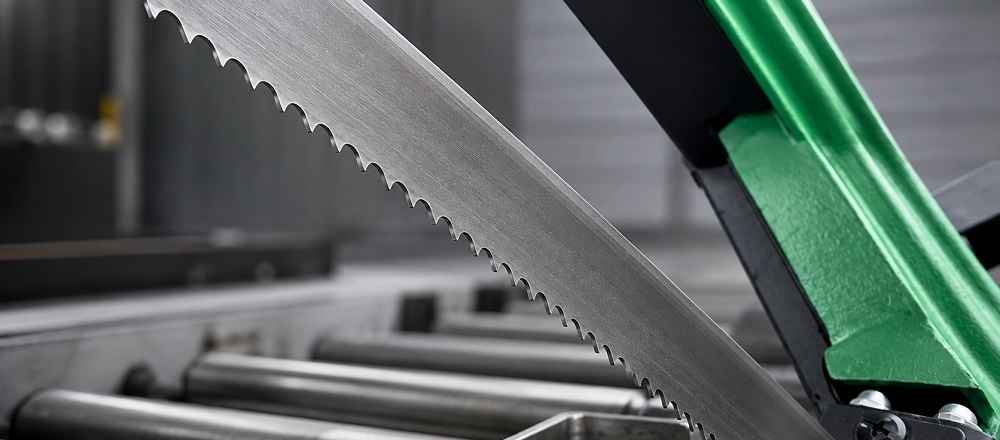
A metal-cutting band consists of a flexible backing, toothed edge, chip gullets and a weld that forms the band into a continuous loop. The backing must withstand repeated bending around the wheels, while the teeth must retain cutting ability and wear resistance. Tooth set alternates the position of the cutting edges and creates a kerf slightly wider than the body of the blade. This reduces side friction and allows the band to travel through the material without becoming trapped.
Where specified for the application, bimetal blades combine a flexible, fatigue-resistant backing with a harder toothed edge. This construction is suitable for many carbon steels, alloy steels, stainless steels and non-ferrous metals. Particularly hard, abrasive or difficult-to-cut materials may require different blade constructions or carbide-tipped teeth, provided the NEBES Elettromeccanica saw is suitable for the required speed, tension and rigidity. Blade construction should be verified from the manufacturer’s specification rather than assumed from external appearance.
Tooth pitch describes the spacing and frequency of teeth along the blade. Coarse pitch has wider tooth spacing and larger gullets capable of carrying more chip volume, making it suitable for substantial solid sections and cuts where the blade remains engaged for an extended distance. Fine pitch keeps more teeth in contact and is appropriate for tubes, sheet and thin-wall profiles. If the pitch is too coarse, too few teeth engage and the blade may catch, vibrate or break. If the pitch is too fine, the gullets fill before leaving the cut, resulting in loading, increased heat and wandering.
Constant pitch maintains equal spacing between the teeth and provides uniform behaviour when material and section remain consistent. Variable pitch alternates different tooth spacing, reducing contact periodicity, resonance, noise and vibration. This arrangement is particularly versatile for tubes, profiles, bundles and mixed sections where the number of engaged teeth changes continuously. Selection must consider the complete section crossed by the blade rather than only the nominal wall thickness.
When cutting a solid bar, the blade remains engaged across a continuous section and requires sufficient gullet capacity to evacuate the produced chip volume. In tubes and hollow profiles, the band alternately crosses walls and empty spaces, making it important to retain several teeth in contact with each wall. The orientation of angle, channel, T-section and box profiles can radically change cutting conditions. The component should be positioned so that the blade encounters a progressive change in section and avoids an abrupt transition from a thin wall to a broad surface.
Round tubes must be clamped so that they cannot rotate. Bars and profiles should rest securely close to the cutting line, while long workpieces require roller conveyors or supports aligned with the saw. Supports that are too low or too high tilt the component, apply lateral load to the blade and can produce an out-of-square cut. During bundle cutting, every piece must be immobilised because relative movement can catch the teeth, open the bundle or draw material out of position.
Mitre cutting increases the effective length of the section crossed by the blade. A profile presenting only a limited wall during a straight cut may create a much broader contact area when angled. Tooth pitch should therefore take account of the most common mitre operations. The vice must clamp the component close to the cutting line, while the guides, saw frame and supports must be adjusted for the selected configuration. A correct blade cannot compensate for poor clamping or inadequate support.
On vertical band saws, blade width becomes especially important in addition to pitch and material. A wide blade provides greater rigidity for straight cutting, whereas a narrower blade can follow curves and contours. Attempting a tighter radius than the blade permits causes twisting, heat and possible failure. Relief cuts in waste areas can divide a complicated profile and reduce the risk of material trapping the back of the band.
Blade speed must correspond to the workpiece material and blade construction. Hard steels, stainless steels and tough alloys generally require lower speeds, whereas aluminium, brass and more readily machinable materials may permit higher speeds. Saws with electronic or inverter speed control make it easier to match band movement to the application. Excessive speed overheats the teeth and accelerates wear, while excessively low speed combined with unsuitable feed can impair chip formation and productivity.
Feed pressure or rate must allow the teeth to cut rather than rub. Insufficient feed often produces dust or extremely fine chips and can promote work hardening. Excessive feed overloads the teeth, deflects the band and can cause cutting deviation or breakage. A regular chip appropriate to the material is a useful process indication. Heavily coloured, distorted or welded chips may indicate excessive temperature, incorrect feed or inadequate coolant.
A new NEBES Elettromeccanica blade requires a controlled break-in period. Initial cuts should be performed under a lower load than normal operating conditions so that the cutting edges can stabilise without microscopic chipping. Feed may then be increased progressively. Installing a new blade and immediately applying maximum load, especially on material with a hard skin, scale or an irregular surface, can significantly reduce its service life.
Cooling helps limit temperature and friction, protects the teeth and supports chip evacuation. On machines equipped with coolant, the fluid must reach the point where the blade enters the material. Fluid level, concentration and cleanliness require regular checks because degraded or contaminated coolant loses effectiveness and can leave deposits. Liquids must not be introduced on saws designed for dry cutting unless their use is approved by the manufacturer.
Installation must respect the specified tooth direction. A blade fitted backwards will not cut correctly and can be damaged quickly. Before tensioning, the operator should confirm that the band is seated on the wheels and correctly inserted into the guides. Tension must correspond to the machine setting. Insufficient tension promotes wandering, while excessive tension loads the weld, backing, bearings and wheels.
The weld should be inspected before installation and during regular checks. It must be free from cracks, misalignment, excessive thickness variation or defects that prevent smooth passage through the guides. A misaligned joint creates an impact on every revolution, producing periodic vibration and possible damage to the guides and blade. The band must also be handled and unfolded carefully using an appropriate controlled procedure and suitable protective equipment.
Blade guides should be positioned close to the workpiece, leaving only the length required for the cut unsupported. Excessive guide spacing increases deflection and vibration. Bearings, pads and inserts must be clean and adjusted without clamping the band. The blade-cleaning brush is equally important: it should remove chips from the gullets before the teeth return to the material without rubbing excessively against the tooth sides.
An out-of-square cut does not necessarily mean that the blade dimensions are incorrect. Possible causes include unsuitable tooth pitch, uneven tooth wear, insufficient tension, guides positioned too far apart, excessive feed, vice misalignment or poor workpiece support. A heavily scored surface may indicate vibration, damaged teeth or unsuitable pitch. Missing teeth within a localised area may result from snagging, a hard inclusion or workpiece movement. Analysing the failure prevents the replacement blade from suffering the same damage.
Saw maintenance directly affects blade life. Dirty wheels, worn bearings, misaligned guides, ineffective brushes, accumulated chips and irregular tension can damage even a correctly selected original blade. The machine must be cleaned with the blade stopped, and chips must never be removed by hand. Guards, descent system, vice, coolant circuit, wheel alignment and wheel-surface condition require regular inspection.
New blades should be stored in a dry environment and protected from impacts, corrosion and deformation. Loads that could bend the band or alter the tooth set must not be placed on them. Before installation, the item code and declared compatibility should be compared with the exact NEBES Elettromeccanica saw model, confirming that length, width, thickness and tooth pitch match the intended application. Selecting a blade by length alone is insufficient.
Before purchasing, users should identify the exact saw model, workpiece materials, section shapes and sizes, frequency of straight and mitre cuts and any requirement for curved profiles. A workshop alternating between solid bars and tubes may benefit from keeping blades with different pitches instead of using one tooth configuration for every operation. Keeping a correctly stored replacement blade reduces downtime and allows an immediately damaged band to be replaced.
NEBES Elettromeccanica band saw blades are used in metal fabrication shops, machine shops, toolrooms, construction sites and maintenance departments. Applications include structural-steel manufacture, machine-tool rebuilding and the production of frames, supports, pipework, metal doors, railings and components intended for welding or CNC machining. Correct blade selection enables compatible carbon steels, alloy steels, stainless steels, aluminium, brass, copper and other metals to be cut efficiently.
Tadaah supports the selection of original NEBES Elettromeccanica blades by assessing the saw model, material, solid or hollow section, profile geometry, wall thickness, mitre cutting and operating frequency. Correct coordination between blade length, width, thickness, tooth pitch, speed, feed, tension and cooling improves cut quality, controls wear and allows the saw to be used consistently with professional requirements.