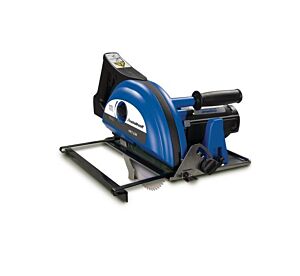
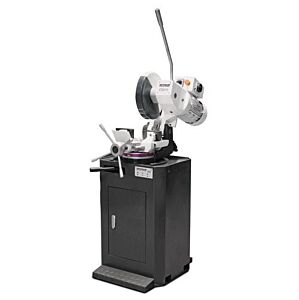
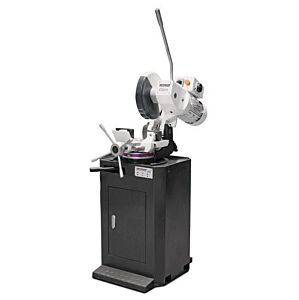
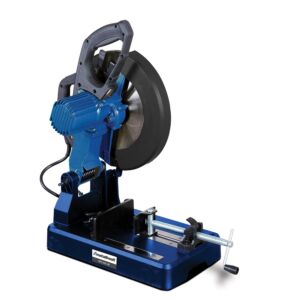
METALLKRAFT and OPTIMUM circular saws and circular cut-off saws use toothed blades to produce accurate cuts in tubes, bars, profiles, flats, sandwich panels, sheet metal and other semi-finished products. The category includes hand-guided portable saws, pivot-head cut-off saws and automatic circular saws for batch production. These machines share the same tooth-cutting principle but differ in structure, workholding, feed method, mitre capability, automation and intended duty cycle.
The difference between a circular saw and a circular cut-off saw mainly concerns how the machine, cutting head and workpiece are moved. With portable circular saws, the operator guides the machine across the material using the base, a fence or a compatible guide rail. On a cut-off saw, the workpiece remains clamped to the base while the blade head descends into the section. On an automatic circular saw, the stock is fed, positioned and clamped as part of a controlled cutting cycle.
Hand-guided circular saws are useful for sandwich panels, sheet metal, channels, profiles and large components that are difficult to transfer to a fixed machine. The workpiece must be supported on a stable surface and clamped so that it cannot move, vibrate or close the kerf around the blade. The saw base should remain fully supported throughout the operation. A rigid fence or guide rail is recommended for long straight cuts.
Where cutting depth is adjustable, it should be set according to the actual material thickness. Excessive blade exposure reduces control, while insufficient depth prevents the cut from being completed correctly. The offcut must remain supported without obstructing the blade path. Power cables, extraction hoses and other connections must remain clear of the cutting direction.
On circular cut-off saws, the workpiece should contact clean vice reference surfaces and be clamped as close as practical to the cutting line. Excessive distance between the blade and clamping point increases vibration, bending and deviation. Tubes and round bars must be prevented from rotating. Thin-wall or hollow profiles may require shaped jaws, inserts or packing pieces that distribute clamping force without deforming the section.
Long components require roller conveyors or adjustable stands aligned with the machine bed. Supports set too high lift the stock from the vice; supports set too low transfer an unwanted load to the cutting area. The offcut side must also be supported so that the separated component cannot fall, tilt or pinch the blade at the end of the cut. Small, short and irregular parts require dedicated workholding and must not be held by hand.
METALLKRAFT and OPTIMUM automatic circular saws are intended for repetitive cutting of bars, profiles and stock where productivity and dimensional consistency are required. The feed mechanism moves the material to the cutting position, the vice clamps it and the head completes the cycle. Before batch production starts, a sample part should be checked for length, squareness, surface finish and burr formation. Automation improves consistency but still requires correct feed, clamping, stop and chip-management settings.
Depending on machine design, mitre cuts are obtained by rotating the head, vice or reference base. The graduated scale provides a practical setting, but components intended for accurate welding and assembly should be checked with an adjustable square, protractor or sample part. Every locking device must be secured before starting. Available cutting capacity may decrease at an angle because the profile occupies more of the working envelope.
Blade selection begins with machine compatibility. Diameter, bore, body thickness, direction of rotation, maximum speed, flanges and guarding must match the manufacturer’s requirements. A blade that appears dimensionally suitable may still be unsuitable if tooth geometry, cutting-edge material or peripheral speed does not correspond to the intended operation.
Tooth pitch should match the section actually crossed by the blade. Thin walls generally require finer spacing so that several teeth remain engaged at the same time. Solid and thick sections require larger gullets for chip formation and evacuation. Too few teeth in contact can cause grabbing, vibration and breakage. Too many can pack the gullets, increase heat and reduce penetration.
Workpiece geometry also affects tooth selection. The number of walls engaged changes as a tube is cut. Rectangular profiles behave differently according to orientation. When cutting bundles, every element must be secured against movement and rotation. Where possible, the profile should be positioned so that the teeth enter progressively rather than striking a wide surface suddenly.
Blade material and geometry must also suit the workpiece. Carbon steel, stainless steel, aluminium, brass, copper, cast iron and composite materials require different cutting conditions. Non-ferrous metals often need teeth that reduce grabbing and chip adhesion. Stainless steel and tough alloys require effective tooth penetration to avoid rubbing, heat and work hardening.
Separate, clearly identified blades are advisable when processing different material groups. A blade used on steel may not provide ideal performance on aluminium, while a blade loaded with adhered material loses cutting efficiency and can damage the finish. Selection should also consider required surface quality, permitted burr, cutting frequency and subsequent operations.
The blade should reach its intended speed before entering the component. Feed must be smooth and proportionate to section size. Excessive pressure can deflect the blade, overload the motor, increase temperature and reduce squareness. Insufficient pressure can cause rubbing and premature dulling. Sound, vibration, chip formation and surface quality provide useful evidence about cutting conditions.
Cooling depends on machine and blade configuration. On machines equipped with flood coolant, fluid should reach the area where the teeth enter the workpiece, reducing heat and friction and helping to remove chips. Insufficient flow, incorrectly directed nozzles, dirty filters or unsuitable concentration reduce blade life. Tank, pump, filters and lines require regular cleaning.
Saws designed for dry cutting must not be modified with improvised liquid systems. Correct blade selection, steady feed and effective chip removal become particularly important. The blade and offcut may become hot and should be treated accordingly. Minimum-quantity lubrication may only be used where compatible with the machine, blade, material and extraction arrangement.
Routine maintenance includes cleaning the working area, removing chips and checking the blade, flanges, spindle, transmission, vice, guides, material-feed equipment, guards and safety switches. Support and clamping surfaces must remain free from chips and burrs that could tilt the workpiece. Flanges must be clean and undamaged because uneven support can produce blade runout.
A blade with chipped teeth, cracks, deformation or irregular wear must be replaced. New vibration, unusual noise, reduced accuracy, feed difficulties or rising temperature should be investigated before work continues. A cut that is out of square may result from the blade, but also from vice misalignment, inadequate workpiece support, spindle play, dirty flanges, incorrect feed or an unstable machine.
Guards must cover the unused portion of the blade and return correctly to their protective position. Operators require suitable eye or face protection, hearing protection and respiratory protection where indicated by the risk assessment. Loose clothing, hair, jewellery and other entanglement hazards must remain away from moving parts. Adjustments, cleaning and blade replacement must be performed with the machine stopped and isolated.
Useful accessories include pedestals, roller conveyors, adjustable stands, parallel fences, portable-saw guide rails, length stops, shaped jaws, tube fixtures, loading and unloading systems, chip trays, coolant equipment and compatible extraction systems. Accessories must be correctly matched and aligned with the machine; improvised supports can reduce accuracy, ergonomics and safety.
Before purchasing, users should evaluate predominant materials, geometries, sections, required finish, cutting volume, mitre requirements, available space and handling method. Important features include structural rigidity, clamping accuracy, spindle stability, flange quality, blade-change access, feed control, chip collection and the availability of blades and spare parts. A hand-guided saw provides mobility, a cut-off saw improves control over sizing operations, and an automatic saw suits repetitive production.
METALLKRAFT and OPTIMUM circular saws and cut-off saws are used in fabrication shops, machine shops, toolrooms, maintenance departments, machine-tool building and rebuilding, metal construction and steel-structure production. Applications also include automotive, railway, marine, agricultural, energy and plant-engineering work and the preparation of blanks for welding, turning, milling and assembly.
Tadaah supports the selection process by evaluating the machine, blade, material, workpiece geometry, accuracy, clamping, cooling, accessories and duty cycle as one integrated cutting system. This approach identifies a configuration suited to professional requirements, reducing blade consumption, rework, scrap and setup time while improving safety, quality and repeatability.