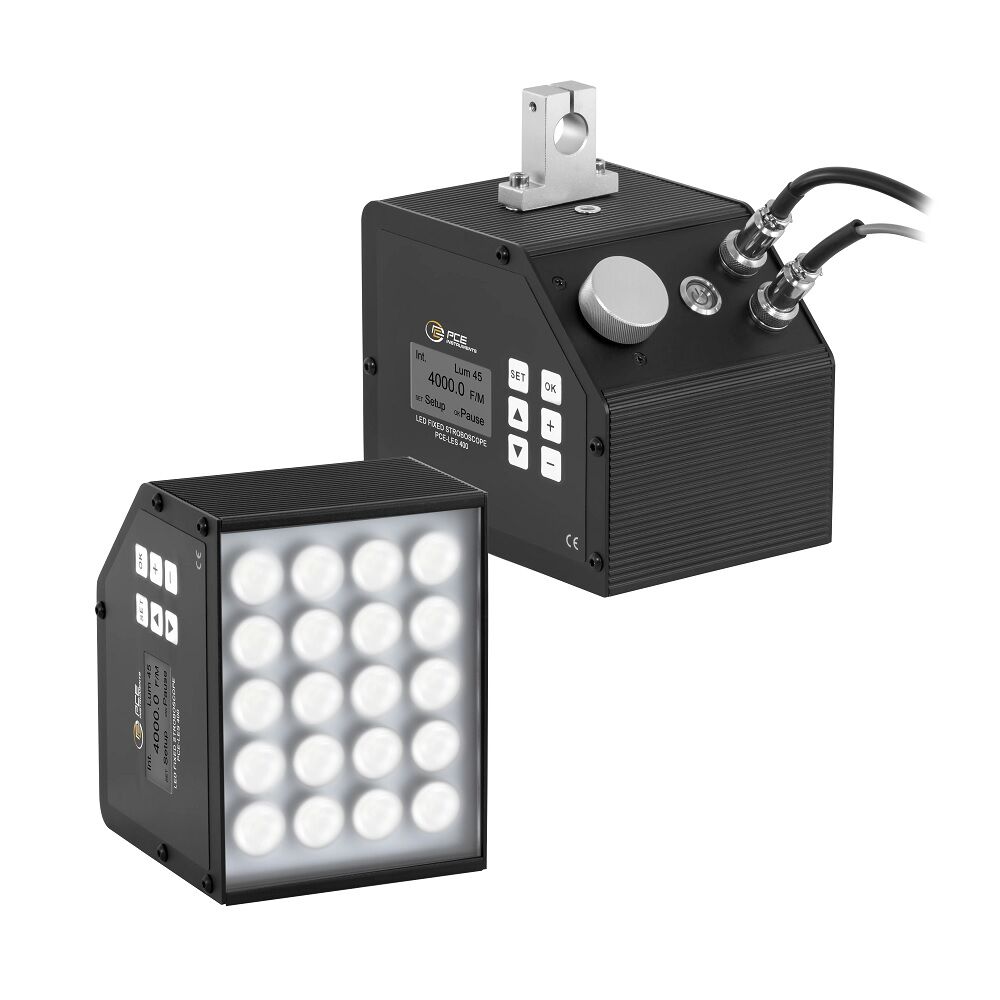
Features:
- Frequency 50 ... 36000 FPM
- FPM Doubling/Division
- Light Source 20 LEDs
- 2.4-inch LCD Display
- Flash Frequency Units: FPM, Hz, m/min
- Illumination: 1590 Lux @ 36000 FPM / 10 cm
- Phase Shift: 0 ... 359°
- Flash Duration 1 ... 3%, max. 100µs
- Trigger Input
| Frequency |
|
| Measurement Range |
50 ... 36000 FPM |
| Resolution |
0.1 FPM |
| Accuracy |
±0.01% of value |
| Frequency |
|
| Measurement Range |
1 ... 600 Hz |
| Resolution |
0.01 Hz |
| Accuracy |
±0.01% of value |
| General Technical Specifications |
|
| Units |
Hz, FPM, m/min |
| Display Type |
Graphic LCD |
| Display Size |
2.4 Inches |
| Light Intensity |
1590 Lux @ 36000 FPM / 10 cm |
| Phase Shift |
0 ... 359° |
| Pulse Width |
Flash Duration 1 ... 3%, max. 100 µs |
| Light Source |
20 LEDs |
| Trigger Input |
greater than +2.5 V peak, 20 µs min. Pulse Width
Sensor Power: 12 V, 50 mA |
| Menu Language |
English, Chinese |
| Protection Class (device) |
IP20 |
| Power Supply |
220 V AC | 50Hz |
| Connector Type |
Ground contact plug |
| Weight |
1280 g |
| Operating Conditions |
0 ... 50 °C , 0 ... 95% RH |
| Storage Conditions |
0 ... 50 °C , 0 ... 95% RH |
| Dimensions (L x W x H) |
150 x 115 x 130 mm |
The stationary stroboscope emits rapid flashes of light using high-efficiency, long-lasting LEDs. With a measurement range from 50 to 36,000 FPM and a high resolution of 0.1 FPM, it offers precise and reliable measurements with an accuracy of 0.01%.
The device can be triggered both internally and externally and supports four modes of external triggering. The sensor power supply is 12 V and 50 mA with a minimum pulse width of 20 µs. The flash duration is adjustable between 1 and 3% of the period, with a maximum of 100 µs. The phase shift function ranges from 0 to 359°, allowing flexible adaptation to various needs. With an illuminance of 1590 lux at 36,000 FPM and a light source composed of 20 LEDs, the device provides intense and clear flashes. The 2.4-inch LCD display facilitates use and adjustment. Additionally, the stroboscope allows doubling or halving the flash frequency (FPM) for quick adjustments. The compact dimensions of 150 x 115 x 130 mm allow for easy mounting on aluminum profiles. The power supply is provided by 220 V AC at 50 Hz, ensuring stable and reliable operation.
Used in industrial settings for machinery monitoring and quality control, in scientific research for motion analysis, and in medicine for specialized diagnostic procedures, the LED stroboscope for stationary installation represents a versatile and efficient solution, appreciated for its reliability, energy efficiency, long lifespan, and low heat generation.
Shipment Contents:
1 x Stroboscope PCE-LES 400
1 x Aluminum slot profile
1 x 4-pin coupling
1 x Connection cable
1 x External trigger sensor
1 x Mounting screws
1 x User manual (available in English, Italian in translation)
Stroboscopes: Essential Tools for Measuring Moving Parts
A stroboscope is a fundamental device for obtaining a stationary image of moving parts, indispensable in measurement technology. In printing, for example, it is used to monitor printing rollers, while in industry it is employed to measure the speed of rotating parts.
Before purchasing a stroboscope, it is essential to define its specific use. The frequency of the generated flashes is a crucial aspect: some industrial models can reach thousands of hertz, allowing for optical inspection of rapid sequences.
Light Source
Another decisive factor is the light source. Modern LED flashes offer powerful LED arrays that allow for complete illumination of an object, comparable to xenon bulbs. Some stroboscopes can expand the LED array to properly inspect wide, moving parts, such as paper strips. There are also models with UV LED light sources, used for non-destructive testing in maintenance.
Triggering the Light Source
Another selection criterion is the method of triggering the light source. A simple flash has an internal regulator, while a more sophisticated stroboscope is equipped with a trigger input for external speed sensors, ensuring that the flashes are always synchronized with the object's speed. This is particularly useful when rollers rotate at different speeds, such as in paper production or printed product testing.
Adjusting Flash Frequency and Phase Shift
Modern stroboscopes also offer flash frequency adjustment and the ability to adjust the phase shift, briefly delaying the flash pulse to obtain an "optically rotating" image. This allows moving part marks to be shifted to the correct position.
Power Supply
For portable stroboscopes, power is a key factor. If used sporadically, a battery-powered model may suffice, but for frequent use, a model with rechargeable batteries is recommended. Fixed models are generally powered by a power supply or directly from the mains.
IP Protection Rating
The IP protection rating of the stroboscope is another important aspect to consider, as it indicates the level of protection against dust and water. For challenging environments, a model with an IP67 protection rating is ideal, as it offers optimal protection from external environmental influences.
Conclusions
Choosing the right stroboscope depends on several factors, including flash frequency, light source, triggering method, frequency and phase shift adjustment, power supply, and IP protection rating. By considering these aspects, it is possible to select the model that best meets the specific measurement and inspection needs.